


I’ve been glued to my feeds since the big news dropped yesterday about SpaceX acquiring xAI—valued at a mind-blowing $1.25 trillion—and while I’m staking $VANRY from my quiet corner in Lviv (nothing fancy, just my laptop and a cold coffee), Vanar’s official Twitter comments on it really hit home for me. I caught their replies right after the announcements from WatcherGuru, The Verge, and Techmeme started blowing up. Vanar tweeted things like “Big moves! Excited to see how combining space and AI intelligence pushes the boundaries of autonomous systems” and “This is what happens when capital meets momentum.” It wasn’t just generic hype; it felt like they were drawing a line straight to their own AI-native blockchain setup. As someone who’s been testing their agents on testnet for weeks (mostly late nights after work), this merger news made me pause and connect the dots on how big AI shifts like this could ripple into projects like Vanar.
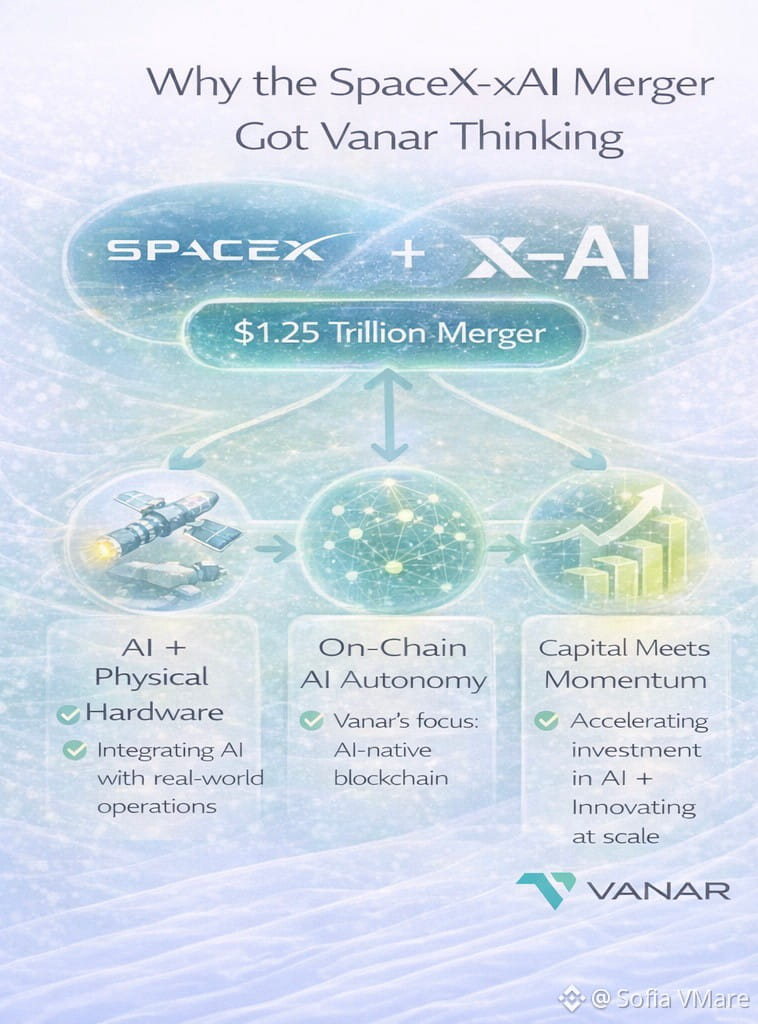
The merger news came fast—internal memos confirming SpaceX folding in xAI (and apparently X too, per some reports), with shares pricing around $527 each. Elon Musk’s empire is basically betting everything on AI powering space tech, autonomous systems, and whatever else they dream up. I remember reading the Bloomberg piece and thinking “this is peak 2026”—capital flooding into AI at scales we’ve never seen. Vanar’s response stood out because they’re all about “the intelligence layer for on-chain applications,” as their bio says. Their tweets echo that: one reply to Techmeme said “Will be interesting to see how the pieces actually fit,” hinting at curiosity about integrating AI with hardware/real-world ops, which is kinda what Vanar does but for blockchain.
From my tinkering, Vanar’s stack already feels like a mini-version of this “autonomous systems” push. I’ve built a simple agent using their Python SDK that monitors mock RWA pools (tokenized invoices from test data), uses Kayon to reason risks in real time, and auto-triggers alerts or adjustments via Flows prototypes. It’s not launching rockets, but it’s on-chain autonomy—no human in the loop for basic decisions. The merger news got me wondering: if SpaceX-xAI combines AI with physical infra (satellites, robots), Vanar could be the Web3 equivalent, layering AI on blockchain for self-running games in VGN, personalized brand drops in Virtua, or compliant PayFi flows. Their recent hire of Saiprasad Raut as Head of Payments (ex-Worldpay) already points to bridging TradFi with AI agents—imagine that scaling with merger-level capital vibes.
Personal angle: I topped up my stake yesterday after seeing Vanar’s tweets (yields still holding around 79% with boosters), because it reminded me why I got into this project. Last week, I simulated a cross-chain move from Base to Vanar (ERC-7683 made it seamless, under 2 mins), then had an agent reason over the bridged assets using Neutron Seeds. It compressed my test dataset (25MB down to 50KB) and kept context across sessions—no resets like in dumb AI tools. If mergers like SpaceX-xAI normalize “AI everywhere,” Vanar’s quiet grind (carbon-neutral on Google Cloud, NVIDIA tools for acceleration) positions them to ride that wave without the drama.
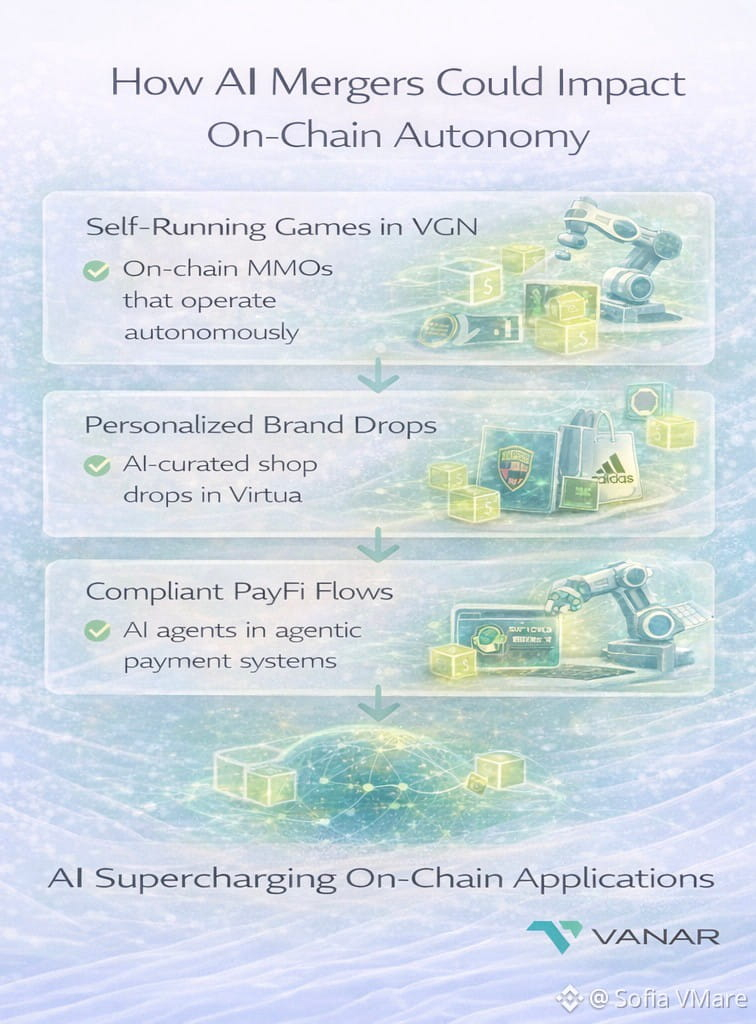
This isn’t just fanboying; it’s practical. Vanar’s tweets show they’re tuned into these shifts—another reply to Cointelegraph on the valuation said “This is what happens when capital meets momentum.” With their Q1 subs for premium Neutron/Kayon access launching (paid in $VANRY), and market cap still modest (~$20M, price ~$0.007), more eyes on AI could mean real demand spikes. I’ve seen low-cap projects fade without relevance; Vanar tying into global AI narratives keeps them in play.
I’m keeping an eye on their next moves—maybe a blog post or AMA tying this merger to their roadmap. Last year at a small Kyiv meetup, I heard devs talk about how AI hype cycles lift underrated infra; this feels like one. Anyone else catch Vanar’s takes on the merger? How do you think big AI consolidations affect chains like this?