

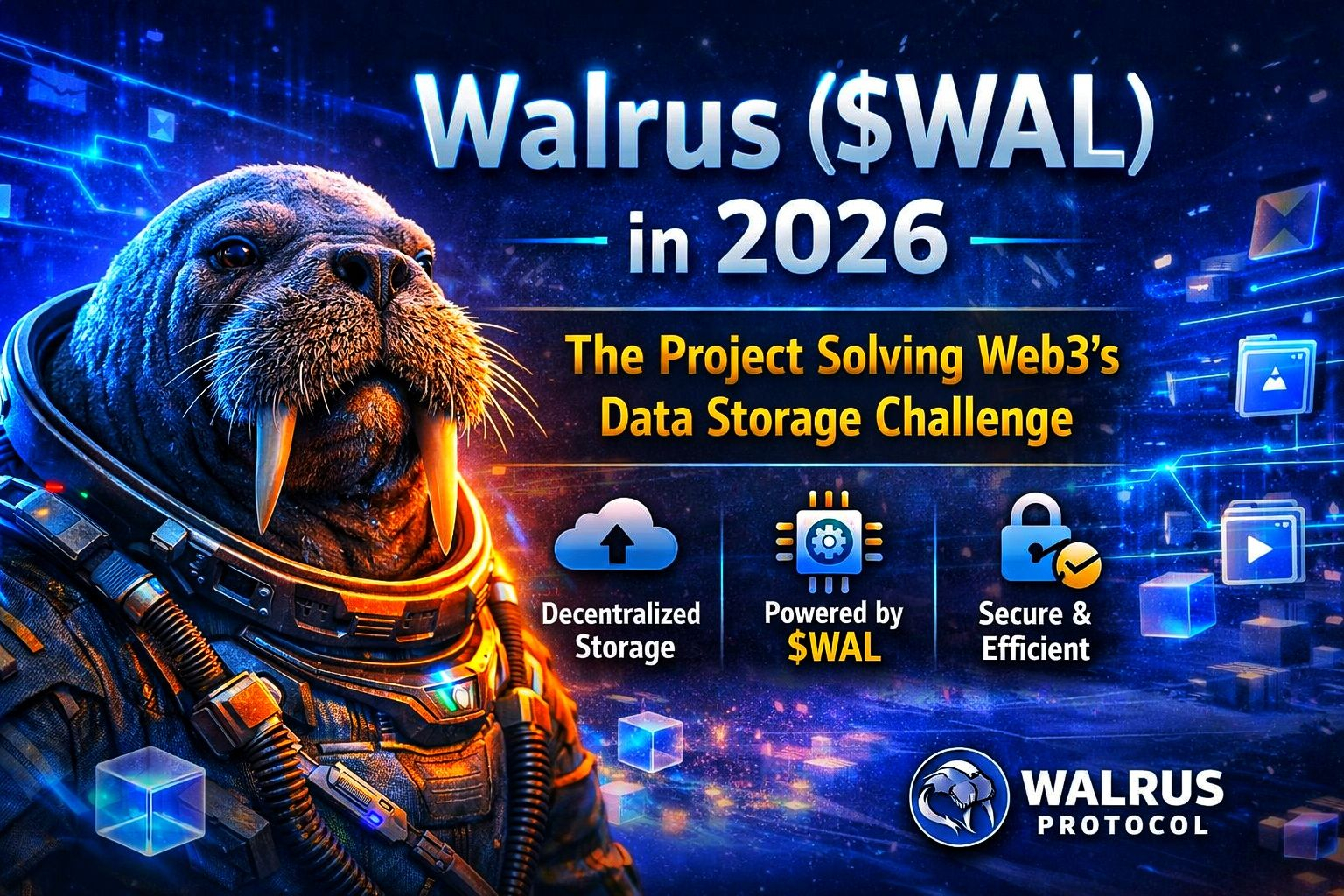
"WALRUS: Decentralized data storage for the future."
In 2026, I noticed a very clear change in the crypto market: people got tired of empty promises. Today, when a project becomes a real topic, it's not because of noise... it's because of utility. And Walrus ($WAL) is exactly in that group: a project that started to gain prominence because it solves a problem that many people ignored but is huge in the Web3 world — data storage.
Everyone talks about transactions, DeFi, and tokens, but few remember that the internet doesn't just live on that. The internet lives on data: photos, videos, documents, digital collections, records, heavy files, and even databases used in AI. However, blockchain was not designed to easily store this type of thing. And when you have to rely on centralized solutions, you lose the main value of Web3: autonomy.
Walrus comes as a practical and well-thought-out response to this. The proposal is to allow applications to store and access files in a decentralized, efficient, and secure manner, opening space for very real use cases: games with persistent items, social networks with heavy media, projects with verifiable data, and even applications that need to keep files available for years without the risk of disappearing.
And the most interesting thing is that the $WAL is not a "decorative token". It has a clear function within the ecosystem: it serves as fuel to pay for storage, incentivize the functioning of the network, and reward those who keep the infrastructure active. In other words, if Walrus grows in usage, the token naturally gains relevance within the system.
For me, the highlight of Walrus in 2026 is a strong signal of market maturity: increasingly, those who build useful infrastructure become the foundation of the future.