
Why Walrus Threatens the Cloud Giants’ Business Model 🏗️⚡
Here’s what keeps executives at centralized cloud providers awake at night:
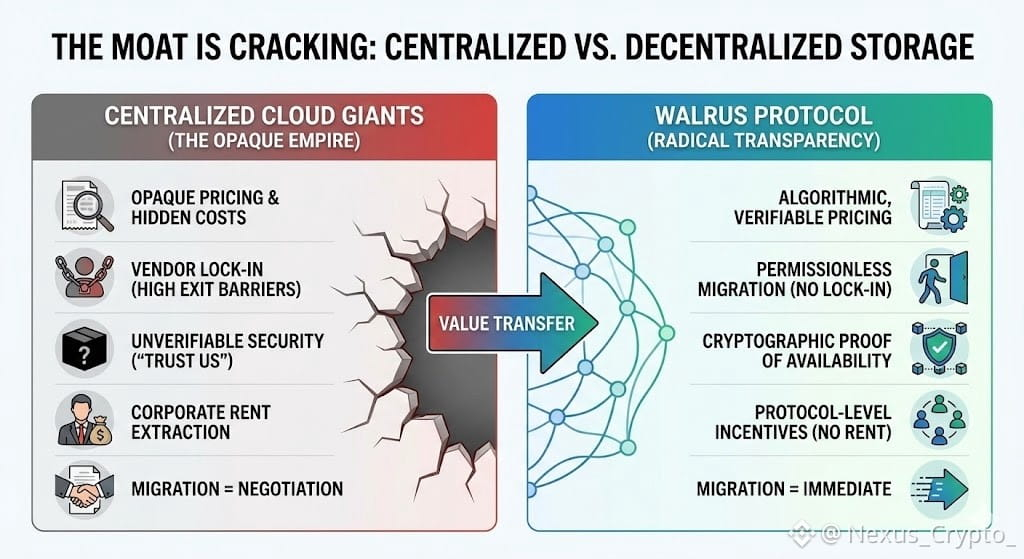
Their entire empire is built on opacity.
You don’t really know what you’re paying for.
You can’t independently verify security claims.
And once you’re in, leaving is painfully expensive.
This is the hidden tax of Web2 infrastructure — and it’s exactly the model @walrusprotocol on Sui is designed to dismantle. 💎
The Real Cloud Moat: Lock-In, Not Technology 📉
AWS didn’t win because storage is inherently hard.
It won because:
Pricing is complex and negotiable
Infrastructure costs are opaque
Migration requires lawyers, contracts, and downtime
Vendor lock-in creates artificial switching costs that trap users long after better options exist.
This is not efficiency.
It’s information asymmetry.
Radical Transparency Changes Everything 🧠
Walrus flips the competitive equation.
Every storage operation is:
Publicly verifiable
Cryptographically provable
Coordinated on Sui blockchain
There are no closed dashboards.
No “trust us” metrics.
No black-box billing.
If data is stored, you can verify it.
If availability is promised, it’s provable.
Transparency stops being a marketing claim and becomes a protocol property.
Algorithmic Pricing vs Corporate Rent Extraction 📉⚡
Centralized clouds price to maximize margins.
Walrus prices via:
Protocol-level rules
Algorithmic incentives
Open participation
There is no executive layer extracting profit.
No quarterly earnings pressure.
No monopoly rent.
That difference compounds over time.
Traditional providers may respond by temporarily lowering prices, but they cannot remove the structural cost of:
Corporate overhead
Shareholder expectations
Centralized operations
Decentralized networks don’t carry that burden.
Permissionless Migration Is the Real Threat 🏗️
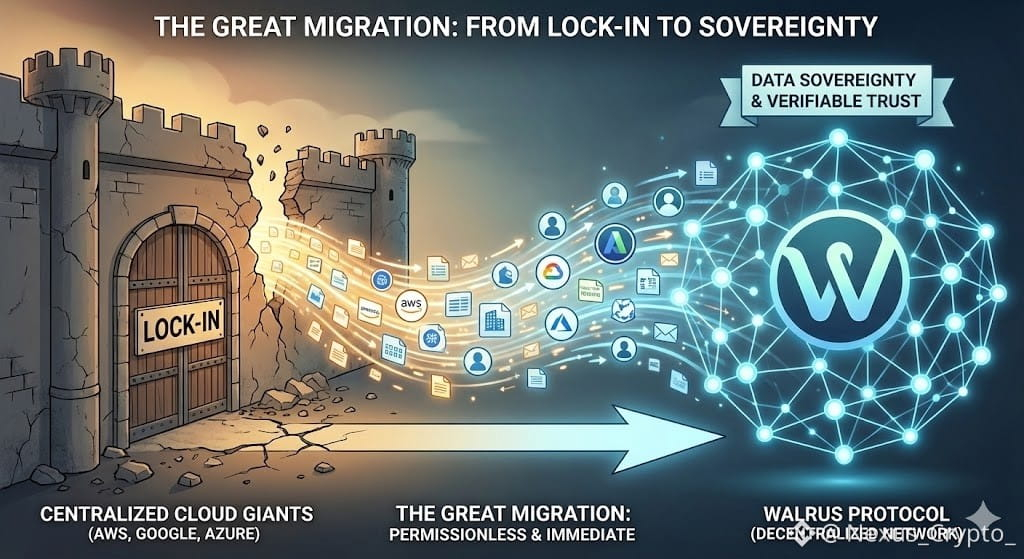
In Web2, migration is a negotiation.
In Walrus, migration is:
Permissionless
Immediate
Non-custodial
No contracts.
No lock-in clauses.
No exit penalties.
This fundamentally changes user behavior.
When leaving is easy, providers must compete continuously — not just at onboarding.
Verifiability Rewrites Trust 🧠⚡
Enterprises don’t actually want to trust providers.
They want to verify them.
Walrus enables:
On-chain verification of storage commitments
Cryptographic proof of availability
Immutable records on Sui
Trust moves from institutions to math.
And once verification becomes standard, opaque systems look outdated — and risky.
The Cost Curve Advantage 🏗️📉
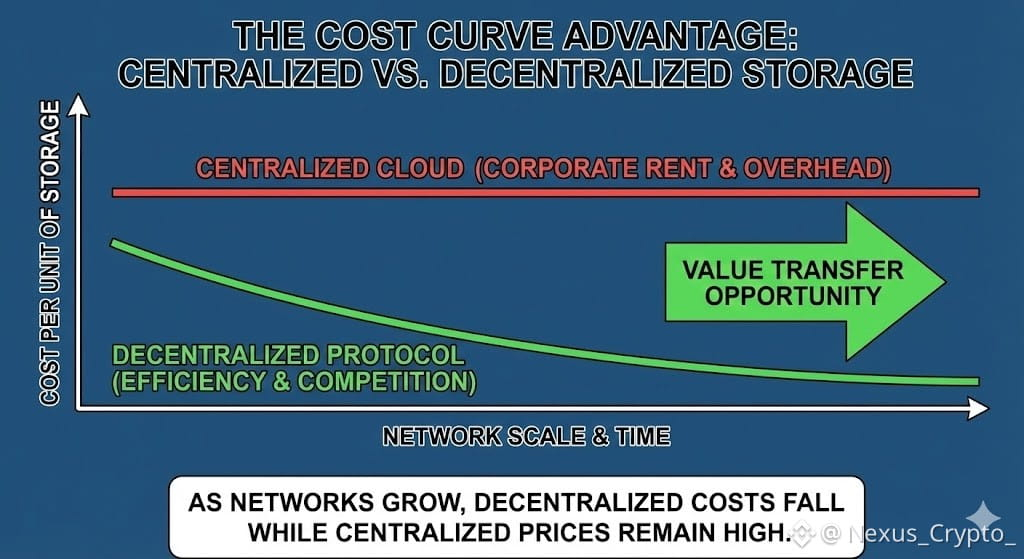
Decentralized storage networks scale differently.
As Walrus grows:
More providers join
Competition increases
Marginal costs fall
Meanwhile, centralized providers face:
Rising compliance costs
Political pressure
Increasing scrutiny
This divergence is slow at first…
Then sudden.
That’s how infrastructure disruption always looks.
The Coming Value Transfer ⚡
What we’re witnessing isn’t just competition.
It’s a massive value transfer:
From centralized intermediaries
To protocol participants
To builders, operators, and early adopters
Infrastructure value moves to the edges.
This is how the internet itself evolved — and storage is next.
Why Enterprises Will Move Faster Than Expected 🧠
Enterprises don’t care about ideology.
They care about:
Cost
Reliability
Compliance
Control
When they realize they can:
Slash infrastructure spend
Gain data sovereignty
Eliminate vendor lock-in
Migration won’t be gradual.
It will be exponential.
By the time it’s obvious, it will already be too late to catch up.
Walrus + Sui: The Strategic Stack 💧
Walrus leverages Sui for fast finality and scalable coordination, enabling enterprise-grade guarantees without sacrificing decentralization.
This isn’t experimental infrastructure.
It’s production-ready architecture designed for adversarial conditions.
Final Thought
Cloud giants didn’t lose because they were bad at technology.
They lost when users gained visibility and choice.
Walrus introduces both.
The storage wars haven’t truly begun yet — but the rules have already changed.
And in this game, transparency is the ultimate weapon.
CTA — your take:
Do you think enterprises will adopt decentralized storage for cost reasons first, or sovereignty reasons? What would trigger mass migration? Share below 👇
If you’re tracking infrastructure disruption and long-term value flows, drop a 🏗️⚡ and follow — more deep dives coming.
⚠️ DISCLAIMER: This content is for educational purposes only and does not constitute financial advice. Cryptocurrency investment involves high risk. Always do your own research (DYOR) before investing. The views expressed are my own.
