
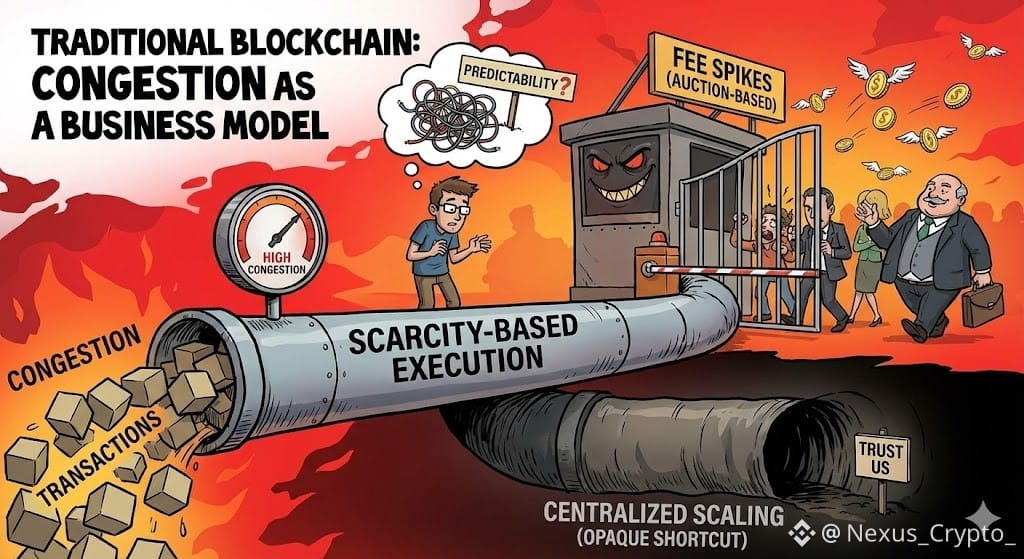
For years, blockchain scalability has been constrained by an uncomfortable truth: many networks implicitly rely on congestion as part of their economic design. Block space scarcity drives fees, fees prioritize transactions, and unpredictability becomes normalized. Developers adapt, users tolerate friction, and centralized scaling providers step in to smooth the experience—often by introducing new trust assumptions. This model works only until demand becomes sustained. At that point, its weaknesses are impossible to ignore.
Plasma is designed to break this pattern entirely.
The Hidden Economics of Congestion
On most blockchains, congestion is not just a technical limitation; it is an economic mechanism. When demand increases, users bid against each other for inclusion. Fees spike, smaller participants are priced out, and only well-capitalized actors remain competitive. While this may appear neutral, it creates information asymmetry and unpredictability.
Developers cannot reliably estimate costs. Users cannot anticipate whether transactions will succeed. Applications that depend on composability fail when one leg of execution is delayed or priced out. Over time, this pushes ecosystems toward centralized execution layers that promise stability at the cost of transparency.
Congestion becomes a silent form of vendor lock-in.
Why Traditional Scaling Can’t Fully Escape This Trap
Many scaling solutions attempt to mitigate congestion by increasing capacity or batching transactions. While these approaches improve throughput, they often preserve the underlying scarcity model. Fees remain auction-based. Performance remains variable. Trust is shifted rather than eliminated.
Centralized sequencers and opaque execution environments may offer temporary relief, but they introduce new risks. Users must trust operators. Developers must accept execution guarantees that cannot always be independently verified. The system scales, but decentralization erodes quietly.
Plasma takes a fundamentally different approach.
Plasma’s Architectural Shift
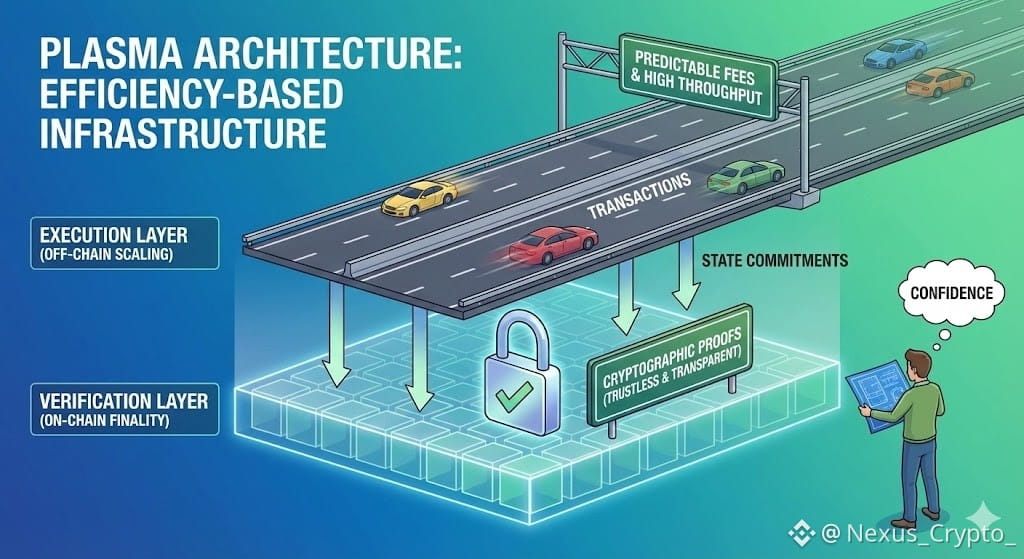
Plasma eliminates congestion as a core economic primitive by separating execution from verification. Instead of forcing all computation onto a single shared base layer, execution occurs in scalable environments designed for high throughput. Crucially, final state commitments are still verified on-chain using cryptographic guarantees.
This design changes the competitive dynamics entirely:
Performance is no longer tied directly to block space scarcity
Fees become predictable rather than auction-driven
Verification remains trustless and transparent
Congestion is structurally reduced, not managed reactively
In Plasma’s model, scalability is achieved through efficiency, not artificial scarcity.
Transparency Over Information Asymmetry
One of the most important consequences of Plasma’s design is radical transparency. Because verification remains on-chain, participants do not need to trust execution environments blindly. State transitions are provable. Outcomes are auditable. Correctness is enforced by the protocol, not by reputation or contracts.
This removes the information asymmetry that plagues both centralized providers and many scaling solutions. Developers can reason about costs and performance with confidence. Users can interact with applications knowing execution guarantees do not disappear under load.
When systems are verifiable by design, power shifts away from intermediaries and back to protocol participants.
Why Legacy Models Can’t Compete Long-Term
Legacy blockchains and centralized scaling providers may respond by subsidizing fees, increasing limits, or temporarily masking congestion. These tactics can delay friction, but they cannot change the underlying architecture. As long as demand and scarcity remain tightly coupled, unpredictability will resurface.
Plasma’s advantage is structural. By removing congestion as a business model, it aligns incentives around efficiency rather than extraction. There is no need to monetize scarcity when execution is designed to scale horizontally.
This mirrors broader shifts in technology history, where open, verifiable systems eventually outperform closed, friction-based incumbents—not immediately, but decisively.
Implications for Developers and Ecosystems
For developers, Plasma represents a shift from defensive engineering to intentional design. Applications no longer need to assume degraded performance during success. High-frequency use cases become viable without centralized shortcuts. Composability can be preserved without fear of congestion-induced failure.
For ecosystems, this means healthier growth. Users are not priced out during peak activity. Smaller participants remain competitive. Innovation is not limited to those who can afford volatility.
Conclusion
The next phase of blockchain adoption will not be won by networks that manage congestion better. It will be won by those that eliminate congestion as a defining constraint. Plasma does this by redesigning scalability at the protocol level—separating execution from verification, enforcing transparency, and rejecting scarcity-driven economics.
We are witnessing the early stages of a shift away from congestion-based models toward efficiency-based infrastructure.
The scalability wars are only beginning.
And Plasma is built for the phase where architecture, not hype, decides the outcome.
For years, blockchain scalability has been constrained by an uncomfortable truth: many networks implicitly rely on congestion as part of their economic design. Block space scarcity drives fees, fees prioritize transactions, and unpredictability becomes normalized. Developers adapt, users tolerate friction, and centralized scaling providers step in to smooth the experience—often by introducing new trust assumptions. This model works only until demand becomes sustained. At that point, its weaknesses are impossible to ignore.
Plasma is designed to break this pattern entirely.
The Hidden Economics of Congestion
On most blockchains, congestion is not just a technical limitation; it is an economic mechanism. When demand increases, users bid against each other for inclusion. Fees spike, smaller participants are priced out, and only well-capitalized actors remain competitive. While this may appear neutral, it creates information asymmetry and unpredictability.
Developers cannot reliably estimate costs. Users cannot anticipate whether transactions will succeed. Applications that depend on composability fail when one leg of execution is delayed or priced out. Over time, this pushes ecosystems toward centralized execution layers that promise stability at the cost of transparency.
Congestion becomes a silent form of vendor lock-in.
Why Traditional Scaling Can’t Fully Escape This Trap
Many scaling solutions attempt to mitigate congestion by increasing capacity or batching transactions. While these approaches improve throughput, they often preserve the underlying scarcity model. Fees remain auction-based. Performance remains variable. Trust is shifted rather than eliminated.
Centralized sequencers and opaque execution environments may offer temporary relief, but they introduce new risks. Users must trust operators. Developers must accept execution guarantees that cannot always be independently verified. The system scales, but decentralization erodes quietly.
Plasma takes a fundamentally different approach.
Plasma’s Architectural Shift
Plasma eliminates congestion as a core economic primitive by separating execution from verification. Instead of forcing all computation onto a single shared base layer, execution occurs in scalable environments designed for high throughput. Crucially, final state commitments are still verified on-chain using cryptographic guarantees.
This design changes the competitive dynamics entirely:
Performance is no longer tied directly to block space scarcity
Fees become predictable rather than auction-driven
Verification remains trustless and transparent
Congestion is structurally reduced, not managed reactively
In Plasma’s model, scalability is achieved through efficiency, not artificial scarcity.
Transparency Over Information Asymmetry
One of the most important consequences of Plasma’s design is radical transparency. Because verification remains on-chain, participants do not need to trust execution environments blindly. State transitions are provable. Outcomes are auditable. Correctness is enforced by the protocol, not by reputation or contracts.
This removes the information asymmetry that plagues both centralized providers and many scaling solutions. Developers can reason about costs and performance with confidence. Users can interact with applications knowing execution guarantees do not disappear under load.
When systems are verifiable by design, power shifts away from intermediaries and back to protocol participants.
Why Legacy Models Can’t Compete Long-Term
Legacy blockchains and centralized scaling providers may respond by subsidizing fees, increasing limits, or temporarily masking congestion. These tactics can delay friction, but they cannot change the underlying architecture. As long as demand and scarcity remain tightly coupled, unpredictability will resurface.
Plasma’s advantage is structural. By removing congestion as a business model, it aligns incentives around efficiency rather than extraction. There is no need to monetize scarcity when execution is designed to scale horizontally.
This mirrors broader shifts in technology history, where open, verifiable systems eventually outperform closed, friction-based incumbents—not immediately, but decisively.
Implications for Developers and Ecosystems
For developers, Plasma represents a shift from defensive engineering to intentional design. Applications no longer need to assume degraded performance during success. High-frequency use cases become viable without centralized shortcuts. Composability can be preserved without fear of congestion-induced failure.
For ecosystems, this means healthier growth. Users are not priced out during peak activity. Smaller participants remain competitive. Innovation is not limited to those who can afford volatility.
Conclusion
The next phase of blockchain adoption will not be won by networks that manage congestion better. It will be won by those that eliminate congestion as a defining constraint. Plasma does this by redesigning scalability at the protocol level—separating execution from verification, enforcing transparency, and rejecting scarcity-driven economics.
We are witnessing the early stages of a shift away from congestion-based models toward efficiency-based infrastructure.
The scalability wars are only beginning.
And Plasma is built for the phase where architecture, not hype, decides the outcome.