The first time I heard the name Walrus, I’ll admit, I smiled. It sounded friendly. Solid. Like something that wouldn’t rush you or pretend to be flashy. And honestly? That’s kind of the perfect energy for what Walrus is trying to do in the crypto world.
We’ve gotten used to moving fast online. Upload the file. Click accept. Trust the cloud. Don’t think too hard about where your data actually lives or who can peek at it when you’re not looking. Most of the time, that works fine—until it doesn’t. A locked account. A vanished folder. A service quietly changing its rules. That uneasy feeling in your stomach when you realize something important is no longer fully yours.
Walrus exists in that exact discomfort.
At its core, Walrus is a protocol built on the Sui blockchain that’s quietly asking a very human question: what if your data didn’t belong to anyone else but you? Not a corporation. Not a platform. Just you. And instead of storing everything in one giant digital warehouse, Walrus breaks files apart, scatters them across a decentralized network, and uses some clever math—erasure coding and blob storage—to make sure those pieces can always find their way back together.
It reminds me of how my grandmother used to store important documents. Birth certificates in one place. Letters in another. Photos tucked into books. Nothing critical lived in just one drawer. If there was ever a fire or a flood, not everything would be lost at once. Walrus does that same thing, just at internet scale.
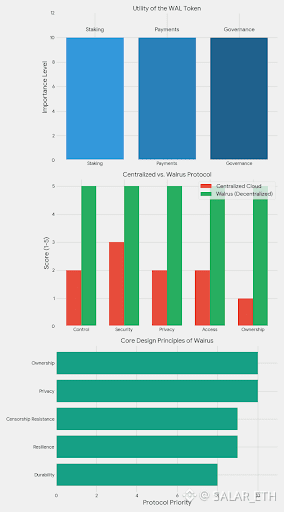
Now, WAL—the token—fits into this like a quiet engine under the hood. It’s what keeps everything moving. People stake it to help secure the network. They use it to pay for storage and transactions. They vote with it when decisions about the protocol’s future need to be made. It’s less about speculation and more about participation, which is refreshing in a space that sometimes feels obsessed with price charts and little else.
What really sets Walrus apart, though, is the way it treats privacy. Not as a luxury feature. Not as an optional upgrade. Privacy is baked in from the start. Transactions can be private. Interactions with decentralized apps don’t need to feel like you’re shouting your business across the internet. For developers building tools that deal with sensitive data—health records, financial documents, internal company files—that’s not just nice to have. It’s essential.
I once worked with a small creative team that lost access to years of video footage because a centralized service flagged an account by mistake. No warning. No human support for days. That panic? That scramble? Walrus is trying to design a world where that kind of power imbalance simply doesn’t exist. No single switch to flip. No single gatekeeper to appease.
Of course, this isn’t magic. Decentralized storage is more complex than dragging files into a folder. There’s a learning curve. There are trade-offs. And adoption takes time, especially when people are comfortable with the tools they already know. But there’s something quietly reassuring about a system that prioritizes resilience over convenience, ownership over ease.
Walrus feels less like a loud revolution and more like a steady shift. A reminder that the internet doesn’t have to be built around surveillance, control, and centralized trust. That we can design systems that assume people deserve privacy by default. That data can be durable, censorship-resistant, and still practical.
It’s not trying to dazzle you with hype. It’s offering something simpler and, in many ways, braver: a chance to take responsibility for your digital life again.
And maybe that’s why the name fits so well. Walruses aren’t flashy. They’re grounded. They survive in harsh environments by sticking together and adapting. In a noisy crypto landscape full of promises and performance, Walrus just quietly does its job—holding your data steady, even when the ice starts to crack.