
I noticed it mid-session, not because something went wrong, but because nothing slowed down.
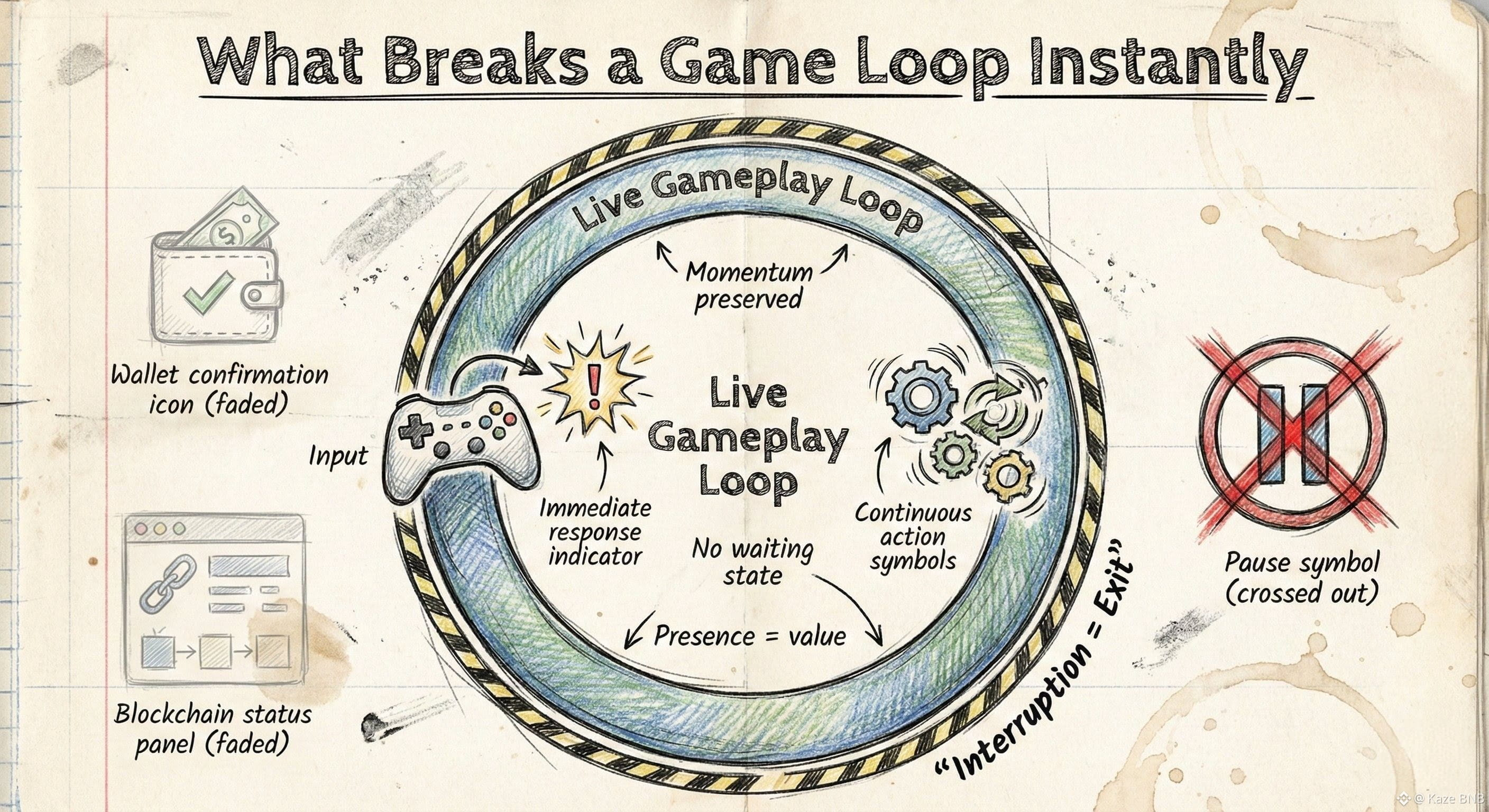
Inside a live game loop running through the VGN Games Network, actions resolve the way players expect them to: input, response, continuation. You don’t finish a step and wait. You finish it and you’re already doing the next thing. That rhythm isn’t a design preference, it’s survival inside entertainment-native systems built for mass usage. The moment a loop hesitates, attention leaks out.
I still carried the old assumption with me that blockchain would eventually surface.
It usually does. A pause. A confirm. A reminder that there’s infrastructure underneath the experience. In most chains, that reminder is treated as normal. Inside a Vanar-powered game session, it would have been fatal. Games punish interruption quietly. They don’t argue. They just lose players.
This time, that moment never arrived.
The session kept moving. Rewards resolved. State advanced. My game inventory updated in the background, not as a ceremony but as a consequence. There was no break where the system asked me to acknowledge anything “on-chain.” The loop behaved exactly like a consumer-grade experience should, even though the underlying execution was happening on Vanar Chain.
That’s when I realized how unforgiving gaming loops actually are.
Players don’t pause to admire systems. They don’t tolerate waiting for context. They stay as long as momentum holds. The second a pause appears—especially one that forces them to think like an operator instead of a player—the loop fractures. Not with complaints. With silent exit.
I’ve seen this inside Virtua Metaverse environments too. These aren’t dashboards or sandboxes. They’re persistent digital worlds where presence is the product. You’re not “completing transactions.” You’re occupying space. A single blockchain pause can collapse immersion instantly. The world keeps rendering, but the non-crypto-native user is already gone.
What stood out here was how deliberately Vanar avoided becoming visible.
Vanar didn’t try to teach me how a blockchain works mid-session. It didn’t surface confirmations, panels, or metrics. It treated the game loop as sacred. Whatever protocol work was happening stayed invisible, because visibility would have been the failure. For a consumer-first blockchain, that’s not ideology—it’s architecture.
Non-crypto-native players don’t arrive curious about chains. They arrive curious about play. If the system asks them to care about infrastructure before value shows up, real-world adoption stalls before it starts. That’s the gap most blockchains fall into: they work technically, but interrupt experientially.
Vanar is built around that gap.
The design assumes mainstream adoption looks like repetition, not education. Sessions move forward without revalidation rituals. Game inventory behaves like part of the world, not a ledger event. Responsibility shifts away from the player and into the system. That’s how entertainment platforms survive at scale.
You feel the tradeoff later, not during play.
When someone asks after the session where something landed or when it resolved, the answer doesn’t point to a dramatic blockchain moment. It points to continuity. The game moved on. Verification lives downstream, handled by Vanar instead of by the player.
“Do you have the session ID?” someone asked.
Not because anything looked broken. Because there wasn’t a clean place to point. The inventory page stayed empty long enough to start that familiar second-guessing, and the only thing anyone trusted was whatever reference could survive a handoff.
That relocation is intentional.
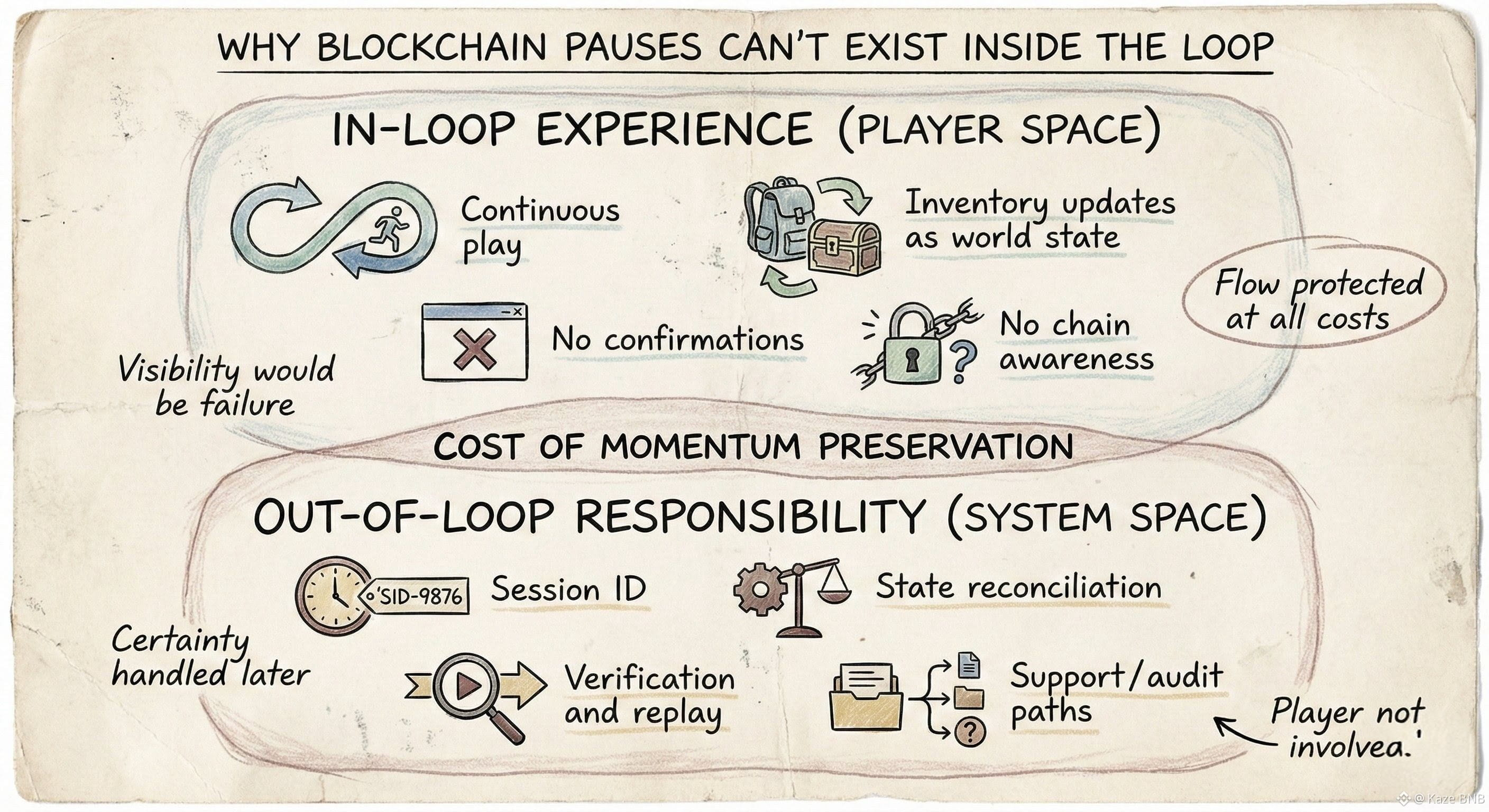
Inside gaming loops, pauses cost more than complexity. Once momentum breaks, there’s no second explanation. You just lose the player. Vanar doesn’t try to correct that behavior. It accepts it and builds infrastructure that stays out of the way.
By the end of the session, it was clear why even Vanar ($VANRY ) stays quiet in the flow. Tokens, confirmations, and chain awareness are secondary to presence. The experience didn’t prove anything to me.
It didn’t need to.
It just kept going, until someone asked where “going” was recorded.