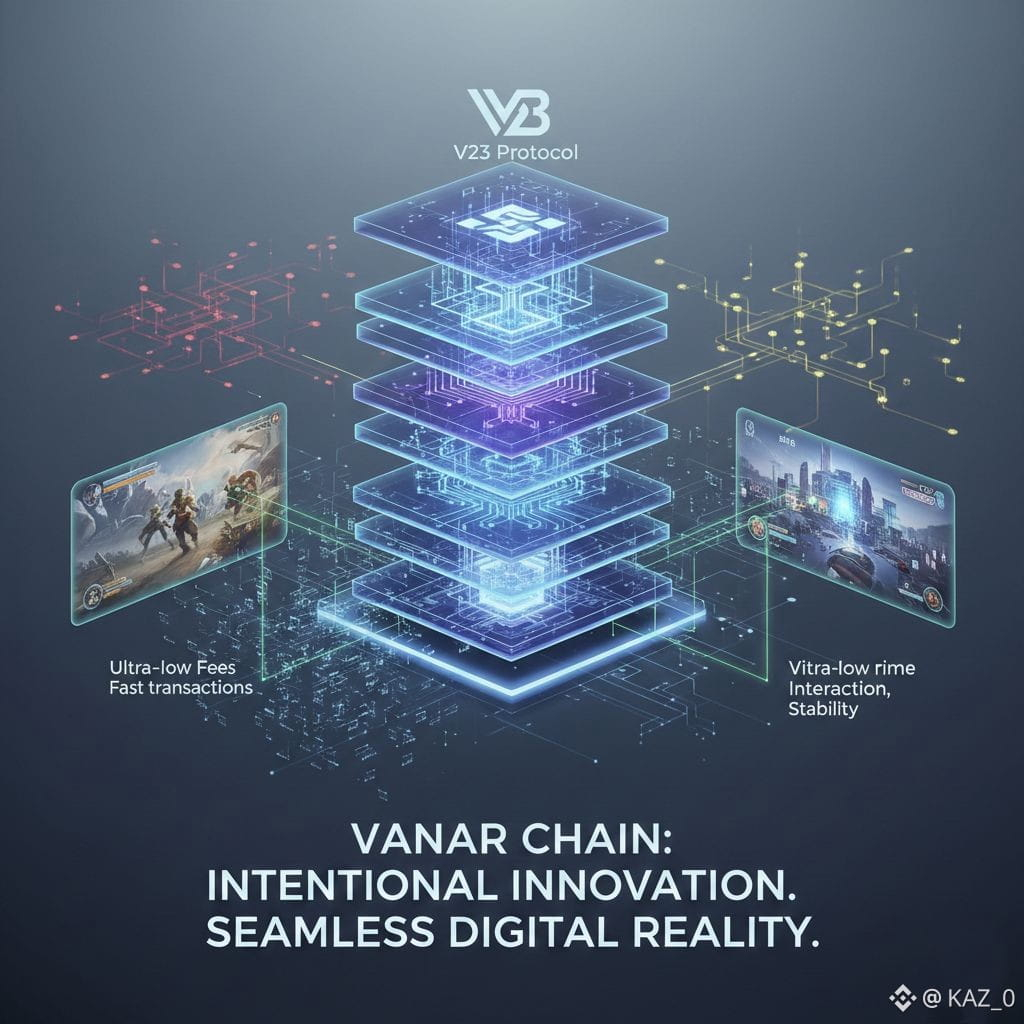
After taking a deeper look at Vanar Chain, I no longer see it as just another Layer-1 blockchain. What stands out is not loud promotion, but a system designed with real digital use in mind. Vanar feels intentional. Every choice seems focused on solving practical problems rather than chasing attention.
At its core, Vanar addresses a simple but critical issue: most blockchains struggle when applications need fast, frequent, and low-cost transactions. Games, virtual worlds, and digital platforms operate continuously. If every action is slow or expensive, the user experience breaks down. Vanar starts from this reality instead of treating it as an afterthought.
Performance highlights this mindset clearly. Transaction fees average around 0.0005 dollars, low enough that users can interact freely without worrying about cost. On networks like Ethereum, even small fees influence how developers design applications. On Vanar, interactions feel natural and uninterrupted. To me, this reflects a strong understanding of how real users behave.
Finality is another key strength. Transactions settle within seconds, enabling real-time applications without relying on complex off-chain workarounds. This is essential for gaming and immersive digital environments. Compared to Ethereum’s slower confirmation times and Solana’s past stability challenges, Vanar appears to prioritize consistent and predictable performance over raw speed.
The V23 Protocol and Vanar’s five-layer architecture further reinforce this approach. Layers such as Neutron, optimized for efficient data handling, and Kayon, designed for reasoning and analysis, allow applications to work intelligently with data. Information isn’t just stored—it becomes usable within the system itself. This reduces complexity for developers and enables more adaptive applications.
Validator selection follows the same practical philosophy. Instead of relying purely on anonymity, Vanar emphasizes reputation and reliability. While some may debate this from a theoretical standpoint, from a developer and user perspective it makes sense. Stability and uptime matter more than ideology when building real products. In my view, this is one of Vanar’s most deliberate design choices.
The types of applications running on Vanar validate these decisions. Games and virtual worlds place constant pressure on the network, acting as real-world stress tests. Vanar is clearly built for sustained activity, not occasional usage.
Recent progress suggests the project is focusing on consolidation rather than hype. Strengthening the protocol, refining products, and aligning the ecosystem point to long-term thinking. This quiet, disciplined development style often produces stronger results than rapid, headline-driven growth.
Vanar Chain doesn’t attempt to reinvent blockchain technology. Instead, it adapts it to how digital systems actually operate. With ultra-low fees, fast finality, and a layered architecture designed for intelligent data use, Vanar aims to stay reliable and largely invisible to the end user. I believe networks built this way are the ones that will make blockchain truly practical for everyday digital experiences.