


Introduction: Why Blockchain Payments Still Feel Broken
For more than a decade, blockchain has promised a better financial system — faster, cheaper, and more open than traditional banking. Yet for most people, using crypto still feels complicated, expensive, and risky. One of the biggest reasons is gas fees.
If you’ve ever tried to send USDT on Ethereum or another smart-contract chain, you already know the frustration. You want to move a stablecoin, but first you need to buy the chain’s native token. Then you worry about gas spikes, failed transactions, and unpredictable costs. For a technology that claims to replace banks, this experience feels strangely worse than using a simple mobile payment app.
This is exactly the problem Plasma is trying to solve.
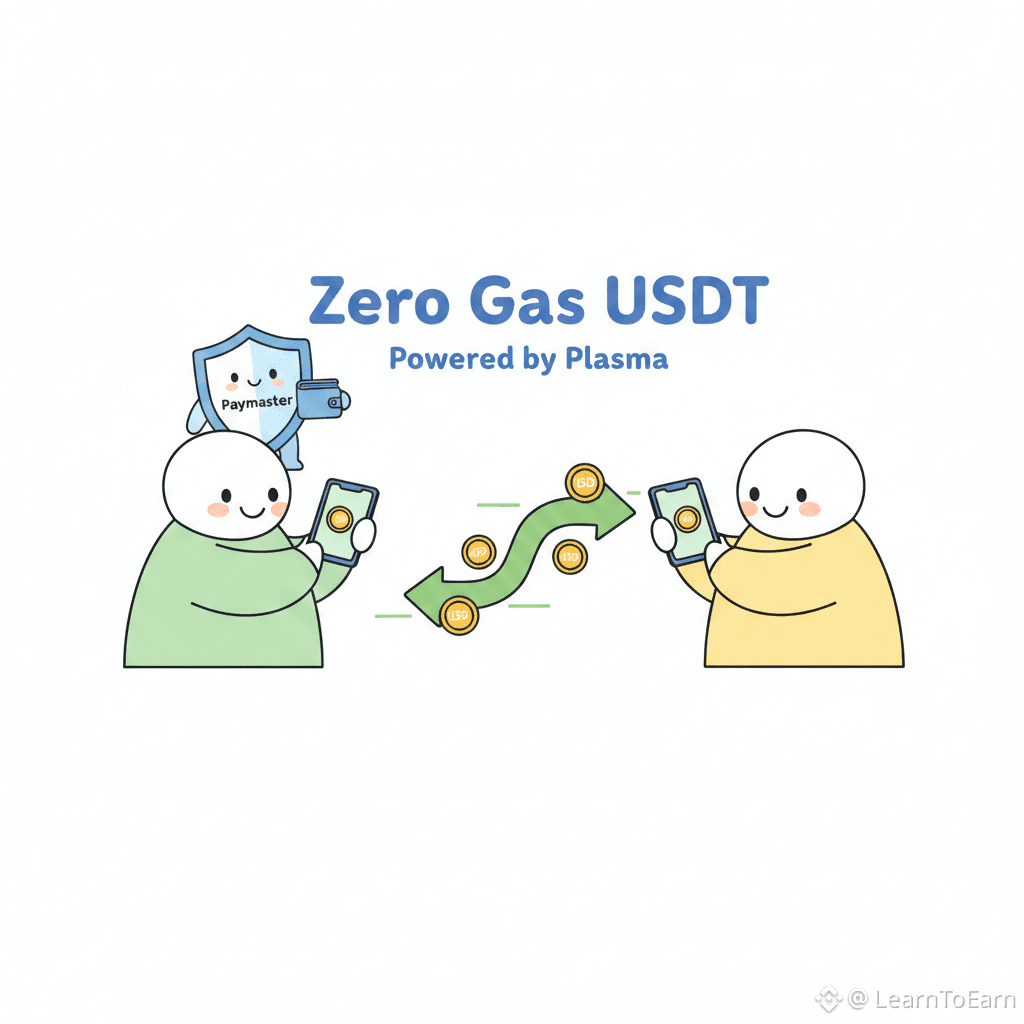
Plasma is not just another Layer-1 blockchain competing for attention. It is designed from the ground up as a stablecoin-native network, optimized specifically for payments, transfers, and real-world financial use. And at the heart of this design lies one powerful idea: users should not have to pay gas to send USDT.
This idea is made possible by Plasma’s Paymaster mechanism, a system that allows gas fees to be paid on behalf of users — quietly, securely, and sustainably. In this article, we’ll explore how Plasma’s Paymaster works, why it matters, and how it could change the future of stablecoin payments forever.
---
Understanding the Core Problem: Gas Fees and User Friction
Gas fees exist for a reason. They compensate validators for processing transactions and help protect networks from spam. But while gas fees make sense from a technical standpoint, they create massive friction for everyday users.
Think about it from a normal person’s perspective:
They only want to send USDT
They don’t care about native tokens
They don’t want to speculate on volatile assets
They want instant, predictable, low-cost transfers
Traditional blockchains fail this test. Requiring users to hold ETH, SOL, or other native tokens just to move stablecoins adds unnecessary complexity. Worse, gas fees fluctuate wildly. A transaction that costs $0.50 today might cost $10 tomorrow.
Plasma takes a different approach. Instead of forcing users to adapt to blockchain mechanics, Plasma adapts the blockchain to how people actually want to use money.
What Is Plasma, Really?
At its core, Plasma is a Layer-1 blockchain built for stablecoins.
While most blockchains are general-purpose platforms trying to support everything from NFTs to gaming to DeFi, Plasma focuses on one thing and does it exceptionally well: making stablecoins behave like real money.
Plasma is designed with:
Ultra-fast confirmation times
Extremely low operational costs
Native support for USDT and other stablecoins
Account abstraction at the protocol level
A payment-first economic model
Instead of asking “What else can we build on a blockchain?”, Plasma asks a more practical question:
“How should money move on the internet?”
The answer to that question leads directly to the Paymaster mechanism.
Introducing the Paymaster: The “Gas Fee Bodyguard”
The easiest way to understand Plasma’s Paymaster is to think of it as a gas-fee bodyguard or 代付小哥 (paid-on-your-behalf helper).
Normally, when you send a transaction, you pay the gas yourself. With a Paymaster, someone else can step in and say:
“I’ll pay the gas for this transaction — as long as it follows my rules.”
Plasma implements this idea at the protocol level, using EIP-4337 account abstraction. This is important because it means gas sponsorship isn’t a hack, a temporary trick, or a third-party service. It’s a first-class feature of the network.
How Plasma’s Paymaster Works (Without the Jargon)
Let’s walk through what happens when a user sends USDT on Plasma — in simple terms.
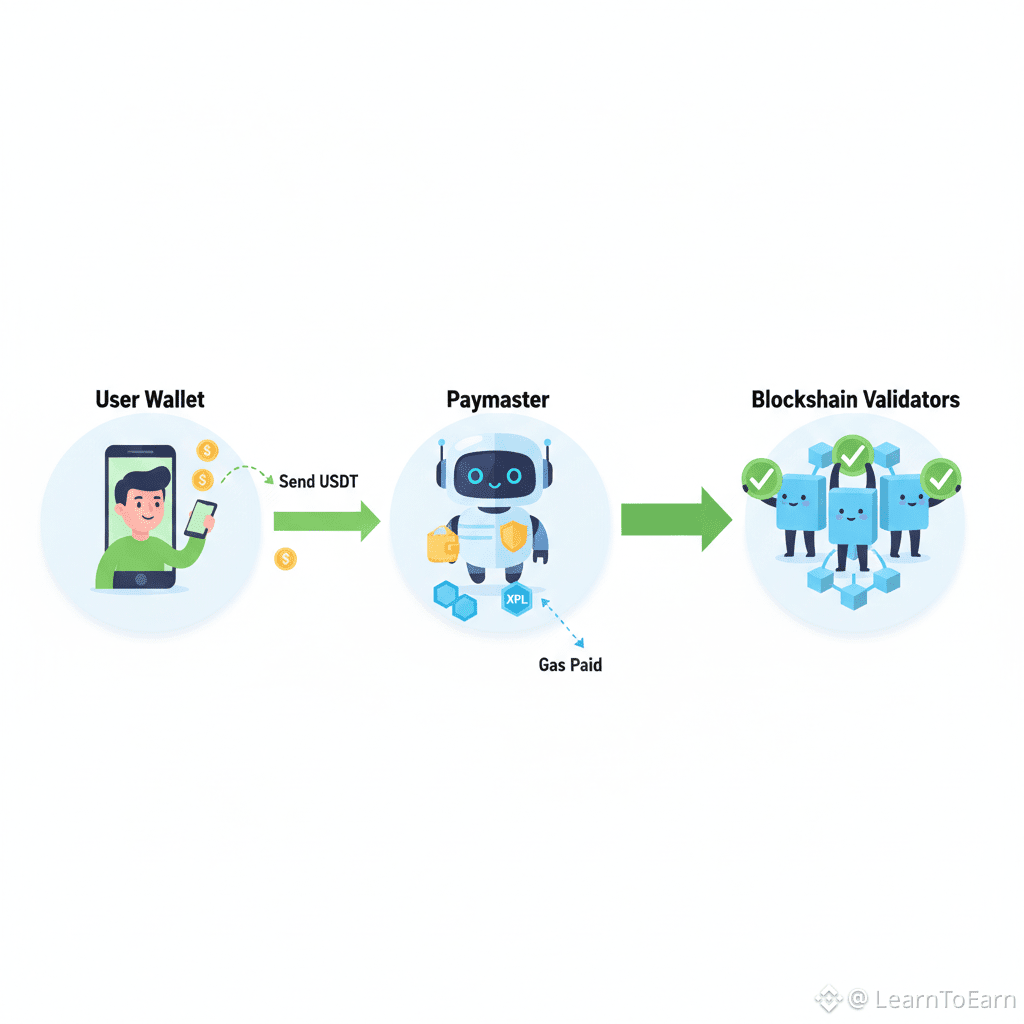
1. The user opens their wallet and sends USDT
They don’t worry about gas. They don’t check fees. They just send.
2. The transaction is prepared using account abstraction
Instead of a traditional transaction, Plasma uses a smarter transaction format that allows flexible gas handling.
3. The Paymaster checks the transaction
The Paymaster verifies that:
The transaction is a simple USDT transfer
It follows rate limits
It meets basic safety rules
4. The Paymaster pays the gas
If the transaction is approved, the Paymaster pays the gas fee using XPL, Plasma’s native token.
5. Validators process the transaction
From the network’s perspective, everything works normally. Gas is paid. Security is preserved.
6. The user receives confirmation
The user sees their USDT sent successfully — without ever touching XPL.
From start to finish, the experience feels closer to sending money through a mobile payment app than using a traditional blockchain.
Why Only USDT Transfers Are Gas-Free
A common question is: why doesn’t Plasma make everything gas-free?
The answer is sustainability.
Plasma intentionally limits gas sponsorship to simple USDT transfers, such as:
transfer()
transferFrom()
More complex actions — like interacting with DeFi protocols, deploying contracts, or running heavy computations — still require gas payments from the user.
This design choice is smart for several reasons:
It prevents abuse and spam
It keeps costs predictable
It protects network resources
It preserves long-term economic balance
In other words, Plasma removes friction where it matters most — everyday payments — while keeping the network healthy.
Who Pays for the Gas?
Here’s the key point many people miss:
Gas is not eliminated. It is relocated.
The gas fees are paid by the Plasma Foundation, using a pre-funded reserve of XPL tokens stored inside the Paymaster contract.
Think of it like a startup offering free shipping to attract users. The cost still exists, but the company absorbs it to create a better experience and grow adoption.
Over time, Plasma plans to balance this through:
Fees from non-sponsored transactions
Ecosystem growth
Enterprise integrations
Custom gas token usage
Value capture around XPL
This is not reckless subsidization — it’s a calculated strategy to onboard users at scale.
Custom Gas Tokens: Another Quiet Innovation
Plasma doesn’t stop at zero-gas transfers.
For transactions that are not gas-free, Plasma allows custom gas tokens. This means users can pay gas using approved assets like USDT instead of XPL.
Behind the scenes:
The Paymaster calculates the required gas
It converts the value using price oracles
It pays validators in XPL
It deducts the equivalent value from the user’s chosen token
The result? Users can operate entirely within stablecoins if they want — no forced exposure to volatility.
This flexibility is rare in blockchain design and extremely powerful for real-world use cases.
Why This Matters for Real-World Payments
Now let’s zoom out.
Why does any of this matter beyond crypto Twitter?
Because stablecoins are already a global financial tool.
They are used for:
Cross-border remittances
Freelance payments
International trade
Inflation protection
On-chain savings
Business settlements
In regions like Southeast Asia, Latin America, Africa, and the Middle East, stablecoins often outperform traditional banking systems in speed and accessibility — but gas fees still hurt adoption.
Plasma directly attacks this problem.
Zero-fee USDT transfers mean:
No hidden costs
No gas anxiety
No failed transactions due to fee miscalculations
No need to educate users about native tokens
This makes Plasma especially powerful for remittance corridors, such as markets where billions of dollars move every year and every percentage point of cost matters.
UX Is the Real Battleground
Blockchain doesn’t lose to banks because of technology. It loses because of user experience.
Plasma understands that mass adoption won’t come from more complex DeFi products. It will come from:
Simplicity
Predictability
Familiarity
Trust
By making USDT transfers feel as easy as sending a message, Plasma lowers the barrier for millions of users who don’t care about decentralization jargon — they just want money that works.
Security, Abuse Prevention, and Limits
Free transactions can be dangerous if poorly designed.
Plasma addresses this with:
Rate limits per wallet
Strict transaction type checks
Paymaster-level validation
Controlled subsidy budgets
These safeguards ensure that zero-gas transfers remain a feature, not an attack vector.
Importantly, validators still earn fees. Network security is not compromised
The Role of XPL in the Ecosystem
Even though users don’t need XPL for basic transfers, XPL remains essential.
XPL is used for:
Paying gas for complex transactions
Funding the Paymaster
Incentivizing validators
Securing the network
Aligning long-term economics
This creates a healthy balance: users enjoy simplicity, while the network maintains a sustainable economic backbone.
Plasma’s Bigger Vision
Plasma isn’t just solving gas fees. It’s redefining how blockchains think about money.
Its broader vision includes:
Stablecoin-first infrastructure
Privacy-enhanced payments
Enterprise-grade settlement rails
Consumer-friendly wallets
Global financial inclusion
The Paymaster is not an isolated feature. It’s a foundational building block for a payment-native blockchain.
Final Thoughts: Why Plasma Feels Different
Most blockchains start with technology and hope users adapt.
Plasma starts with users and builds technology around them.
The Paymaster mechanism is a perfect example of this philosophy. Instead of asking users to learn about gas, Plasma quietly removes the problem. Instead of adding complexity, it subtracts friction.
Zero-gas USDT transfers aren’t just a convenience — they are a statement:
Blockchain payments should feel invisible, effortless, and human.
If stablecoins are going to become the default digital money of the internet, systems like Plasma may be exactly what gets us there.

