

Plasma is not designed as a general-purpose blockchain competing for every possible use case. Instead, it is engineered as a specialized financial infrastructure focused on becoming a global settlement layer for stablecoins and real-world financial value. Its innovation does not come from one isolated feature but from the way multiple architectural components are integrated into a single coherent system. These components include its deterministic consensus mechanism, its Bitcoin-anchored security model, its cross-chain communication framework, its token-driven economic structure, and its progressive decentralization strategy. Together, they create a network that prioritizes certainty, efficiency, neutrality, and long-term sustainability over hype or experimental design.
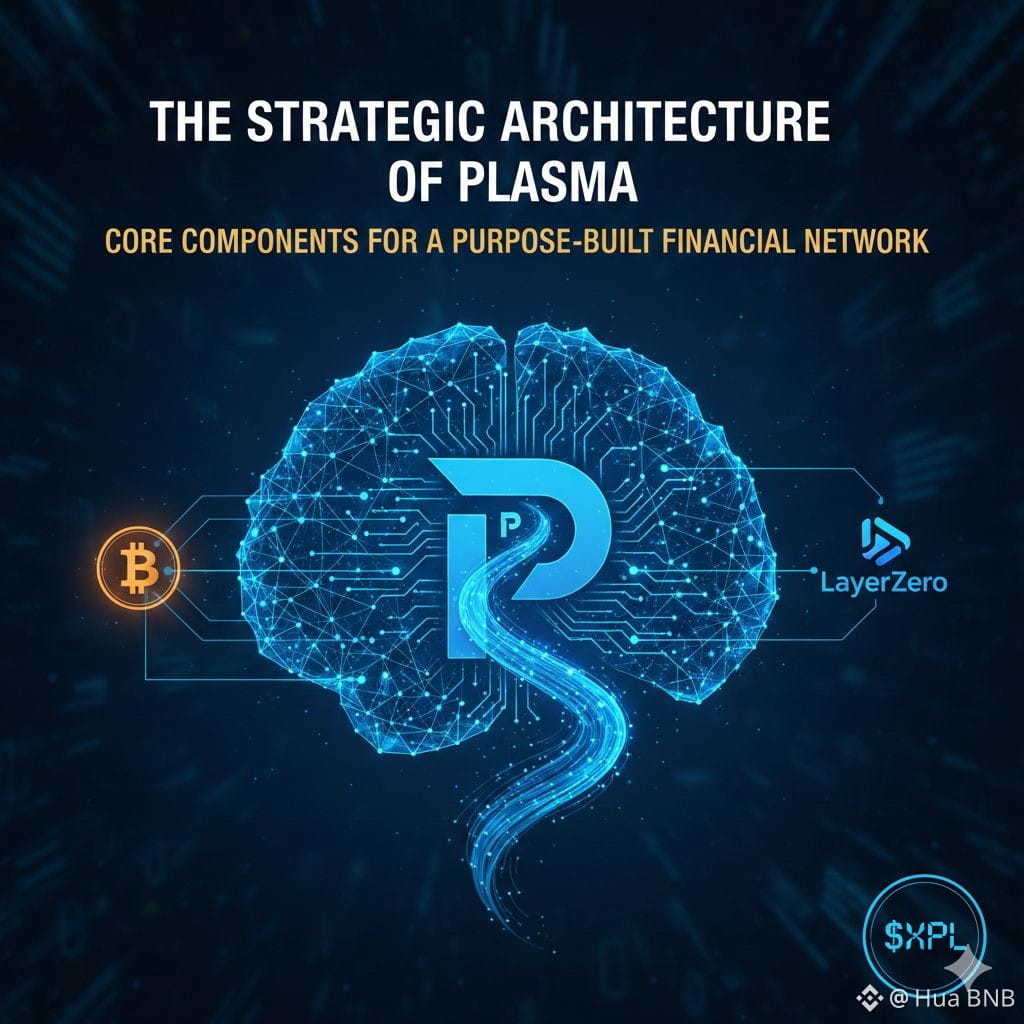
At the core of Plasma’s technical design lies PlasmaBFT, a consensus mechanism derived from the Fast HotStuff family of Byzantine Fault Tolerant protocols. This type of consensus is fundamentally different from probabilistic systems where transactions become “more secure over time” as additional blocks are added. PlasmaBFT provides deterministic finality, meaning that once a transaction is confirmed, it is final and irreversible within seconds. This property is essential for financial settlement. Banks, payment processors, and institutions require certainty that a transaction cannot be rolled back. PlasmaBFT removes settlement risk and enables real-time accounting, treasury operations, and cross-border payments without delay. This makes Plasma suitable not just for retail transfers but for enterprise-scale financial flows where timing and reliability are critical.
Security in Plasma is not treated as a single-layer problem. While PlasmaBFT ensures internal consistency, the network also seeks to anchor itself to Bitcoin, the most secure and decentralized blockchain in existence. Plasma’s Bitcoin bridge is designed as a trust-minimized system using a federated verifier model combined with fraud proofs. Independent verifiers, each staking XPL, must collectively confirm that BTC has been locked on the Bitcoin network before corresponding pBTC is minted on Plasma. This prevents unilateral control and reduces custodial risk. Any malicious behavior can be challenged, and dishonest verifiers face slashing penalties. Over time, Plasma’s state roots are committed to Bitcoin, acting as a cryptographic notary that makes Plasma’s history immutable and censorship-resistant. This dual-layer approach allows Plasma to combine the speed of a modern Layer 1 with the credibility and neutrality of Bitcoin’s security.
Interoperability is another cornerstone of Plasma’s architecture. A settlement layer cannot function in isolation if it is meant to handle global liquidity. Plasma integrates LayerZero as its interoperability protocol, allowing secure and direct communication with other blockchains. Through this infrastructure, assets such as stablecoins can flow into Plasma from external ecosystems without relying on centralized bridges. This design ensures deep liquidity, minimizes fragmentation, and creates a seamless experience for users who want to move value across chains. Plasma’s cross-chain design is not an add-on feature but a foundational element that supports its role as a hub for stablecoin settlement and digital payments.
The Plasma token, XPL, acts as the economic backbone of the entire system. Initially, its role is functional: paying gas for complex transactions, securing the network through validator staking, and serving as collateral for payment agent nodes that enable zero-fee stablecoin transfers. These use cases generate organic demand driven by actual network activity. As the ecosystem grows, XPL evolves into a proxy for adoption. Increased staking participation reflects confidence in the network’s future, while competition among payment agents indicates rising transaction volume and geographical expansion. In the mature phase, XPL becomes a sovereign asset of the Plasma economy, granting governance rights over protocol parameters, treasury allocation, and the integration of new financial products such as real-world assets. Its value then derives not only from utility but from its role in coordinating and governing a complex financial ecosystem.
A defining feature of Plasma’s strategy is progressive decentralization. Rather than launching with full permissionless participation and risking instability, Plasma begins with a controlled validator set operated by the founding team to ensure reliability and rapid development. Over time, control transitions to permissionless validators and delegated staking. This phased approach balances security and credibility. It allows the protocol to mature, the token to distribute, and the community to grow before full decentralization is achieved. This model also aligns with regulatory realities, signaling that Plasma is built for long-term integration with traditional finance rather than short-term experimentation.
User experience is treated as a product in itself. Plasma’s architecture abstracts away blockchain complexity for end users. Through systems like the paymaster and future products such as Plasma One, users can send stablecoins without worrying about gas fees, private keys, or technical interfaces. The blockchain becomes invisible, replaced by a familiar financial application experience. This abstraction is not cosmetic; it is essential for mass adoption. Most people do not want to learn blockchain mechanics. Plasma’s design acknowledges this and focuses on usability as a strategic advantage.
Economically, Plasma is structured to be self-sustaining. Validators earn rewards for securing the network. Payment agents earn incentives proportional to transaction volume. Base fees can be burned, creating deflationary pressure that offsets inflationary emissions. Over time, network activity itself becomes the source of security funding, reducing reliance on token inflation. This creates a closed-loop economy where growth supports security and security supports growth.
From a strategic perspective, Plasma’s architecture positions it as a neutral financial rail rather than a speculative smart contract platform. Its integration with Bitcoin provides trust and credibility. Its consensus provides speed and certainty. Its interoperability provides liquidity. Its token provides governance and incentives. Its decentralization roadmap provides long-term legitimacy. These elements are not independent features but interconnected layers that reinforce each other.

In practice, this means Plasma can support use cases such as zero-fee stablecoin transfers, cross-border remittances, institutional settlement, tokenized real-world assets, and decentralized financial applications that require predictable finality and regulatory compatibility. Its design anticipates the needs of both crypto-native users and traditional financial institutions. By prioritizing reliability, neutrality, and usability, Plasma aims to bridge the gap between blockchain innovation and mainstream finance.
Ultimately, Plasma’s strategic architecture reflects a shift in blockchain design philosophy. Instead of maximizing programmability or speculative throughput, it maximizes certainty, trust, and economic alignment. This makes it less about experimentation and more about infrastructure. If successful, Plasma could function as a global settlement network where stablecoins move with the same confidence as traditional money but with the efficiency of blockchain technology. Its long-term value proposition lies not in short-term price movements but in becoming an indispensable layer for digital finance.

