
Think about the last time a city failed you. Power cut. Network down. Traffic frozen for no obvious reason. You probably didn’t curse the pipes or the routing tables—you just felt frustration, anxiety, that low-level stress of “why is this so hard?”
That feeling is the real enemy of consumer crypto. Not scalability. Not throughput. Friction.
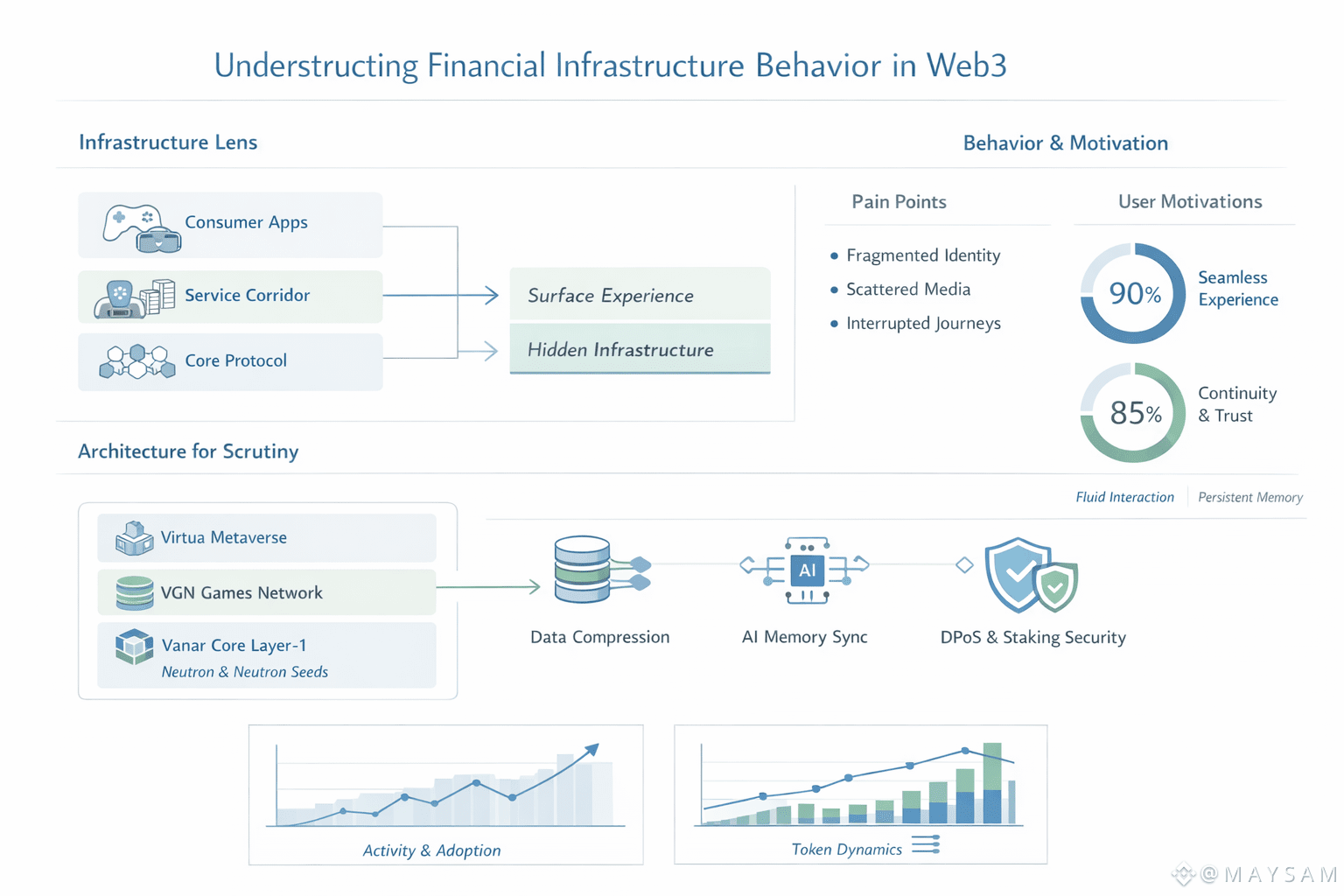
Vanar makes a quiet, almost unglamorous bet: people don’t want to understand Web3. They want it to stop interrupting their lives.
Most blockchains talk like they’re selling a future. Vanar behaves like it’s maintaining a present. It’s less “look what we built” and more “you shouldn’t even have to notice this is here.”
That mindset shows up everywhere once you look for it.
Vanar didn’t start as a blank-slate experiment chasing the latest narrative. It grew out of Virtua’s earlier ecosystem, with the VANRY token arriving through a clean, supported 1:1 swap rather than a chaotic reboot. Emotionally, that matters. It signals continuity instead of abandonment. Builders who didn’t walk away from their users. A project that carried its past forward instead of pretending it never existed.
And that past wasn’t DeFi-first. It was human-first. Games. Virtual worlds. Digital places where people already understand ownership, progression, and identity without being taught new words. That’s why Virtua and VGN don’t feel bolted on—they feel like the reason the chain exists at all.
Here’s the part that really separates Vanar from the usual “consumer chain” pitch: it’s obsessed with memory.
Most crypto apps feel like amnesia machines. Every login is a reset. Every platform is a new self. Your history, media, reputation—fragmented, scattered, fragile. Vanar’s focus on structured data, compression, and reusable storage feels like a response to something deeply human: the desire to be remembered without effort.
You can hear that emotional intention in the ecosystem moments that don’t scream marketing. A public demo showing compressed video reconstructed from onchain data isn’t flashy—it’s intimate. It’s asking, “Can rich experiences actually live here without breaking immersion?” A personal AI memory layer isn’t about buzzwords—it’s about continuity. About not starting from zero every time you cross a digital border.
Even protocol upgrades tell the same story. When Vanar talks about renewals like V23, the tone isn’t “look how advanced we are.” It’s “this should feel smoother.” Fewer sharp edges. Fewer moments where the system reminds you it’s a system.
And yes, there’s a token. VANRY trades, stakes, circulates. But emotionally, it behaves like infrastructure, not identity. It’s the pressure gauge in the engine room. Important. Necessary. Not the reason anyone shows up.
That’s the uncomfortable truth most projects avoid: users don’t fall in love with blockchains. They fall in love with experiences that don’t make them feel stupid, anxious, or interrupted.
Vanar is trying to be the part of the city nobody thanks. The tunnels that don’t flood. The power that doesn’t flicker. The systems that quietly remember you so the surface world can feel effortless.
If it succeeds, people won’t tweet about it. They won’t explain it to their friends. They’ll just keep playing, creating, exploring—and never once feel the urge to ask what chain they’re on.
And honestly, that might be the most human goal in crypto.