

When we talk about blockchain, many people think only of fast transactions. But what really defines whether a network is mature (and useful in the real world) is the ability to prove what happened, when it happened, and who validated it, without relying on 'blind trust'. That's why I chose to delve into a topic that few people discuss: the audit trail as a product, not just a technical detail.
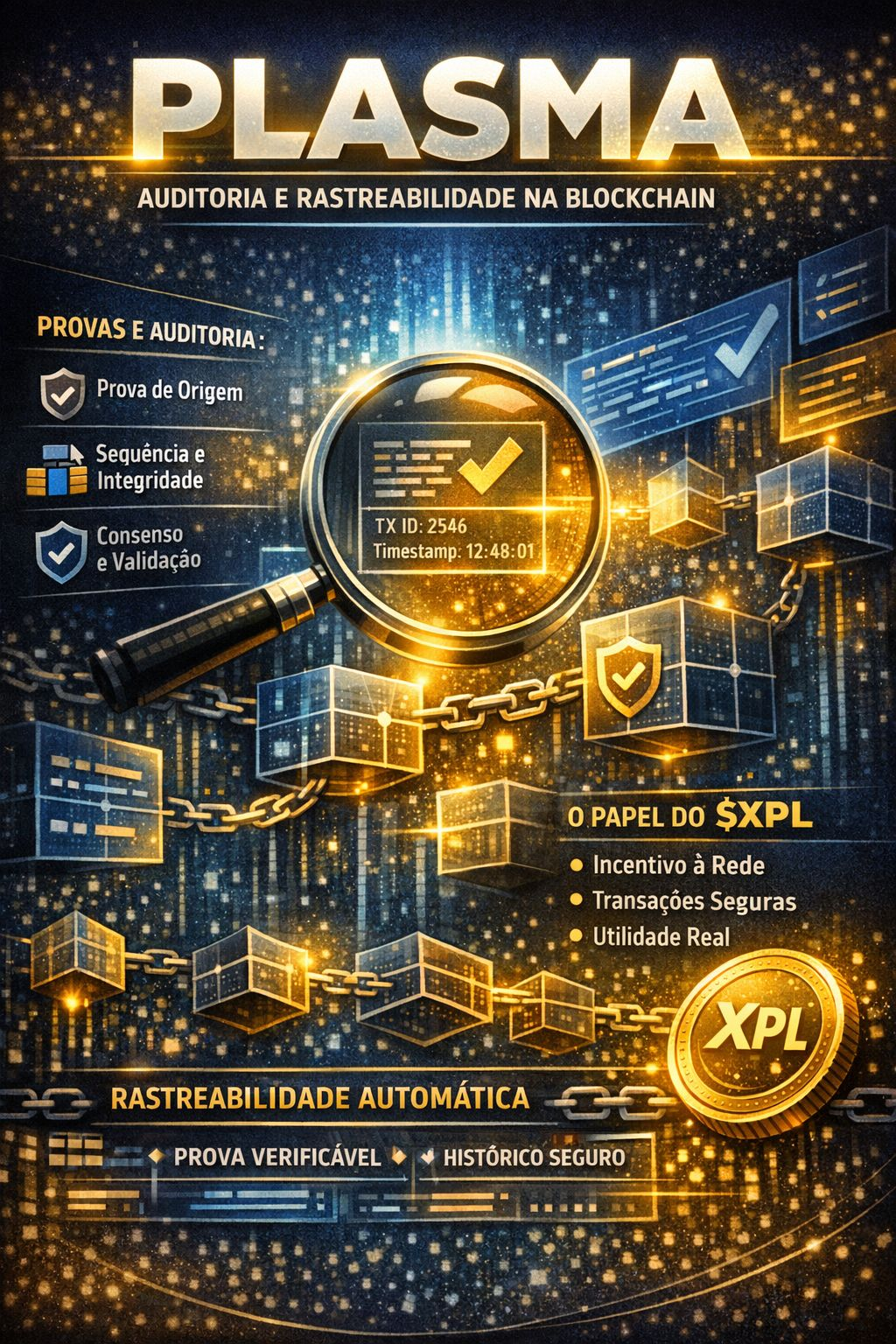
O @Plasma I am building an approach where the network is not just a 'place to transfer tokens', but rather an environment where events can be recorded and verified clearly, something essential for applications that require integrity: payments, traceability, asset issuance, and systems that need reliable history.
The real problem: it’s not speed, it’s verifiability
In many systems, the transaction happens and that’s it. But in practice, what companies and users need is:
proof of origin (where it came from)
proof of sequence (what happened before and after)
proof of integrity (whether it has been altered or not)
proof of consensus (who confirmed and under what rules)
Without this, any 'serious' application becomes a pile of prints, spreadsheets, and manual reconciliation.
How Plasma handles this: record + proof + consistency
The central idea of Plasma is to transform history into something that can be consulted and validated, without noise. Its functioning (at a high level, but with useful details) follows a simple logic:
Event arises (a transaction, a contract action, a data record)
It is packed in a validation block/structure
Consensus ensures that the event entered the chain in an orderly manner
The result becomes a verifiable proof that can be audited
The important point here is: it’s not enough to store. It is necessary to ensure that the storage is reliable and reproducible.
What changes in practice: 'automatic auditing'
This is the kind of detail that separates speculative networks from utility networks.
Instead of someone needing to trust a server, an operator, or a 'report', Plasma allows any interested party to:
validate the authenticity of history
confirm if there were changes
check timestamps and logical sequence
prove execution of rules (contracts)
This drastically reduces the cost of reconciliation, disputes, and 'different versions of the truth'.
Where the ($XPL) fits into this
The token $XPL does not exist just to 'have a price'. It is part of the economic mechanism that supports the functioning:
encourages participation in the network (operations and validation)
keeps the network active with predictable costs
align usage with real demand (the more usage, the more activity)
This type of utility is what gives meaning to the ecosystem: the token circulates because the network is being used, and not just for narrative.
A simple example to understand
Imagine an event recording system (it could be issuing an asset, recurring payments, or even tracking stages of a process). In the traditional world:
someone records in a database
another system replicates
divergence arises
someone 'corrects'
turns into a dispute
In the network model like Plasma:
the event is recorded once
becomes part of the validated history
anyone can verify the same result
the cost of auditing decreases because the proof is already embedded
That’s why I like to view Plasma as an automated trust infrastructure.
Why this topic matters now
The next phase of the market will not reward only 'TPS' or hype. It will reward networks that can:
sustain continuous usage
maintain consistency
deliver verifiability and traceability
allow integration with applications that require proof
And that’s exactly where PLASMA draws attention: it doesn’t try to solve everything with marketing, but rather with a foundation that makes sense when it comes to product and adoption.
If the network continues to evolve in this way, the ($XPL) tends to be increasingly associated with real utility, and not just speculation.