
Nothing announced the end.
I landed on the same layout, the same buttons, the same rules, except this time the “proof” wasn’t a big badge. The activity feed had already flipped to “complete,” while the surface I actually cared about still looked unchanged. What held my attention wasn’t the status. It was that app-state continuity held from the first click to the final state without forcing me into a second experience. The flow just kept its shape.
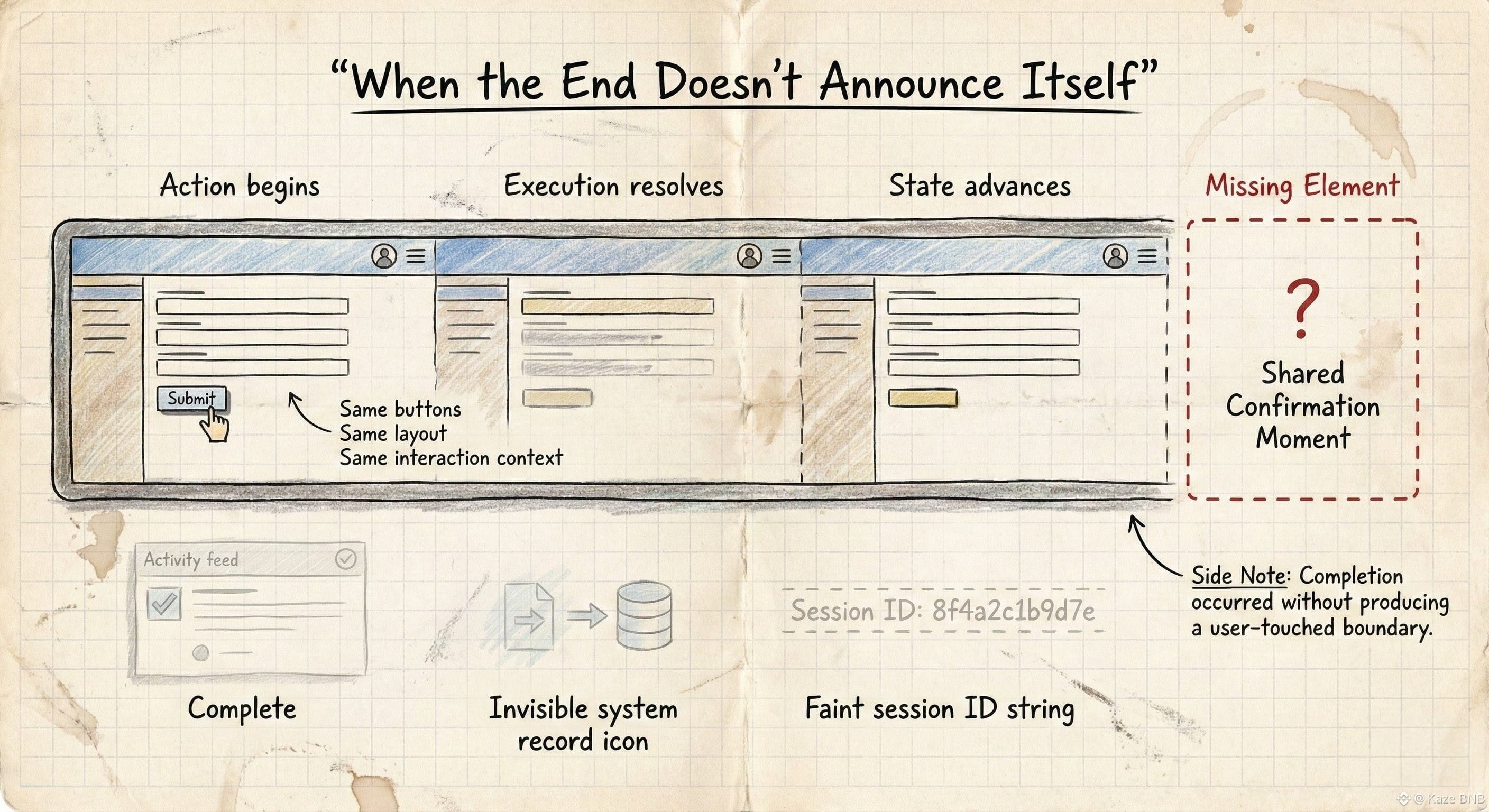
That continuity is intentional on Vanar Chain. On Vanar (@Vanarchain ), completion doesn’t arrive as a ceremony. It arrives as an absence, the absence of interruption, the absence of a second surface hiding behind a new UI layer, the absence of a moment where the system asks me to slow down and acknowledge what just happened.
Most systems do the opposite.
In most consumer adoption attempts, the invisible infrastructure stops being invisible at the worst time: right when I think I’m finished. A confirm screen. A wallet step. An approval ritual. A pause that reframes the interaction from “using something” into “operating something.” That’s usually where the flow breaks, and where the interaction changes shape at the exact moment it should be closing.
On Vanar, that moment never shows up.
Execution resolves inside a single application state. The underlying work happens, but it never creates a user-facing boundary I have to cross. There’s no role shift, no demand for attention at completion, no wallet-shaped interruption where I have to suddenly act like an operator instead of a user. The action stays where it started, inside the same set of rules.
In mainstream workflows, that matters more than it sounds.
So Vanar keeps things boring.
One place.
One flow.
One uninterrupted path from action to outcome.
That boredom is not accidental. A settlement-like UX preserves momentum. Real-world repetition depends on it. A distribution network wants repetition, not pauses. Gaming vertical behavior wants loops, not rituals. On Vanar, app-native execution feels boring on purpose and boring is usually what mainstream behavior needs if you want the action to keep happening without friction.
But boredom has a side effect.
When nothing marks the moment, nothing becomes easy to reference later.
I don’t notice this while the interaction is happening. I notice it afterward, when certainty is requested instead of progress. When someone asks which action counted, where the confirmation lives, or how to point to the exact moment responsibility shifted.
The interface has an answer: it says the task is complete.
The system has an answer too, somewhere deeper.
What’s missing is the shared boundary between them.
That’s where support questions start to stretch. “Did it go through?” becomes “the feed says it did,” and that’s the whole artifact. Not because anyone doubts execution, but because there’s no user-touched confirmation moment. No shared receipt point that feels natural to forward. Operational clarity has to be reconstructed later, which is slower than it sounds, because people don’t argue about the action, they argue about the missing boundary.
This is where integrations quietly feel the pressure.
If a team needs stable markers for auditing, replay, or escalation, the product has to decide where a reference lives without ruining the flow that made it usable in the first place. When continuity is prioritized over ceremony, those markers don’t disappear but they also don’t show up as a “step.” They surface later as reconstruction work. As records pulled after the fact. As reference strings requested once the moment has already passed.
The cost isn’t visible during use.
It shows up downstream, as coordination.
Inside entertainment-grade loops, the kind that power Virtua Metaverse or run through the VGN Games Network, momentum isn’t a luxury. It’s the contract. Loops survive by staying continuous. The instant an “extra step” appears, I’m pushed into a decision I didn’t come for, and the flow loses its shape. In environments like Virtua and VGN, pauses don’t feel protective. They feel like drop-off.
Even the presence of Vanar ($VANRY ) in the ecosystem doesn’t change that dynamic. A token name doesn’t create a boundary. A label doesn’t substitute for a moment. Responsibility only becomes legible where a system chooses to pause and Vanar largely refuses to.
The result is an experience that finishes without announcing itself. The flow completes. I keep moving. Everything behaves exactly the way mainstream workflows expect it to.
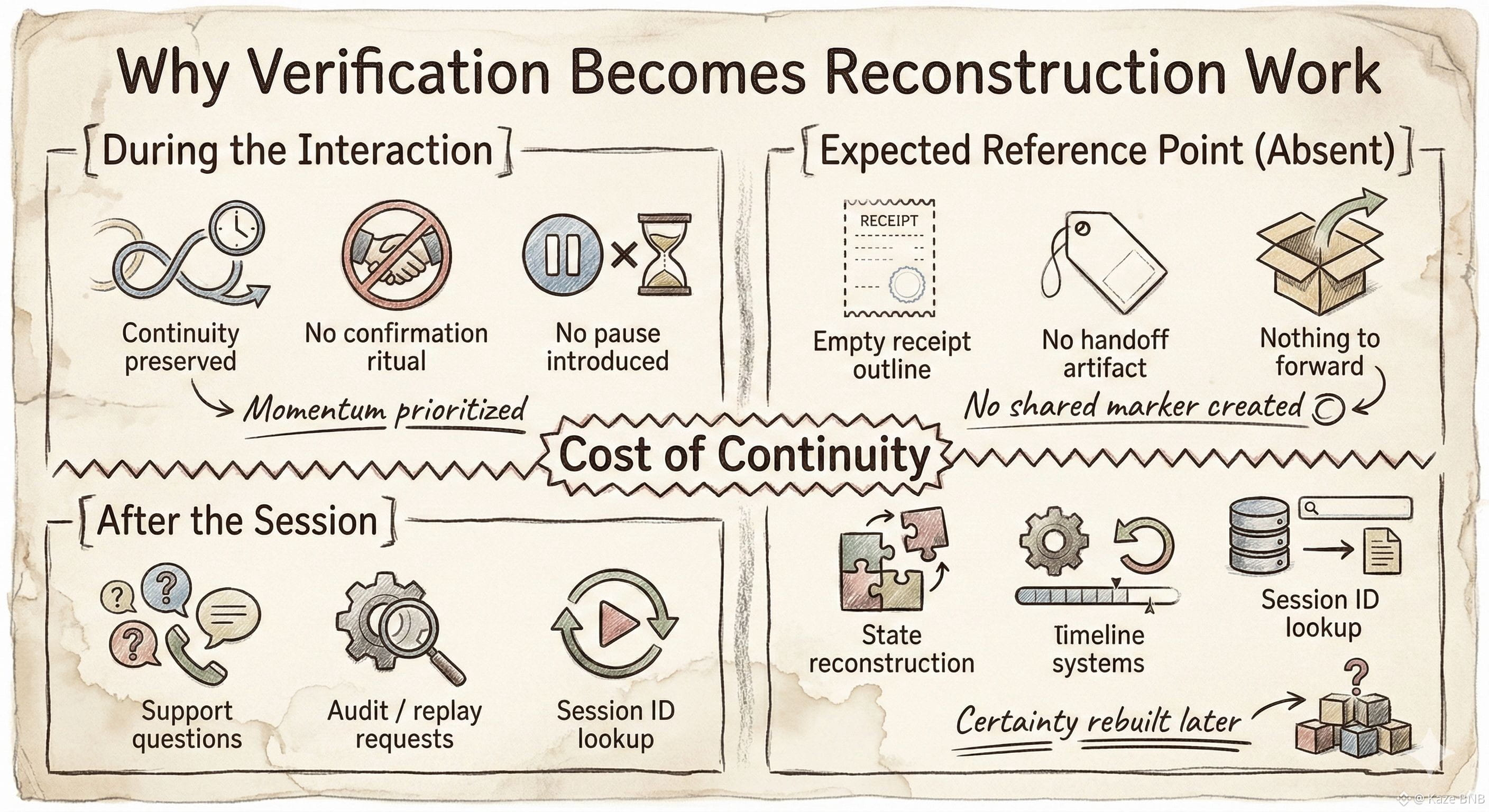
And the missing step stays missing.
The system remembers.
The interface doesn’t ask me to.
So the question lingers, unanswered and slightly uncomfortable:
If completion never produces a handoff point anyone can cite, what counts as the receipt when someone asks for certainty later?