
used to roll my eyes a bit whenever a project tried to sell “privacy + compliance” in the same sentence. Most teams treat privacy like a blackout curtain: either everything is hidden, or everything is public. Dusk feels closer to a dimmer switch. It’s built around the idea that you can keep normal financial behavior private by default, but still produce the specific evidence an auditor or regulator needs when the moment calls for it. You can see that philosophy spelled out in how Dusk describes its two native transaction models Moonlight for transparent, account-style flows, and Phoenix for shielded, note-based flows backed by zero-knowledge proofs, with selective disclosure via viewing keys when required. What made this click for me wasn’t the theory. It was the on-chain “body language.” As of February 4, 2026, the Dusk explorer’s 24-hour snapshot showed 170 transactions total, with 162 Moonlight and 8 shielded, and a 0.0% failure rate (plus an average fee around 0.019882 DUSK and gas price in LUX). That mix is telling: the network is currently being used mostly in the “everyone can see it” lane, with the private lane used less often. I don’t read that as a weakness. I read it as the early shape of adoption for anything targeting institutions: people start with the simplest, most legible flow, and only later reach for confidentiality once the operational workflows and counterparties exist.Blocks paint a similar picture of steady “infrastructure rhythm.” The explorer’s blocks page reports ~10.0s average block time over 24h and 8,639 blocks in that window (with the latest block and epoch counters moving along consistently). For regulated finance, that kind of predictability matters more than flashy peak TPS claims, because compliance teams don’t care what happens on a perfect day they care what happens on an ordinary Tuesday.
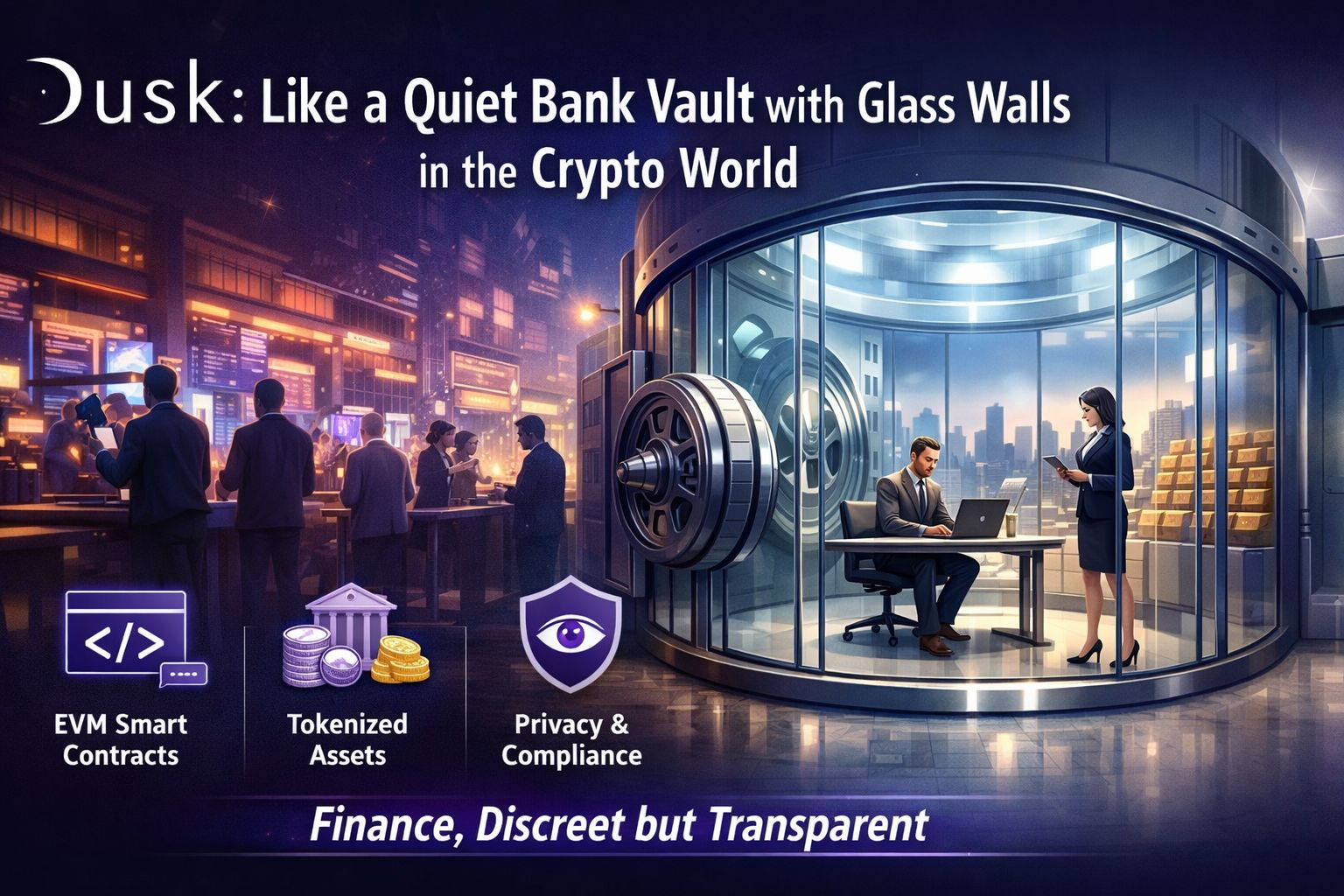
The Moonlight/Phoenix split also gives Dusk a very practical advantage that doesn’t get enough attention: it lets applications choose how observable they need to be on a per-flow basis, instead of forcing the whole system into one disclosure posture. Moonlight behaves like a familiar account model (balances and transfers visible), which makes integrations and reporting straightforward. Phoenix flips the mental model: funds are encrypted “notes,” and transactions prove correctness without exposing amounts or linkable flows while still supporting selective reveal via viewing keys. That’s basically how a lot of real markets operate in the real world: your broker doesn’t publish your positions to the internet, but you can still produce statements when needed.
Token utility becomes more interesting in this context, because DUSK isn’t just “gas.” In the docs, DUSK is positioned as the incentive and fee asset: staking for consensus participation, rewards, network fees, deploying dApps, and paying for services. Tokenomics-wise, the project documents a 500,000,000 initial supply and another 500,000,000 emitted over 36 years to reward stakers, for a 1,000,000,000 maximum. Staking details are spelled out in a very “ops-minded” way: minimum 1,000 DUSK, stake maturity of 2 epochs (4,320 blocks), and no waiting period or penalties for unstaking. Even the fee unit choice feels intentional: gas price is denominated in LUX (1 LUX = 10⁻⁹ DUSK), which makes it easier to express tiny fees without turning user interfaces into a decimal nightmare.
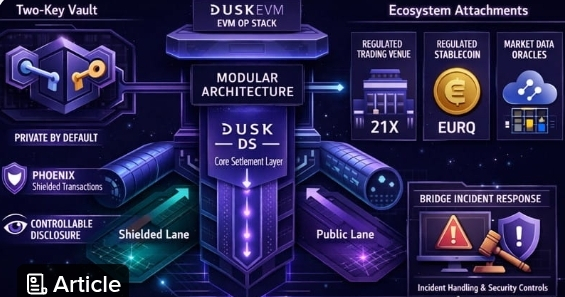
Where things get especially “institutional” is Dusk’s modular direction. The project describes evolving into a three-layer setup: DuskDS as consensus/data availability/settlement, DuskEVM as the EVM execution layer, and a forthcoming privacy layer (DuskVM). It explicitly says one DUSK token fuels all layers, and that a validator-run native bridge moves value across the stack without wrapped assets or custodians. I think of this like designing a financial district: you want the courthouse (settlement) to be boring and consistent, while the storefronts (apps) can change fast without constantly rewriting the legal code underneath.DuskEVM’s own docs are refreshingly candid about the tradeoffs. It uses an OP-Stack style architecture and settles using DuskDS rather than Ethereum. Right now it “inherits” a 7-day finalization period as a temporary limitation (with a stated plan to move toward one-block finality later), and its network info table shows Mainnet “Live: No” while Testnet is live. It also notes there is no public mempool the mempool is only visible to the sequencer, which executes transactions in priority-fee order. Those aren’t minor details; they’re design choices with real consequences. A non-public mempool can reduce certain information leaks and some MEV-style predation, but it concentrates sequencing visibility. A 7-day finalization window changes how you’d structure “this is final” guarantees for regulated settlement and risk management. The fact that Dusk documents these constraints plainly is, in itself, a signal about the kind of users they’re courting.
Interoperability is where theory meets messy reality, and Dusk has been pushing on that too. The two-way bridge update (mainnet ↔ BSC) describes a simple, utilitarian user promise move value where it’s convenient backed by explicit mechanics: mainnet locks trigger minting on BSC, with a 1 DUSK fee and transfers that can take up to 15 minutes. That’s “plumbing,” not glamour, but plumbing is what turns a chain from a demo into something people can route value through.
And then there’s the part of blockchain reality everyone tries to avoid talking about: incidents. On January 17, 2026, Dusk posted a Bridge Services Incident Notice describing monitoring that flagged unusual activity tied to a team-managed wallet used in bridge operations, a precautionary pause of bridge services, recycling related addresses, coordination with Binance once a flow touched their platform, and a web wallet mitigation (a recipient blocklist warning system). It also states it was not a protocol-level issue on DuskDS and that, based on information at the time, no user funds were impacted. I’m not bringing this up for drama; I’m bringing it up because regulated finance judges systems by containment behavior. “We paused, isolated, coordinated externally, and shipped a user-facing mitigation” is the kind of response pattern compliance departments recognize.
The ecosystem story gets more concrete when you look at the triangle Dusk is trying to assemble: a regulated venue, a regulated “money leg,” and regulated data/interoperability.For the venue side, NPEX explicitly states it’s an investment firm with an MTF and ECSPR license from the Netherlands Authority for the Financial Markets, and that it’s under continuous supervision by both the AFM and De Nederlandsche Bank.
For the money leg, Quantoz Payments published a February 19, 2025 post saying the three organizations are working together to release EURQ, describing it as designed to be MiCAR compliant and framing it as the first time an MTF-licensed stock exchange would utilize electronic money tokens via a blockchain. An independent industry outlet, Ledger Insights, echoes the key classification point: EURQ is described as a MiCAR-compliant euro stablecoin and “technically” an electronic money token (EMT), tied to NPEX and Dusk collaboration. For the data/interoperability leg, Dusk’s November 13, 2025 post says that together with NPEX they’re adopting Chainlink standards including CCIP, DataLink, and Data Streams, explicitly positioning them as tools for cross-chain movement and for bringing “official” exchange data and low-latency price updates on-chain.
Put differently: Dusk isn’t just trying to tokenize assets. It’s trying to assemble the three things every serious market needs an exchange venue, a settlement asset that behaves like money, and a reliable “ticker tape” for data while keeping participant behavior confidential by default. That’s a much harder problem than “launch an RWA token,” but it’s also the difference between a tokenized asset existing and a tokenized asset trading like it belongs in finance.
If you want an organic way to track whether the thesis is working, I’d watch three boring signals.First, does the ratio of Moonlight vs shielded usage start to change over time, and does it do so alongside credible applications (not just random spikes)? The current 24-hour mix still leans heavily Moonlight.
Second, do the “plumbing” components reopen and hardenespecially bridging without introducing new trust assumptions? The incident notice explicitly says bridge services were paused pending hardening. Third, does DuskEVM move from “Mainnet Live: No” to live status, and do the temporary constraints (like the inherited 7-day finalization period) narrow in a way that fits institutional settlement expectations?
Dusk’s pitch only becomes real when it stops being a narrative and starts being routine: ordinary blocks, ordinary settlements, private when you want them, explainable when you need them. That’s not the loudest kind of progress but for the kind of markets Dusk claims it wants to host, it’s the only kind that counts.