The first time I really thought about where my data lives, it was because a cloud account locked me out. Nothing dramatic. No hackers. Just a “please verify your identity” loop that never ended. Photos, documents, half-finished ideas — all technically mine, yet completely unreachable. I remember staring at my screen with coffee going cold, thinking, This can’t be the best we’ve come up with.
That frustration is what makes projects like Walrus feel less like abstract crypto experiments and more like a natural evolution.
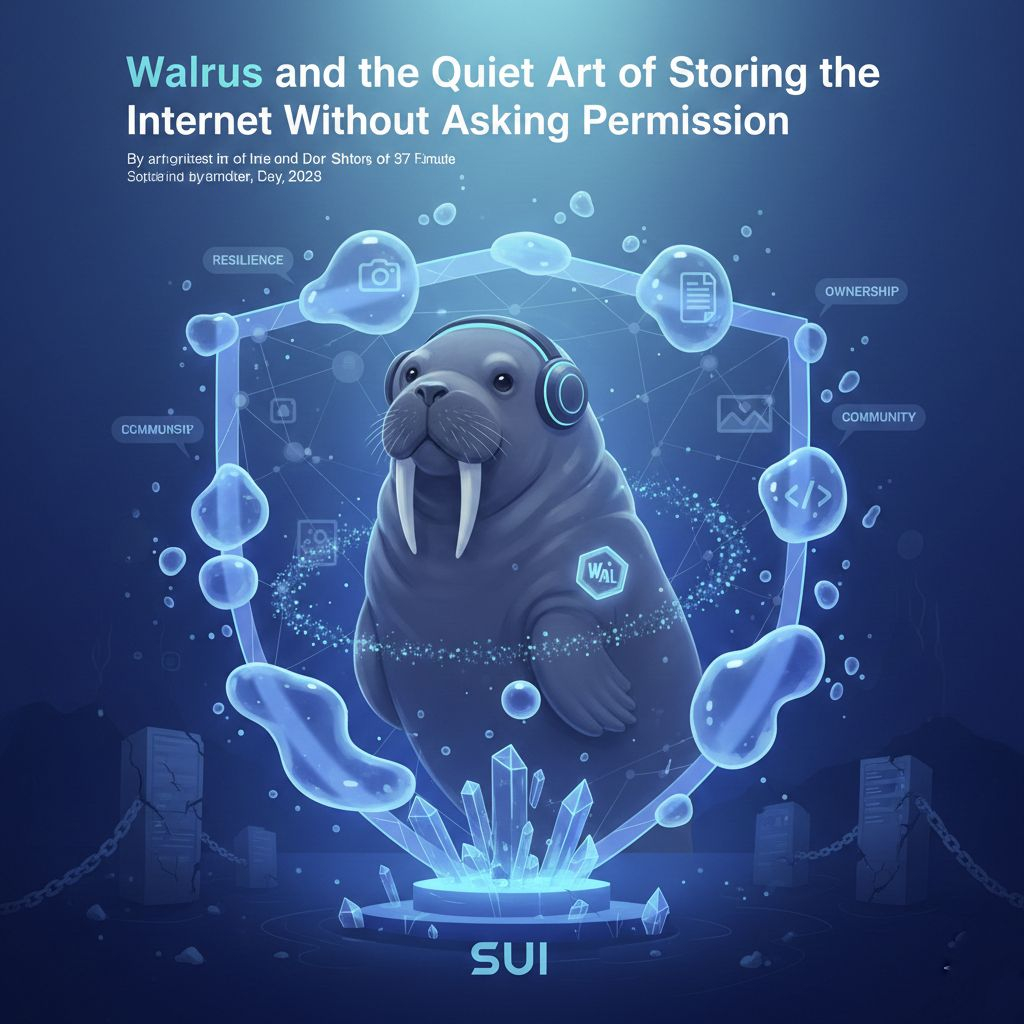
Walrus isn’t loud about what it is. It doesn’t scream promises or throw buzzwords at you. At its core, it’s about something surprisingly simple: giving people a way to store large amounts of data without trusting a single company, server, or gatekeeper. Built on the Sui blockchain, Walrus spreads files across a decentralized network using erasure coding and blob storage, which sounds technical until you realize it’s just a smarter way of sharing responsibility.
Instead of making endless full copies of a file and hoping nothing breaks, Walrus slices data into encoded pieces and distributes them. Lose a few pieces? No problem. The file still comes back whole. It’s a bit like writing a secret in a way where you don’t need every scrap of paper to remember the message. Enough fragments, and the truth reappears.
What I love about this approach is how quietly confident it is. There’s no panic about outages or censorship because the system expects things to fail sometimes. Nodes go offline. Networks wobble. Life happens. Walrus is built with that reality in mind, not against it.
The WAL token fits into this in a practical, almost unromantic way — which I mean as a compliment. It’s used to pay for storage, reward the people who keep data available, and give users a voice in how the protocol evolves. No mystery. No forced hype. Just incentives lining up with actual work being done.
There’s also a subtle elegance in how Walrus treats data as something programmable. Files aren’t just dumped into storage and forgotten. They become objects that apps can interact with directly on-chain. Permissions, availability, verification — all part of the same system. For developers, that opens doors. For regular users, it quietly removes friction they didn’t realize they’d been tolerating for years.
I think about creators a lot when I think about Walrus. Writers, filmmakers, researchers, even small teams training AI models. People who deal with massive files and don’t want their work tied to a single platform’s rules or pricing mood swings. With Walrus, storage costs are designed to be predictable, closer to real-world pricing than token rollercoasters. That matters more than flashy features ever will.
There’s something emotionally reassuring about knowing your data isn’t sitting in one fragile place. It’s scattered, resilient, and recoverable. Like a memory shared among friends instead of locked in a single diary.
Walrus doesn’t promise a perfect world. Decentralized systems are messy. They require patience, thoughtful design, and community buy-in. But they also feel honest. They acknowledge that trust should be earned through structure, not branding.
If you’re just backing up vacation photos, you might never notice the difference. But if you care about ownership, censorship resistance, or building applications that don’t depend on a single company staying benevolent forever, Walrus quietly makes a strong case for itself.
Sometimes progress isn’t loud. Sometimes it looks like a calmer, more thoughtful way of doing something we already rely on every day. Walrus feels like that — not a revolution shouted from rooftops, but a steady, deliberate shift toward an internet that doesn’t ask permission to remember.