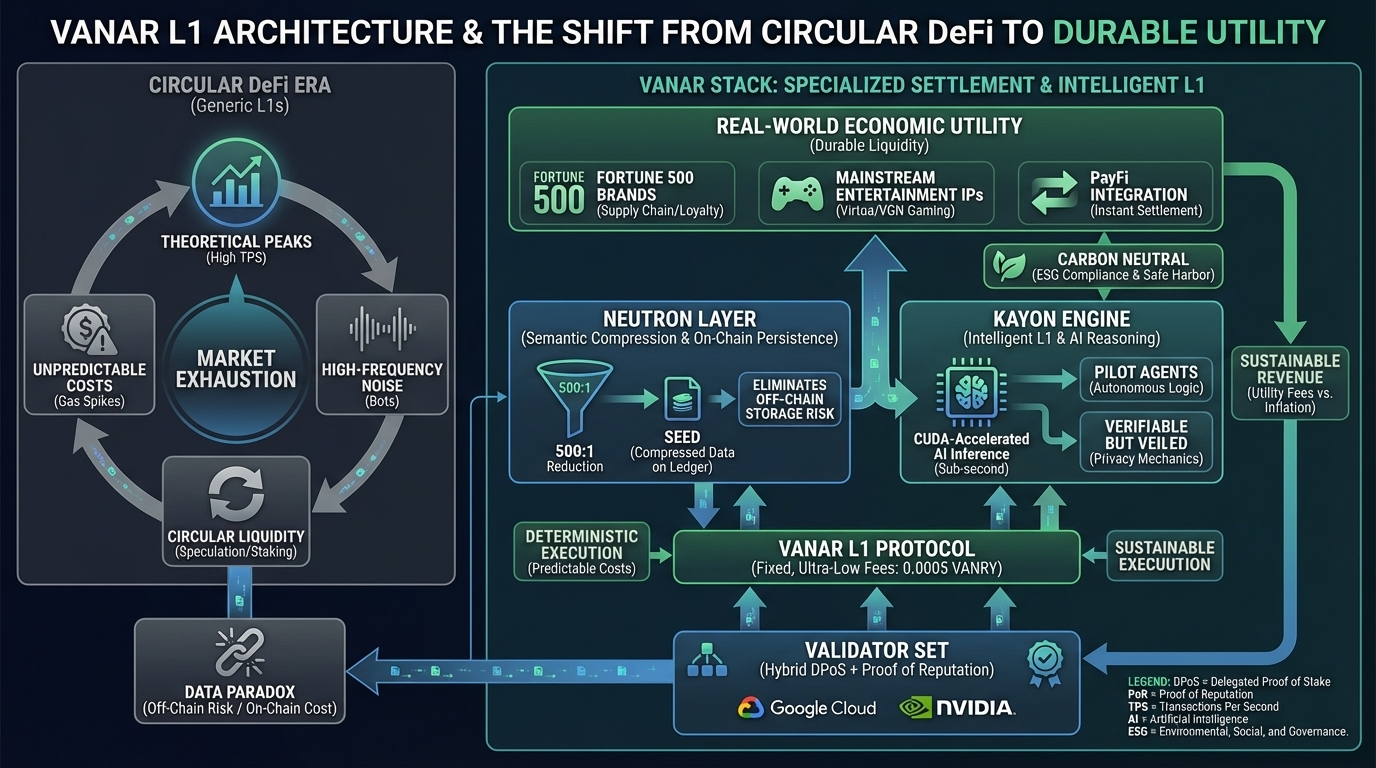
@Vanarchain . The current market exhaustion with generic Layer-1 scaling solutions highlights a fundamental disconnect between technical throughput and actual economic utility. For years, the industry has chased theoretical peaks hundreds of thousands of transactions per second while ignoring the reality that most of that capacity remains empty or filled with the high-frequency noise of arbitrage bots. Vanar enters this landscape not as another entrant in the "TPS arms race," but as a specialized settlement layer designed to solve the specific friction points that have kept Fortune 500 brands and mainstream entertainment IPs confined to the walled gardens of Web2.
The structural weakness of general-purpose blockchains lies in their unpredictability. For an enterprise or a global gaming network, an L1 that allows a viral NFT mint or a DeFi exploit to spike gas fees by 1,000% is a failed piece of infrastructure. Vanar addresses this by decoupling the traditional relationship between network congestion and execution cost. By implementing a fixed, ultra-low transaction fee of 0.0005, the protocol shifts the risk of volatility from the end-user and the developer to the network's internal economic stabilizers. This isn't just a marketing gimmick; it is a fundamental shift in capital efficiency. It allows for the budgeting of millions of micro-transactions the lifeblood of modern gaming and AI agent interaction with a degree of certainty that traditional Ethereum compatible chains simply cannot offer.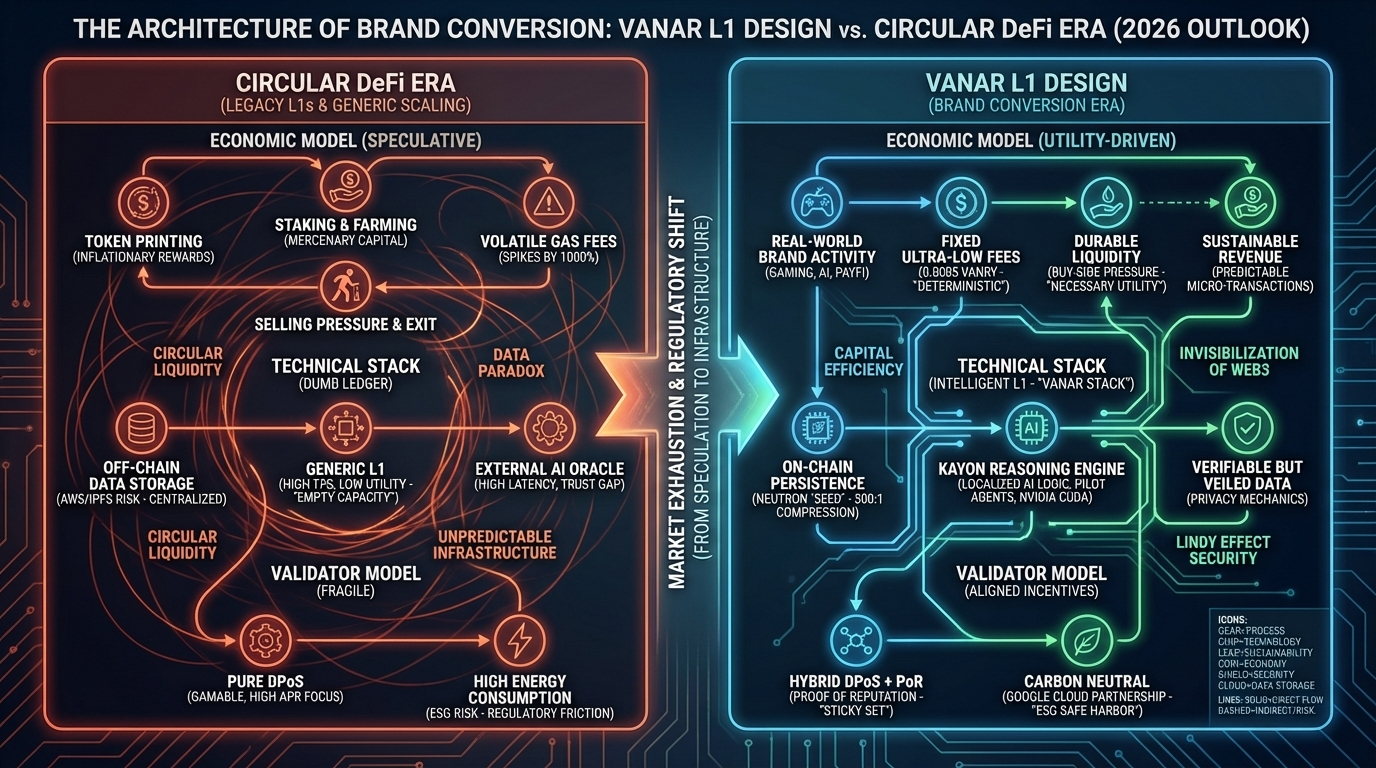
To understand Vanar’s long-term sustainability, one must look past the "gaming and AI" buzzwords and analyze the "Vanar Stack." The architecture is tiered to handle what I call the "Data Paradox" of modern Web3: the fact that storing meaningful data on-chain is prohibitively expensive, yet storing it off-chain (on IPFS or AWS) introduces centralization risks that negate the purpose of using a blockchain. Vanar’s Neutron layer introduces a semantic compression mechanism that claims a 500:1 reduction ratio. From an analyst’s perspective, this isn't just about saving space. It represents a move toward "on-chain persistence." If a legal document, a high-fidelity game asset, or an AI’s memory state can be compressed into a "Seed" and stored directly on the ledger, the settlement risk associated with third-party storage providers disappears. We saw the catastrophic impact of the 2025 AWS outages on the broader crypto ecosystem; Vanar is essentially building an insurance policy against the fragility of the legacy cloud.
The transition from Terra Virtua (TVK) to the VANRY token was more than a rebrand; it was a pivot in validator economics. In the previous cycle, the focus was on NFT provenance. In the current 2026 market, the focus is on "Physical Economy" integration. The Vanar validator set, supported by giants like Google Cloud and NVIDIA, operates on a hybrid model of Delegated Proof of Stake (DPoS) and Proof of Reputation (PoR). This is a critical distinction for institutional adoption. A pure DPoS system can be gamed by mercenary capital liquidity that arrives for high APR and leaves at the first sign of a better yield elsewhere. By incorporating Reputation, Vanar aligns the incentives of its node operators with the long-term health of the brands they serve. A validator isn't just securing a ledger; they are securing a supply chain, a gaming economy, or a brand’s digital loyalty program.
This alignment of incentives directly affects capital flow. Traditional L1s suffer from "circular liquidity," where the only thing to do with a native token is to stake it or trade it for another speculative asset. Vanar is designed to pull "Durable Liquidity" from the real-world economy. When a brand like Shelby American or a studio like Paramount utilizes the Vanar Chain, they aren't just speculating on VANRY; they are consuming it as a necessary utility for their operations. This creates a buy side pressure that is tied to real-world activity rather than market sentiment. If 100 million mobile gamers are making three on-chain moves a day, the aggregate demand for gas becomes a predictable, non-speculative revenue stream for the network.
The Kayon Engine and the Rise of On-Chain Reasoning
The introduction of the Kayon reasoning engine within the Vanar Stack marks the arrival of the "Intelligent L1." Most blockchains are "dumb ledgers" they record that an event happened but have no internal logic to understand why or to adapt to it. Kayon allows smart contracts to interface directly with compressed semantic data. This is where the intersection of AI and blockchain becomes tangible. In most architectures, AI is an external oracle that pushes data to the chain, creating a massive latency bottleneck and a trust gap. In Vanar, the AI logic is localized.
Consider the implications for the VGN games network. Traditional Web3 games struggle because every action requires a signature and a wait time, breaking the "flow state" of play. With Kayon, the chain can handle "Pilot Agents" autonomous entities that manage a player's inventory, execute trades in the background, or even evolve based on in game behavior, all while maintaining the security of the underlying ledger. The computational cost of these agents is traditionally high, but Vanar’s integration of NVIDIA’s CUDA accelerated stacks into its validator infrastructure allows for sub-second AI inference. This is a level of vertical integration that we haven't seen since the early days of centralized gaming consoles, yet it is being executed in a decentralized environment.
The privacy mechanics of this system are also worth noting. For an institutional player, total transparency is often a bug, not a feature. Legal documents or proprietary AI models cannot be blasted onto a public ledger for competitors to scrape. The Neutron "Seed" system, combined with Kayon’s reasoning, allows for a "Verifiable but Veiled" data structure. A brand can prove the validity of a transaction or the ownership of an asset without revealing the underlying sensitive metadata. This addresses one of the primary constraints that has kept corporate legal departments from greenlighting public blockchain initiatives.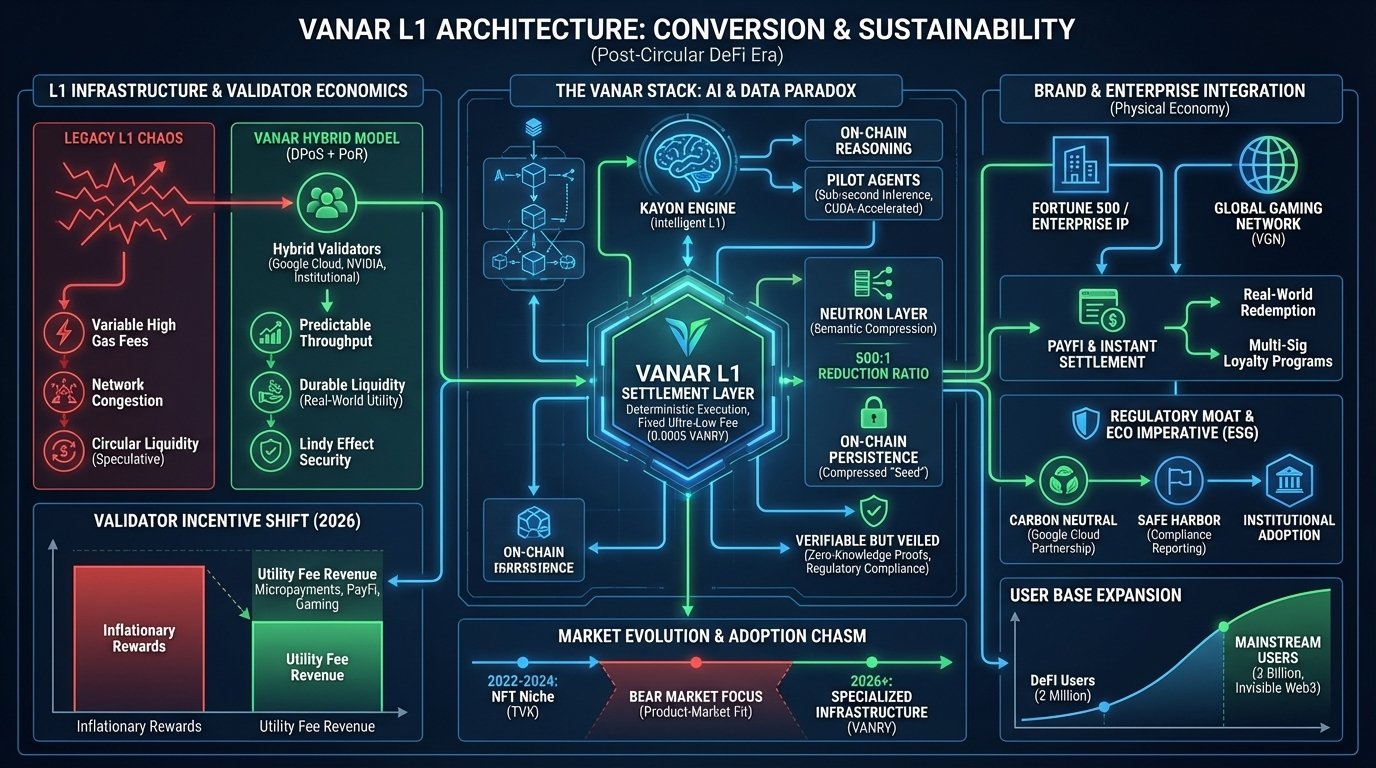
Regulatory Moats and the "Eco" Imperative
In the current regulatory climate of 2026, the "Green" narrative has shifted from a PR preference to a compliance requirement. As global carbon tax frameworks and ESG (Environmental, Social, and Governance) reporting become standardized for publicly traded companies, the energy profile of an L1 becomes a binary filter. If a chain isn't carbon neutral, it is effectively invisible to the world’s largest pools of capital. Vanar’s collaboration with Google Cloud to ensure its infrastructure runs on renewable energy isn't just an environmental choice; it’s a strategic moat.
This "Vanguard" approach to sustainability provides a "Safe Harbor" for brands. When a company deploys on Vanar, they inherit the chain’s carbon credits and transparency metrics. This solves a massive "Hidden Cost" of blockchain adoption: the reputational and regulatory risk of being associated with energy-intensive networks. For a serious analyst, this is a "Top-Down" adoption driver. We are seeing a silent shift where capital is migrating not necessarily to the fastest chain, but to the most "Compliant" chain. Vanar’s ability to provide real-time energy tracking on-chain is the kind of technical detail that seems minor to a retail trader but is a "Must-Have" for a Chief Sustainability Officer at a global brand.
Furthermore, the settlement design of Vanar is optimized for what the industry now calls "PayFi" the intersection of traditional payment flows and decentralized finance. Unlike the "Rebase" or "Algorithmic" models that failed in previous years, Vanar’s settlement is grounded in a deterministic execution model. Every transaction has a predictable path and a fixed cost. In a high-volume environment, this determinism is the difference between a functional economy and a chaotic one. It allows for the creation of complex, multi-sig brand loyalty programs where the "Rewards" are actually on-chain assets with real-world redemption value, settled instantly and at a cost that doesn't eat the underlying margin.
Validator Economics and Long-Term Network Security
The viability of any L1 ultimately rests on the health of its validator set. If it is too expensive to run a node, the network centralizes. If the rewards are too low, the network becomes insecure. Vanar’s tokenomics, with a capped supply of 2.4 billion VANRY and a significant portion allocated to node rewards (~83% in the long-term distribution plan), suggests a heavy lean toward network security and decentralization over time.
However, the real genius of the model lies in how it handles the "Inflationary Death Spiral." Most new L1s pay their validators by printing more tokens, which devalues the token and eventually forces validators to sell, crashing the price. Vanar's strategy is to replace inflationary rewards with "Utility Fees." As the ecosystem grows through Virtua and VGN, the sheer volume of transactions at 0.0005 per tx begins to outweigh the need for token emissions. For a validator, 1,000,000 transactions a day at a microscopic fee is more sustainable and predictable than waiting for the next unlock of a volatile token.
The "Proof of Reputation" layer adds a final level of protection against the "Sybil Attacks" that plague smaller chains. In Vanar, your stake is your collateral, but your reputation earned through uptime, performance, and contribution to the ecosystem is your multiplier. This creates a "Sticky" validator set. Once an entity like Worldpay or a major gaming studio sets up a node on Vanar, they are financially and reputationally disincentivized to leave. This creates a "Lindy Effect" for the network: the longer it stays up and the more brands it attracts, the more secure and valuable it becomes.
The 2026 Outlook: From Speculation to Infrastructure
Looking at the on-chain data, we see the transition in real-time. The "Active Address" count on Vanar is increasingly dominated by "Mainstream Wallet" signatures users who likely don't even know they are using a blockchain. They are playing a game on the VGN network, or interacting with a virtual showroom in the Virtua Metaverse. This is the "Invisibilization" of Web3. The successful blockchain of the future won't be a destination; it will be the plumbing.
Vanar has successfully navigated the "Chasm" that swallows most crypto projects. It moved from a niche NFT platform to a comprehensive L1 stack. It survived the 2022-2024 bear market by focusing on product-market fit rather than just "Number Go Up" mechanics. As an analyst, when I look at Vanar, I don't see a "Gaming Coin." I see a specialized infrastructure play that has identified a massive gap in the market: the need for an enterprise ready, AI-native, and carbon neutral settlement layer.
The risk, of course, is execution. Building a "Full Stack" L1 from the base ledger to the AI reasoning engine to the storage layer is an immense technical undertaking. But the structural advantages are clear. Vanar isn't fighting for the same 2 million DeFi users that every other chain is chasing. It is building the infrastructure for the next 3 billion. In a market that has finally grown tired of "Shiny Object Syndrome," Vanar’s focus on the boring, difficult, and essential work of infrastructure reality is exactly why it remains one of the few projects worth watching as we move into the second half of this decade.