

Jerome Powell recently commented on the projections of the FED, and the tone was clearly hawkish.
At this stage, only one rate cut is expected for 2026, with the dot plot remaining unchanged for now. The Fed has not raised the possibility of rate hikes, but it is important to keep in mind that this scenario cannot be ruled out.
Inflation remains the central issue.
The Fed cannot act decisively while inflation remains sticky, especially as projections have been revised upward to 2.7% for 2026. The Fed expects inflationary pressures to rise again, partly due to the sharp increase in oil and natural gas prices linked to tensions between the U.S. and Iran.
At the same time, the labor market is beginning to show early signs of weakness while economic growth is slowing. As a result, the risk of stagflation is once again entering the discussion.
Such an environment is not favorable for risk assets, including Bitcoin.
This pessimism, combined with geopolitical concerns, is once again strengthening the dollar and pushing treasury yields higher.
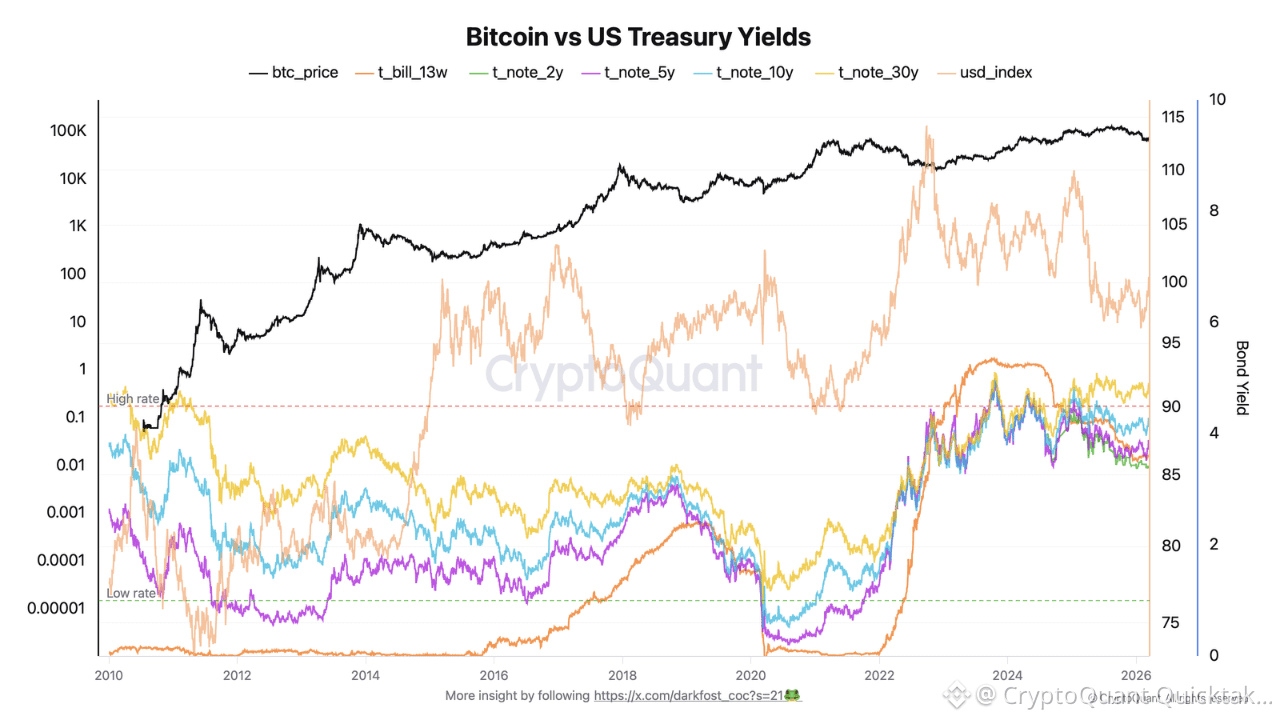
The chart illustrates that periods during which the dollar and treasury yields become too strong tend to create an unfavorable environment for an asset like Bitcoin. Higher interest rates constrain global liquidity. It becomes more difficult to borrow, invest, or finance activity when rates begin to rise again.
With the US30Y yield approaching 5% a key benchmark for mortgage lending and the US10Y yield close to 4.30%, the cost of capital becomes significantly higher.
Finally, if geopolitical tensions persist, these elevated yields could increasingly attract large pools of capital seeking relatively attractive returns with minimal risk. This further diverts already limited liquidity away from other markets.
In other words, the environment remains challenging for Bitcoin, which still struggles to define its place within the broader economic and financial system, somewhere between a store of value and a speculative asset.
Written by Darkfost