Most projects do not admit failure while they are still running. Pixels did.
That is the part worth paying attention to.
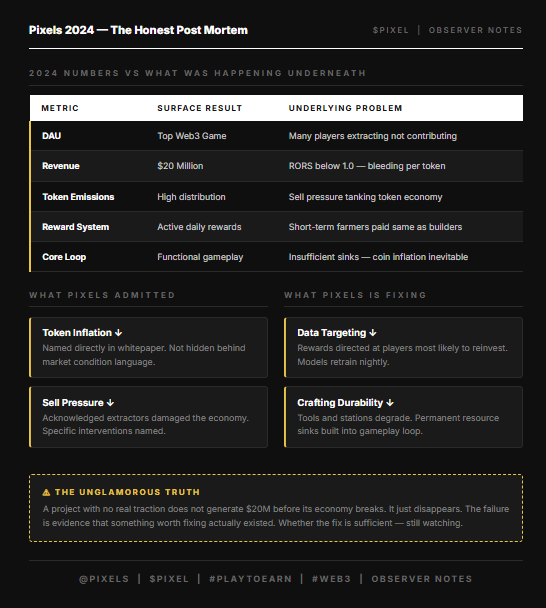
2024 was objectively a strong year on paper. Pixels reached the top position in Web3 gaming by daily active users.
Generated $20 million in revenue. Built one of the most recognized brands in blockchain gaming. By any external metric the project looked like a success story.
Underneath those numbers the economy was quietly breaking.
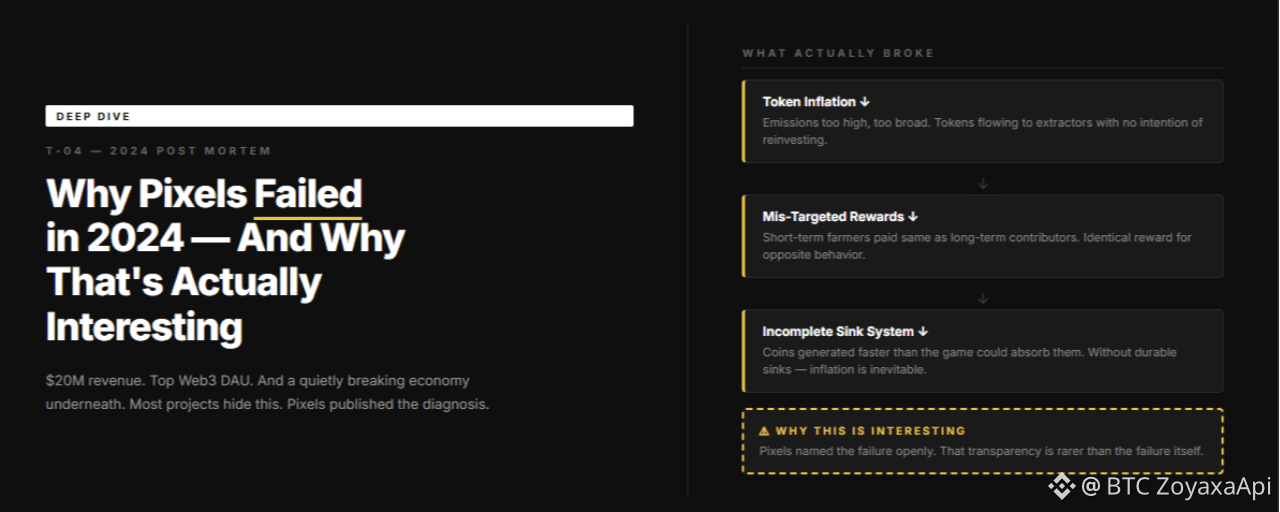
Token inflation was the first visible symptom. Emissions were too high and too broad. Tokens were flowing to players who had no intention of reinvesting them. The sell pressure that followed was not a market problem it was a design problem. The reward system was distributing value to people who were never going to create value back.
The second problem was harder to diagnose. Mis-targeted rewards. The system was paying for short-term engagement instead of long-term contribution. A player who logs in for two weeks, farms aggressively, sells everything, and disappears received the same reward structure as a player building industries, staking tokens, and contributing to ecosystem health.
Those are not equivalent behaviors. Treating them identically was expensive.
The third problem was structural. The core loop had an incomplete sink system. Players were generating coins faster than the game could absorb them. Without durable sinks things that permanently consume resources inflation is not a risk. It is a mathematical certainty.
Here is what makes this interesting rather than just depressing.
Pixels published the diagnosis. Openly. The revised whitepaper does not hide the 2024 problems behind vague language about market conditions. It names token inflation, sell pressure, and mis-targeted rewards directly. Then it explains the specific interventions data-backed targeting, liquidity fees, $vPIXEL, crafting durability, inventory caps, VIP gating.
That level of transparency is genuinely unusual in this space. Most projects pivot quietly and hope nobody notices the old roadmap.
The unglamorous truth is that Pixels built something real enough to fail in interesting ways. A project with no genuine traction does not generate $20 million in revenue before its economy breaks. It just quietly disappears. The failure is evidence that something worth fixing actually existed.
Whether the 2025 interventions are sufficient whether RORS crosses 1.0 before the emission budget creates more damage than the fixes can repair is still an open question.
But the willingness to say what went wrong is a more honest foundation than pretending it did not happen.
I am still watching whether the transparency extends to the fix or whether the diagnosis was just better marketing.
What would make you trust a blockchain project that publicly admitted its 2024 economy failed?