
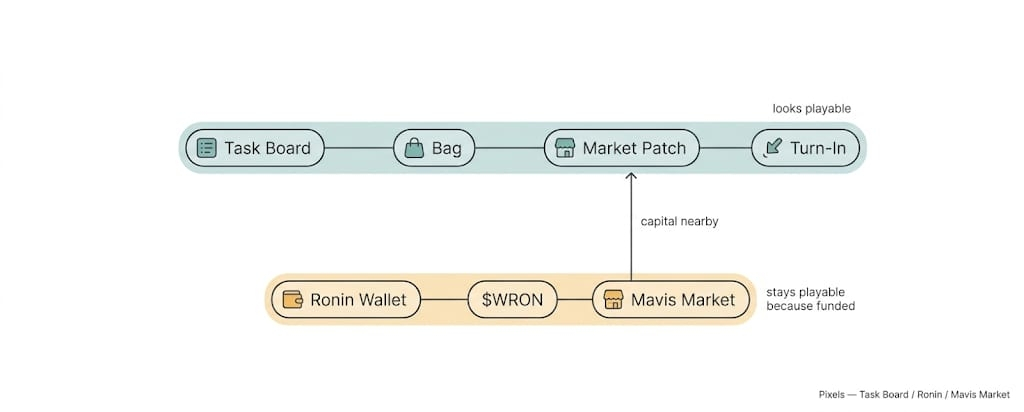


A player clears the task board.
The Pixels system says the day counted.
Great. Now try telling the player the outcome should make sense.
Thats the version of Pixels that keeps bothering me. Not whether the loop executed cleanly. Tasks, energy, Coins landing, visible progression. Fine. Useful. Real system.
The uglier part starts after the system does exactly what it was told.
Because proving a day was played correctly is not the same thing as proving the day deserved the value it ended up with.
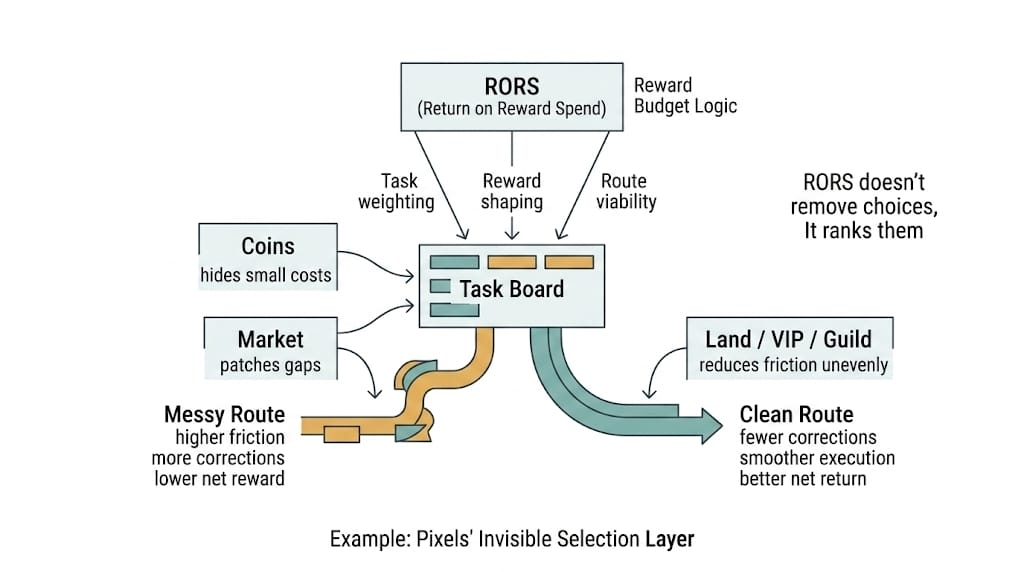
Take a normal route on Pixels. Same chores. Same energy burn. Same path most players would recognize as a standard loop. Coins still land. The board clears. Everything looks correct.
Now the outcome shows up.
One player moves value cleanly.
Another gets less out of the same work.
Or gets delayed.
Or ends up in a thinner lane.
Or runs into a limit that wasn't visible while they were playing the day.
And when they ask why, the answer starts sounding thin very quickly.
Not that the system failed.
Worse
The system worked as designed.
Thats where it gets irritating.
Because bad reward logic enforced cleanly is still bad reward logic. A tight threshold is still tight. A weighting that leans too hard on one signal is still leaning too hard. A routing decision that quietly favors one kind of player over another does not become fair just because the system executed it correctly.
It just becomes harder to argue with.
Pixels can show the work.
It cannot show why the work was valued the way it was.
That’s where it starts smelling bad.
On Pixels the visible loop stays simple, but the value layer sits underneath it. Coins for activity. $PIXEL sitting higher up. Reputation gating certain outcomes. Land, VIP, or route position shifting what the same board actually produces. Stacked routing rewards differently across players. RORS tuning distribution quietly in the background. Maybe the AI layer nudging allocation toward what the system considers efficient.
The system can apply all of that cleanly.
It still doesn’t prove that the combination is right.
Sometimes it’s not even some big structural bias. Worse, honestly. Pixels' Anti-bot thresholds tighten after a bad week. A control meant for edge cases stays in place because nobody wants to be the one who loosens it. A reward weight that made sense during a stress period quietly becomes permanent. The system keeps running. The task board keeps clearing. Outcomes drift.
The logic holds.
The result doesn’t.
Thats the trap.
People see a working loop and relax. The player did the work. Pixels RORS assigned the reward. The process is intact. Good.
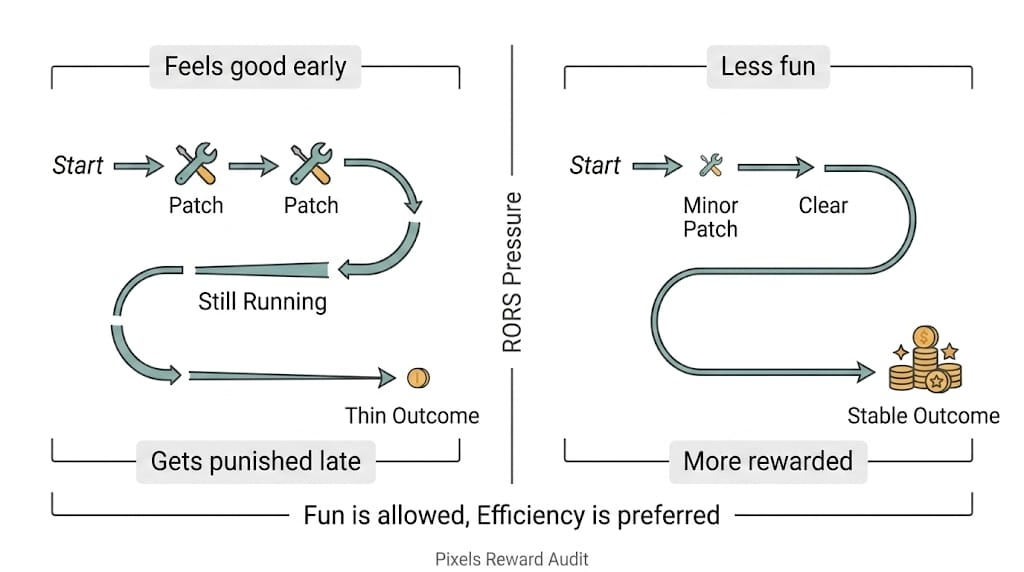
But the loop doesn’t tell you whether the reward logic is calibrated for reality or for the internal pressures that shaped it.
And those pressures change.
Growth wants more days to feel open.
Anti-bot wants fewer to slip through.
LiveOps wants engagement to stay high.
Reward routing wants efficiency.
Everyone says fairness.
Usually they mean their version of it.
Pixels doesn’t create that tension. It just makes it easier to run it continuously while keeping the surface clean.
That matters more than people like pretending it does.
Because once the real allocation logic sits underneath the visible loop, the argument shifts.
Now it’s not whether the player completed the work.
Maybe they did.
Now it’s whether the system that valued that work deserves trust.
And that is a much uglier argument when the player can see the board, but not the full reasoning that shaped the outcome.
A player says the day made no sense.
Another player says the same route works fine.
The system says both days were valid.
Nobody is actually wrong.
That’s the problem.
So no, I don’t think Pixels’ hard question is just whether the loop can run cleanly.
It can.
The harder one is what happens when the reward logic is the thing players stop trusting, and the system just keeps proving that the same logic is being applied consistently.
By then the board is full.
The Coins landed.
The Pixels system did exactly what it was told.
And the player is still left trying to understand why the same day didn’t mean the same thing.