
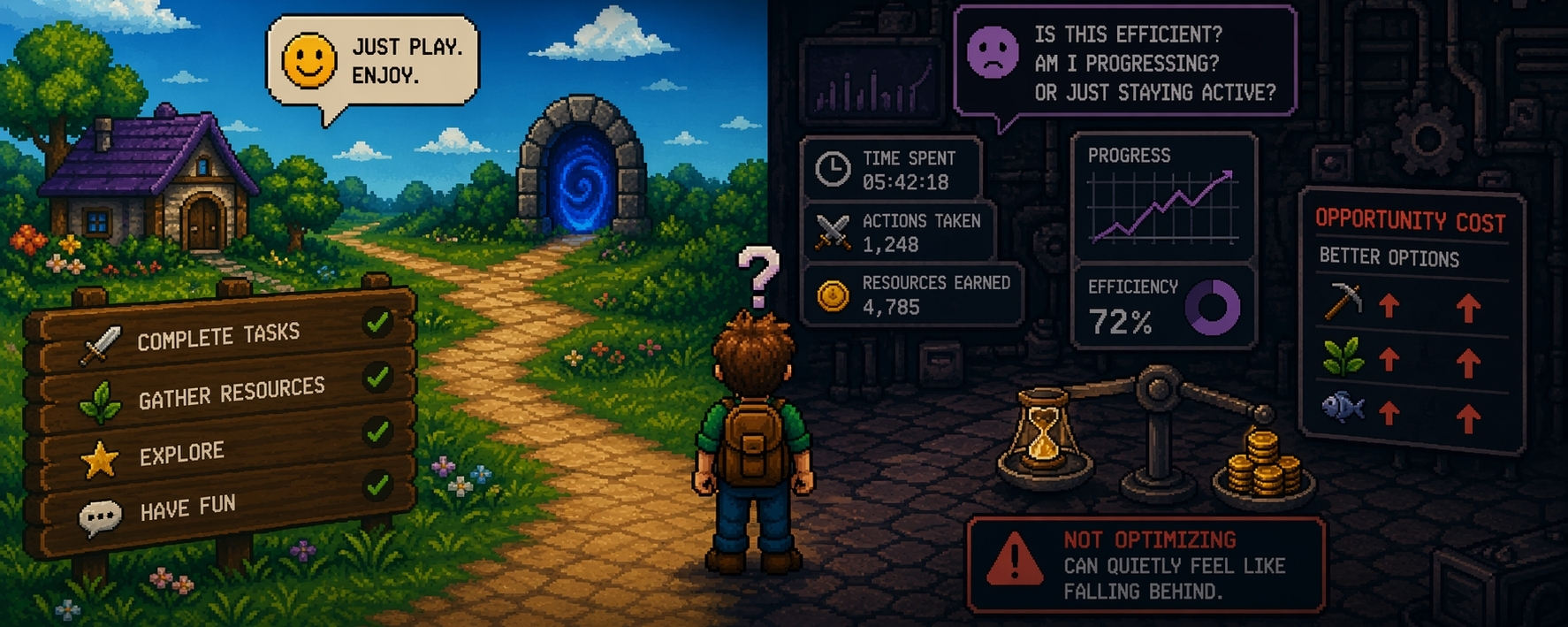
Au début, Pixels se présente comme une expérience légère. Tu te connectes, complètes quelques tâches, navigues dans l'environnement, et tout semble intuitif. Il n'y a pas de pression immédiate pour optimiser ou trop réfléchir aux décisions. On a l'impression d'évoluer dans un système où la participation seule suffit.
Cette simplicité initiale est ce qui rend l'expérience captivante.
Cependant, au fil du temps, l'interaction commence à évoluer—non pas parce que le jeu change, mais parce que la façon dont les joueurs interagissent avec lui évolue.
Sans aucune instruction explicite, les actions commencent à être évaluées.
Des décisions simples commencent à porter des questions implicites :
Est-ce la meilleure utilisation de mon temps ?
Y a-t-il une alternative plus efficace ?
Est-ce que je progresse, ou est-ce que je reste simplement actif ?
Ce changement est subtil. Le système n'impose pas l'optimisation, mais il crée progressivement des conditions où l'efficacité commence à avoir de l'importance. À mesure que la valeur est associée aux actions, les joueurs commencent naturellement à comparer, prioriser et mesurer leurs choix.
Ce qui était autrefois une interaction décontractée devient une prise de décision structurée.
Il est important de noter que l'expérience externe reste inchangée. Les mêmes boucles, mouvements et activités continuent de définir le jeu. Mais intérieurement, l'état d'esprit du joueur n'est plus le même. L'expérience devient moins une question de participation et plus d'évaluation.
Avec le temps, même les actions routinières commencent à peser - non pas parce qu'elles sont complexes, mais parce qu'elles sont constamment évaluées par rapport à des alternatives.
C'est là que le système révèle une couche plus profonde.
Pixels n'impose pas explicitement l'optimisation - mais avec le temps, il crée un environnement où ne pas optimiser peut discrètement sembler être un retard.
Une fois ce changement opéré, il est difficile de revenir en arrière. Même en tentant de revenir à une approche plus décontractée, la tendance sous-jacente à mesurer les actions demeure.
De cette façon, l'expérience évolue sans aucun changement visible dans la structure.
Pixels ne se contente pas de maintenir l'activité. Il introduit un cadre où le temps des joueurs est continuellement évalué à travers l'action.
Et quand l'interaction devient quelque chose qui est constamment mesuré plutôt que simplement vécu, le système cesse de sembler purement décontracté.
Cela devient quelque chose où le temps est constamment évalué.