
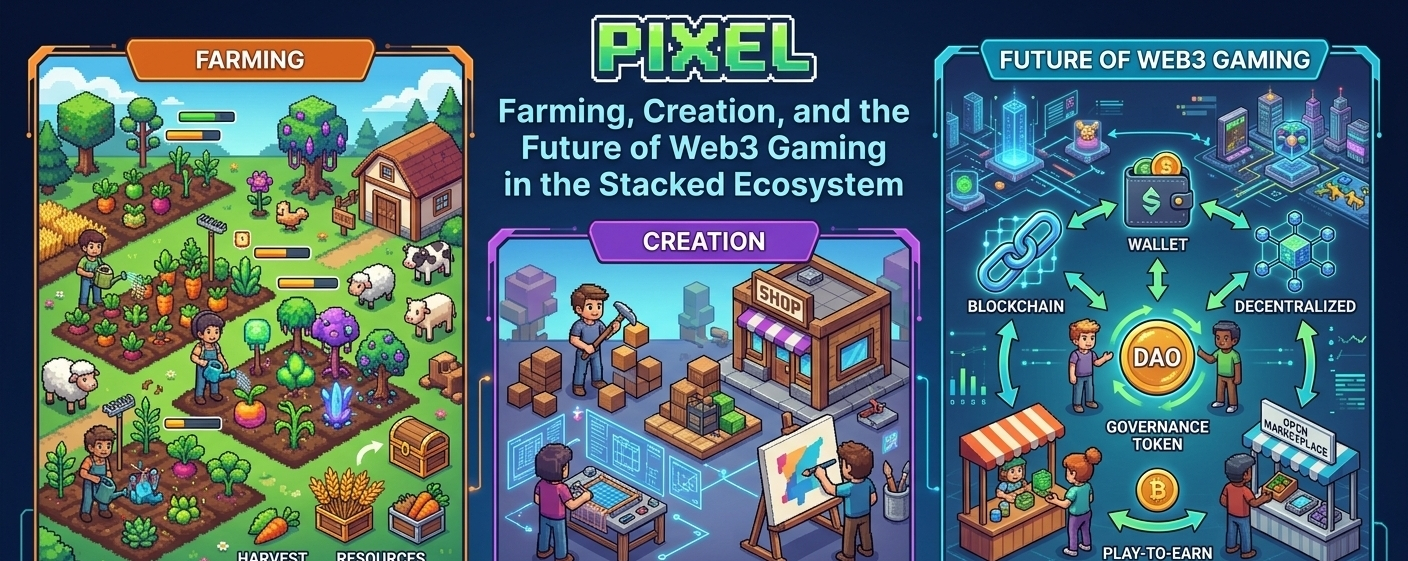
Pixels is not the kind of Web3 game that tries to impress you with noise. It works in a slower way, and that is exactly why it matters.
At its core, Pixels is a social casual game on Ronin built around farming, exploration, and creation. That sounds simple, almost too simple. But the longer you look at it, the more you see that the project is trying to build a world that people can actually live in for a while, not just visit for a quick reward. That difference is the whole story.
A lot of Web3 games make a big first promise and then struggle to keep the feeling alive. Pixels takes a more practical path. It gives players a routine. You grow crops, gather resources, move through the world, improve your land, and come back later to do it again. Nothing about that loop is flashy. Still, it works because it feels natural. People understand it quickly. They do not need a long explanation just to begin.
That matters more than many teams realize. When a game is easy to enter, more people stay long enough to see what is underneath. Pixels seems to understand that basic truth. It does not force the player into complexity on day one. It lets the world open up little by little. That slower opening gives the game a calmer and more human feeling.
The best games are not always the loudest ones. Sometimes they are the ones that make daily play feel comfortable. Pixels does that well.
There is also something stronger happening behind the surface. Pixels is not only a game with farming and exploration. It is also a project that is trying to make its economy make sense. That is where many Web3 games break. They build a game loop, but the token system feels empty or unstable. Players notice that fast. They may not say it in technical terms, but they feel it.
Pixels seems to be working harder on that part. The role of $PIXEL is not decorative. It is tied into the ecosystem in a way that gives the token real use. That is important because a token without a purpose becomes weak very quickly. A token with real utility can help hold a game together. It can support spending, rewards, and long-term player activity. That is the kind of thing that makes a project feel more serious.
And to be blunt, seriousness is rare in this space.
Many projects talk like they are building the future, but the actual systems are thin. Pixels feels different because it keeps adjusting itself. It is not pretending to be finished. It is still being shaped, and that is a sign of life, not weakness. A game that keeps changing can still be growing. A game that never changes usually stops mattering.
Ronin adds another layer to this strength. Being built on Ronin gives Pixels a stronger home than many Web3 games ever get. It does not sit alone in a vacuum. It is part of a wider gaming environment, which means there is room for connection, shared tools, and broader ecosystem value. That matters because games do better when they are not isolated. A connected world has more chances to grow.
There is a very small but real feeling that helps Pixels stand out: the game does not rush you.
That sounds minor, but it is not. A player can log in for a simple task and end up staying longer than expected because the world is easy to move through. One crop leads to another task. One upgrade leads to one more change. One quiet session becomes a longer habit. A player might sit down for five minutes and stay for twenty without planning to. That kind of behavior is a strong sign that the game loop is working.
The social part matters too. Pixels is not only about private progress. It is about being inside a shared world. Farming feels different when other people are around. Creation feels better when your work has a place in a community. Even simple spaces become more interesting when they feel lived in. Pixels benefits from that feeling. It makes the world feel less like a menu and more like a place.
That is what gives the project weight.
Pixels is also interesting because it does not rely only on one kind of value. It is not just about token movement, and it is not just about gameplay. It sits between those two things. The game has to be fun enough to hold attention, but the ecosystem also has to be stable enough to support long-term use. That balance is hard. Many teams fail there. They lean too far into speculation or too far into play and lose the other side. Pixels is trying to keep both alive at the same time.
That is not easy work.
There are also signs that the project is thinking beyond the present moment. When a game keeps improving its economy, refining its systems, and making its world easier to return to, it starts to feel less like a short-term launch and more like a living product. Pixels gives that impression. It feels like a project that wants players to stay, not just arrive.
A small detail makes this even clearer. Imagine opening the game on a quiet evening, checking one part of your land, and then noticing that something is slightly out of place. You move a few things around. You make the space feel cleaner. Nothing dramatic happens, but the session still feels meaningful. That is the kind of moment that tells you the game is doing its job. It is giving players small reasons to care.
Those small reasons matter.
Because in the end, most people do not stay with a game because of one huge event. They stay because the world keeps giving them a simple reason to return. Pixels seems built around that idea. It does not depend on noise. It depends on rhythm. It does not need to shout. It needs to keep working.
And honestly, that is stronger.
The real test for a Web3 game is not whether people talk about it once. The real test is whether it still feels useful after the first wave of attention fades. Pixels looks like one of the projects trying to pass that test. It has a clear world, a clear loop, a token with a purpose, and a network around it that gives it room to grow. That combination is not perfect, but it is solid. Sometimes solid is better than flashy.
Pixels does not feel like a project built for a single moment. It feels like a project built to keep going.
