

In late 2024, Pixels published a financial transparency report. Not common in this industry. The kind of document that most Web3 gaming projects avoid writing because the numbers are usually embarrassing. Pixels published it anyway.
By the end of 2024, the return on rewards ratio inside Pixels sat at 0.5. For every 100 PIXEL tokens distributed as rewards, only 50 were coming back through in-game spending. The ecosystem was giving out twice what it was getting back.
That is not a sustainable model. Everyone in the team knew it. The report said it plainly rather than burying it. And then somewhere over the following year, something changed.
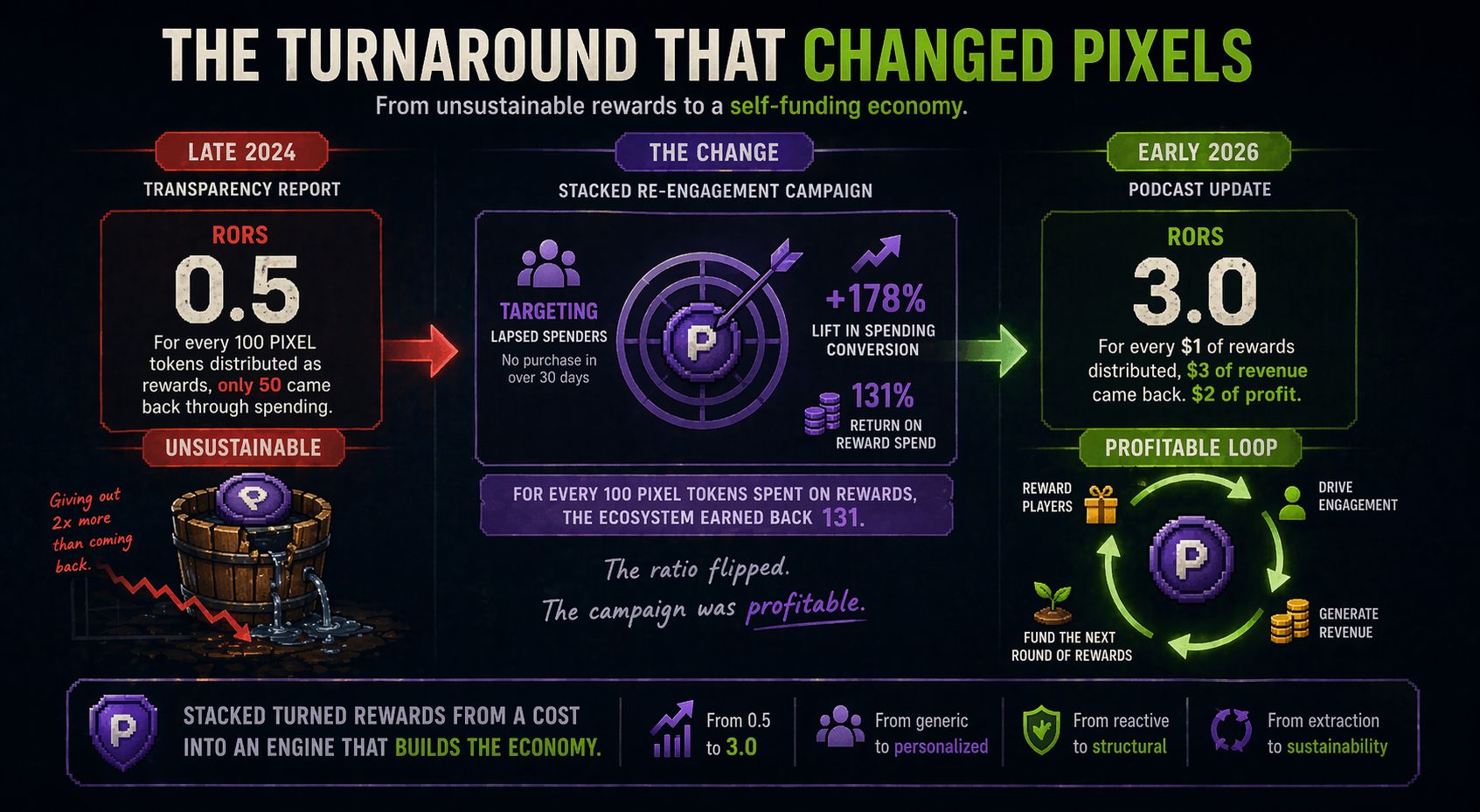
A re-engagement campaign run through Stacked targeting lapsed spenders, players who had not made a purchase in over 30 days, produced a 178% lift in spending conversion and a 131% return on reward spend.
Read that again slowly. A campaign targeting players who had already stopped spending. Players the old system would have written off or blasted with the same generic quest as everyone else. Stacked found them, understood something about their behavior, and offered them something specific enough that they came back and spent more than the campaign cost to run.
131% return means for every token given away as a reward, the ecosystem got back more than one token in spending. The ratio flipped. The campaign was profitable.
I have been watching Web3 gaming for long enough to know how rare that sentence is.
By the time of the Blockchain Gaming World podcast in early 2026, the founder described the overall RORS across the Pixels ecosystem as three to one. For every dollar of rewards distributed, three dollars of revenue was coming back. Two dollars of profit.
The distance between 0.5 and 3.0 is not just a number improvement. It is a completely different economic reality. At 0.5 the game is burning through its treasury to sustain activity. At 3.0 the rewards are generating the revenue that funds the next round of rewards. The loop closed.
What Stacked actually did to produce that shift is the part most coverage skips over.
The core of what Stacked does is deceptively simple to describe. A studio sends gameplay events into the system. Stacked decides which player should see which reward, at what moment, in what amount. Then it measures whether that reward actually moved retention, revenue, or lifetime value.
The difference between that and a normal quest board is the difference between a doctor prescribing medication based on your specific bloodwork and a pharmacy handing everyone who walks in the same pill.
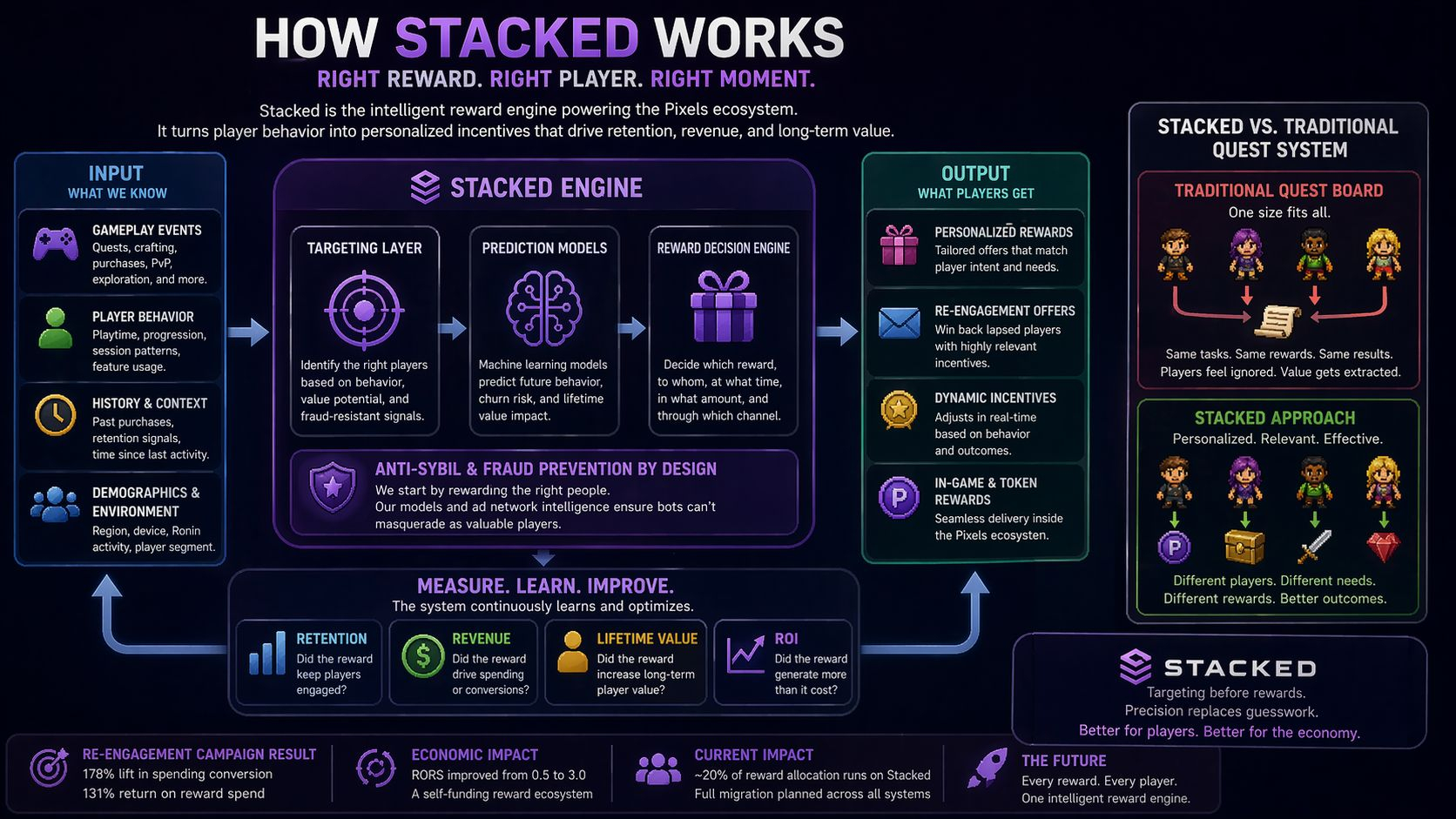
Every failed Web3 game I have watched collapse made the same mistake. The quest board treated a veteran player with 500 hours in the game identically to someone who downloaded it yesterday. Same tasks. Same rewards. Same everything. The veteran finds it trivially easy and extracts. The newcomer finds it overwhelming and leaves. Neither outcome builds a healthy economy.
The team described their anti-sybil approach inside Stacked as starting from the right premise: reward the right people from the beginning. Strong reward attribution, ad network technology that builds genuine understanding of users, prediction models for future behavior, demographic context. The best fraud prevention is not catching bots after the fact. It is building a system where bots cannot fake being the kind of player the rewards are designed for.
That framing stuck with me because it inverts how the industry usually thinks about the problem. Most platforms build the reward system first and then try to patch the fraud layer on top. Stacked built the targeting first, which means the fraud prevention is structural rather than reactive.
The founder described the shift that led here as a complete change of direction after realizing that chasing short-term monetization was not working. Spend spikes were high but unbalanced. The team stopped optimizing for numbers that looked good in announcements and started building features players actually wanted, combined with targeted reward offers aimed at players who were genuinely engaged.
Reading that I thought about how unusual it is for a team to openly describe abandoning a strategy that was producing impressive surface metrics. DAU was high. Revenue spikes were real. Most companies would have kept running that playbook and hoping the fundamentals caught up eventually.
What changed the calculus was RORS as a non-negotiable internal benchmark. When your north star is whether the rewards you give out generate more revenue than they cost, you cannot hide from a 0.5 ratio by pointing at daily active user counts. The number forces honesty.
Stacked currently handles about 20% of reward allocation inside the Pixels ecosystem, with the task board covering around 50% and the remaining portion spread across Neon Zone, Merchant Ships and other in-game systems. The long-term plan is to migrate everything into Stacked eventually.
That migration is the real signal to watch. Right now Stacked and the task board coexist. A campaign on lapsed spenders is one problem with one clear metric. The full migration is a different beast entirely. Edge cases multiply fast when personalization runs everything simultaneously, and a model that worked beautifully on a defined audience might behave differently when it has no boundaries at all.
The task board is the familiar, visible surface of the rewards experience. Stacked operates underneath it, handling targeted campaigns that most players experience without knowing there is a separate system behind the offer they just received.
Most people who received a Stacked campaign this month have no idea the offer was written specifically for them. They just played the game they were already playing and something showed up at the right moment. That gap between what the player feels and what is actually happening underneath is either the most elegant thing about this system or the most worth paying attention to, depending on how long you think about it.