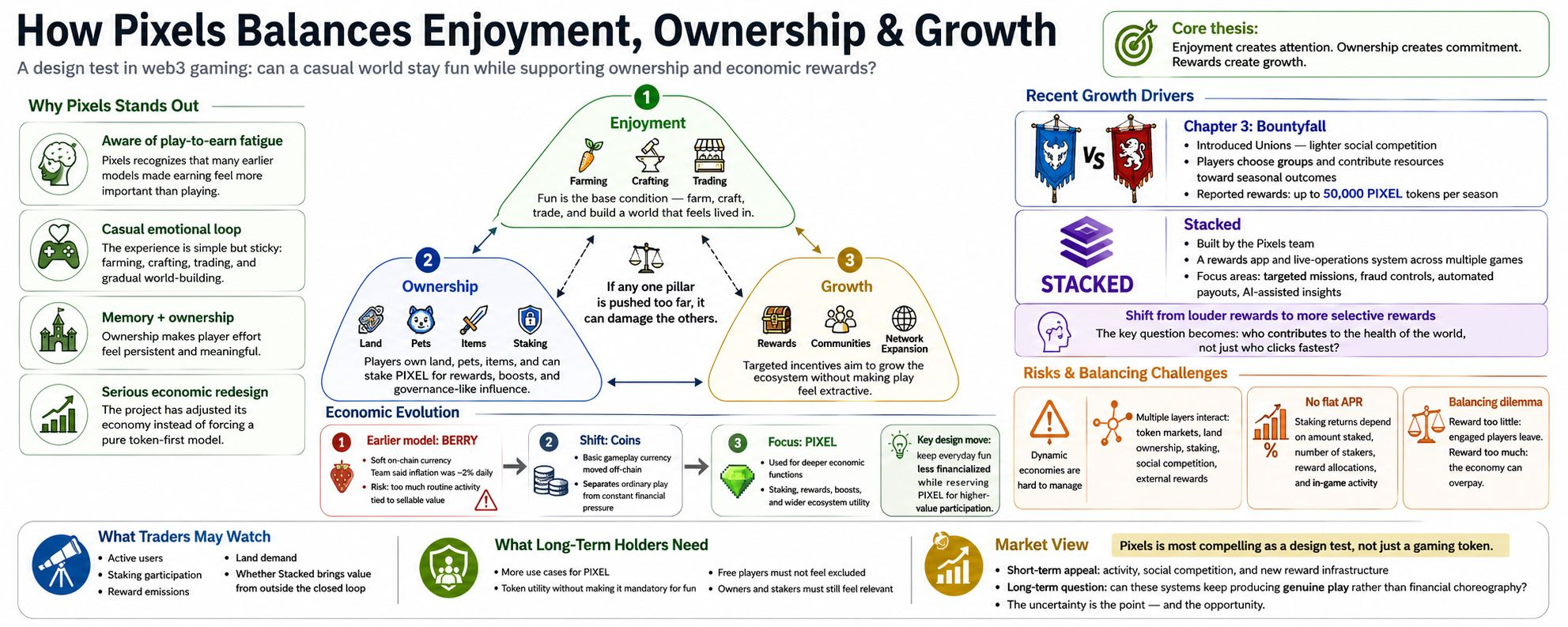

I keep coming back to Pixels because it looks awkward but interesting place. It wants to be a game people enjoy while also asking players to care about ownership rewards and economic design. My first instinct with projects like this used to be skepticism because play-to-earn too often made the playing feel secondary. Pixels seems aware of that problem. Its whitepaper says the goal is bigger than a farming game since it wants to use targeted rewards and better incentive alignment to rethink game growth while still treating fun as the base condition.
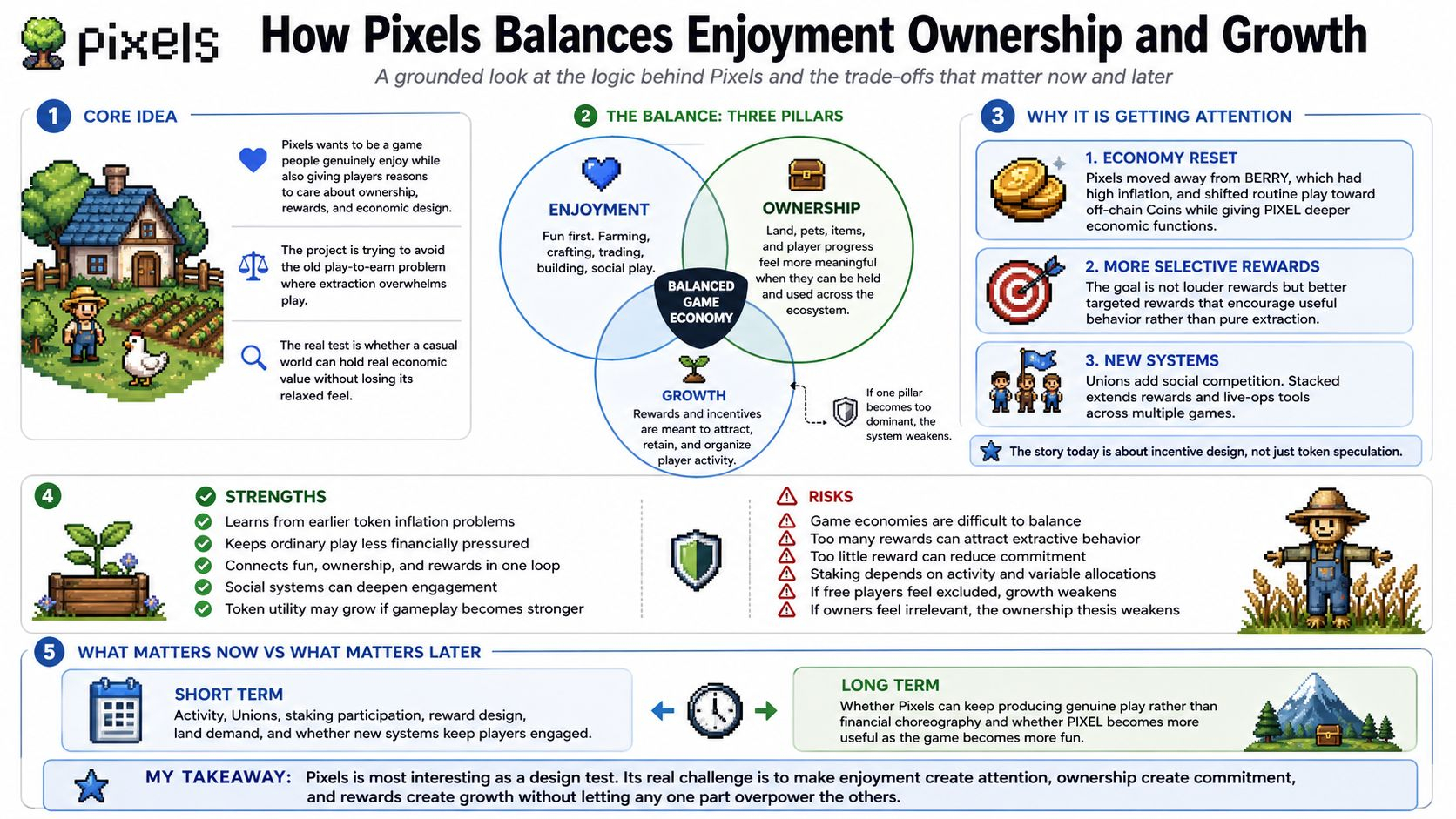
That matters because Pixels is built around a simple emotional loop. You farm and craft and trade while slowly building a sense that the world has memory. The ownership layer is supposed to make that memory concrete through land pets items and rewards that connect to blockchain rails. The official site says what players build is theirs to own and that staking PIXEL can unlock rewards gameplay boosts and a role in shaping the wider universe. I find it helpful to see this as an experiment in whether a casual world can carry real economic weight without losing its casual feel.
The strongest part of the thesis is that Pixels has learned from earlier mistakes. The project moved away from BERRY which was a soft on-chain currency that the team said had roughly 2% daily inflation. It then shifted toward off-chain Coins for basic play while focusing PIXEL on deeper economic functions. That is not glamorous but it is serious. If every routine action produces a sellable token then the game risks attracting people who are mainly there to extract value. By keeping ordinary currency off-chain Pixels is trying to separate enjoyment from constant financial pressure.
The recent attention makes sense in that context. Chapter 3 Bountyfall added Unions as a lighter social layer where players choose among competing groups and contribute resources toward seasonal outcomes. Reporting described rewards of up to 50,000 PIXEL tokens per season. More recently Stacked was built by the Pixels team and has been framed as a rewards app and live-operations system across multiple games. It focuses on targeted missions fraud controls automated payouts and AI-assisted insights. What surprises me is that the important shift is not louder rewards but more selective rewards. Pixels appears to be asking who contributes to the health of the world rather than who can click fastest.
There are clear risks. Dynamic economies are hard even for large traditional games and Pixels is adding token markets land ownership staking incentives social competition and external rewards on top. Staking is not a guaranteed yield product since Pixels says there is no flat APR and returns depend on factors such as the amount staked the number of stakers and reward allocations. In-game staking also requires activity which helps fight passivity but creates another balancing problem. If dedicated players are rewarded too little they may leave. If they are rewarded too much then the economy can overpay.
For market participants I would not frame the short-term question as whether PIXEL will go up. That is too thin. The better question is whether the token becomes more useful as the game becomes more fun. Traders may watch active users staking participation reward emissions land demand and whether Stacked can bring value from outside the closed loop. Longer-term holders need a different kind of conviction. They need to see whether Pixels can expand use cases for PIXEL without making the token feel mandatory for ordinary enjoyment. If free players feel excluded then growth weakens. If owners and stakers feel irrelevant then the ownership thesis weakens.
My market view is that Pixels is most interesting when judged as a design test rather than as a simple gaming token. Its advantage is that it understands the tension it is trying to solve. Enjoyment creates attention. Ownership creates commitment. Rewards create growth. Yet any one of those can damage the others if pushed too far. The short-term appeal is activity social competition and new reward infrastructure. The long-term question is whether those systems can keep producing genuine play rather than financial choreography. I do not think the answer is settled and that uncertainty is the point.