
I've been watching something interesting play out over the past year... I think most people are reading it wrong.
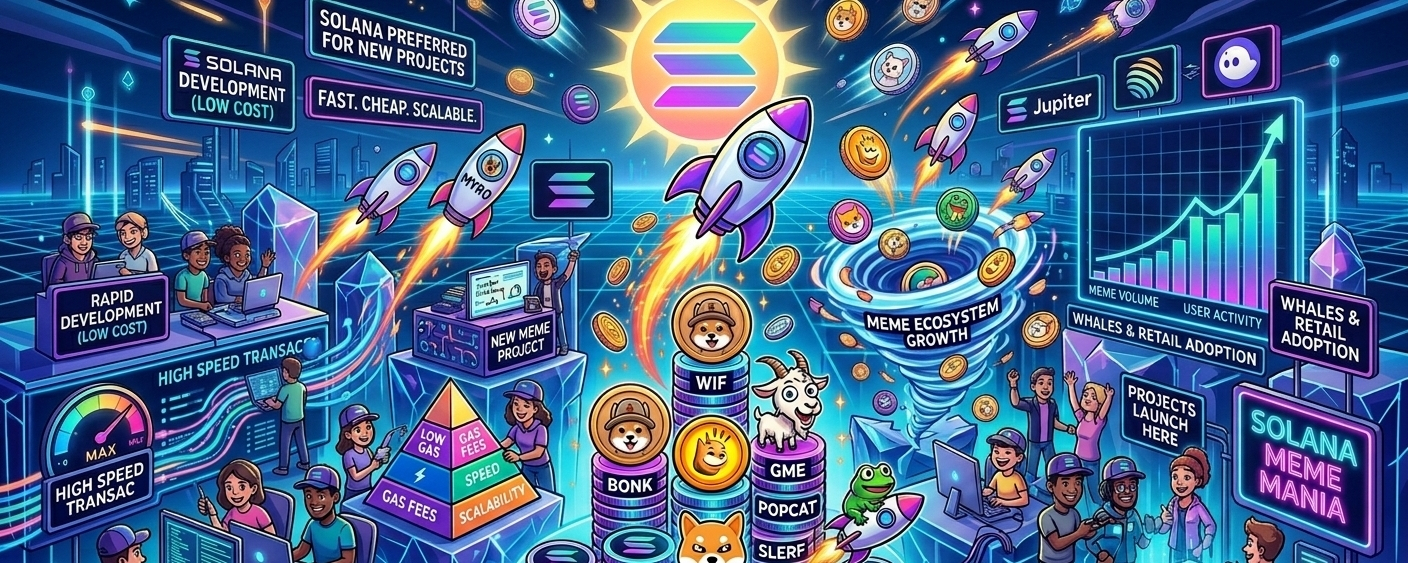
The meme coin explosion on solana — pump.fun launches, viral tokens, thousands of new coins minted daily — gets written off as noise. Speculation theater. The degeneracy wing of crypto doing what it does. And on the surface, sure. But if you pull back and look at what's actually happening underneath it, the signal is different... I believe meme coins don't tell you what's fun. They tell you where developers want to build.
Why solana specifically matters?
Solana's architecture was built for throughput. 65,000 transactions per second theoretical capacity, sub-400ms block times, and fees that are effectively rounding errors. When you're launching a token that could go from zero to a million wallets interacting with it inside 48 hours, that infrastructure matters enormously.
I think ethereum couldn't handle the meme coin moment without L2s, and even then the UX friction adds cognitive overhead. On solana, you mint, you list, you go. The pipeline from idea to live token is measured in minutes. Pump.fun made that even more extreme — one-click token creation, bonding curve liquidity by default, automatic graduation to raydium once a market cap threshold is hit. It removed every remaining technical barrier.
But here's the thing what I noticed... The developers building on pump.fun, building new AMMs, building token launchers and sniping bots and portfolio tools — they're not doing that because meme coins are their passion. They're doing it because solana is where the users are, where the liquidity is, and where the tooling is fast enough to iterate without friction.
The meme coin wave is revealing solana as the developer-preferred testbed for anything that requires speed and volume. What the tooling looks like right now
I believe this is the technical part most commentary skips over.
The solana's programming model is fundamentally different from the EVM. Programs (smart contracts on solana) are stateless — they don't hold data themselves. State lives in accounts, which are separate objects the program reads from and writes to. It's a more complex mental model upfront, but it enables parallel transaction processing in ways that EVM architectures structurally can't match.
The dominant development framework for solana programs, has matured significantly... It handles account validation, serialization, and a lot of the boilerplate that made raw solana development painful in 2021-2022. A competent developer today can write a functional solana program in a fraction of the time it would have taken two years ago.
The solana program library gives you battle-tested implementations of token standards, staking, governance, and associated account logic out of the box. You're not reinventing primitives. You're composing from a solid base.
Then there's the RPC layer... Elius, triton, and quicknode have built solana-specific infrastructure with features like geyser plugins for real-time account streaming, transaction priority fee APIs, and dedicated nodes that filter the spam from the signal. for anyone building something that needs live data — trading bots, analytics dashboards, alert systems — this is meaningfully better than what's available for most other chains.
The fee market evolution and Solana low fee matters
One thing that gets underappreciated: solana's priority fee system has matured into something actually useful. During the height of the meme coin congestion last year, base fees were essentially useless as a congestion signal. But the introduction of local fee markets — where priority fees are scoped to the specific accounts being written to, not the entire network — changed that.
What this means practically: A highly contested token launch doesn't necessarily clog unrelated transactions. The fee market is more granular. you're paying for priority access to the specific state you're contending for, not to the whole blockchain. This is a more intelligent design, and it's one reason developer experience on solana during high-throughput periods is improving rather than degrading.
What developers actually care abOut?
I've talked to enough people building on-chain to know the decision usually comes down to three things: who are the users, how fast can i ship, and how much does a bug cost me.
Solana wins on the first two. The user base skews younger and more active on-chain than any other L1 right now. the tooling lets you move fast. And while the third point — bugs on solana can be catastrophic, given that program upgrades require governance or admin keys and account exploits can be subtle — the developer community has gotten much better at auditing practices and the anchor framework has closed a lot of the low-hanging attack surface.
The meme coin moment accelerated all of this. It brought liquidity, it brought users, and it brought developers who stuck around after the hype moved on and started building infrastructure that actually matters — bridges, indexers, order books, identity layers, yield protocols.
That's the signal worth tracking. Not the meme coins themselves, but what their success required solana to become, and what it attracted in the process.
I think the chain that wins the next cycle won't be the one with the cleanest whitepaper. It will be the one where developers kept showing up even when it was messy.