

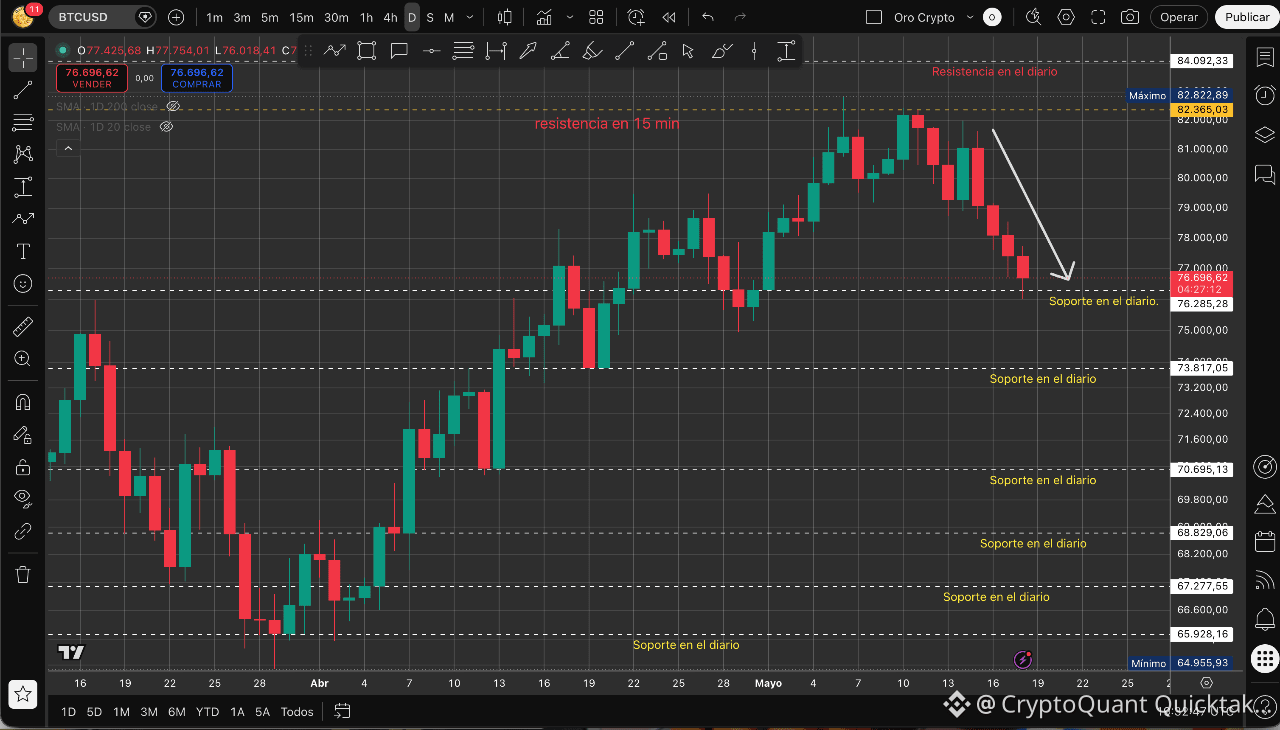
BTC pulled back from the $81,000 area and moved close to daily support at $76,285. The key question is whether it came from aggressive futures closing.
The data does not point there.
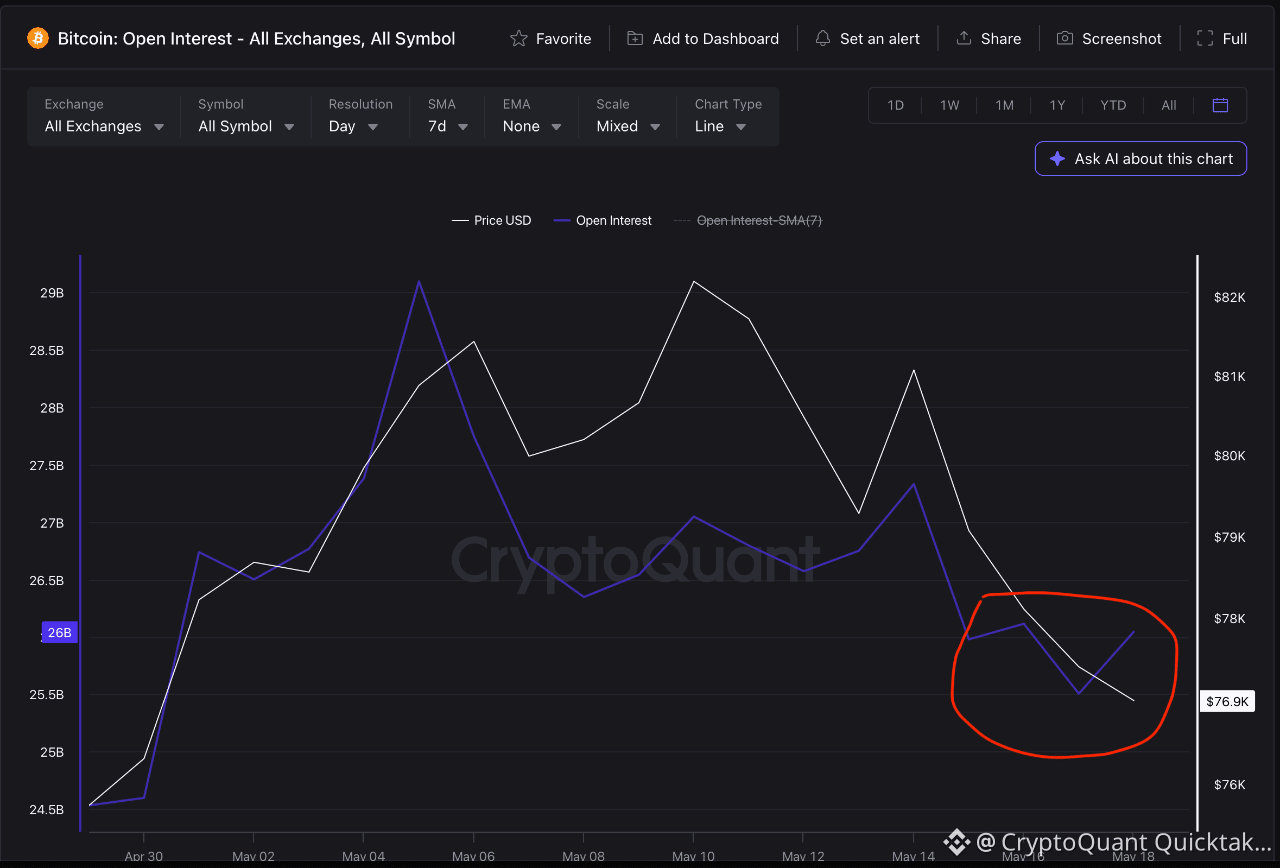
Open Interest remained stable. On May 15, it was close to $25.977 billion, and on May 18 it was around $26.180 billion. In other words, it increased by about $202 million, +0.78%. Therefore, it does not look caused by a massive derivatives unwind.
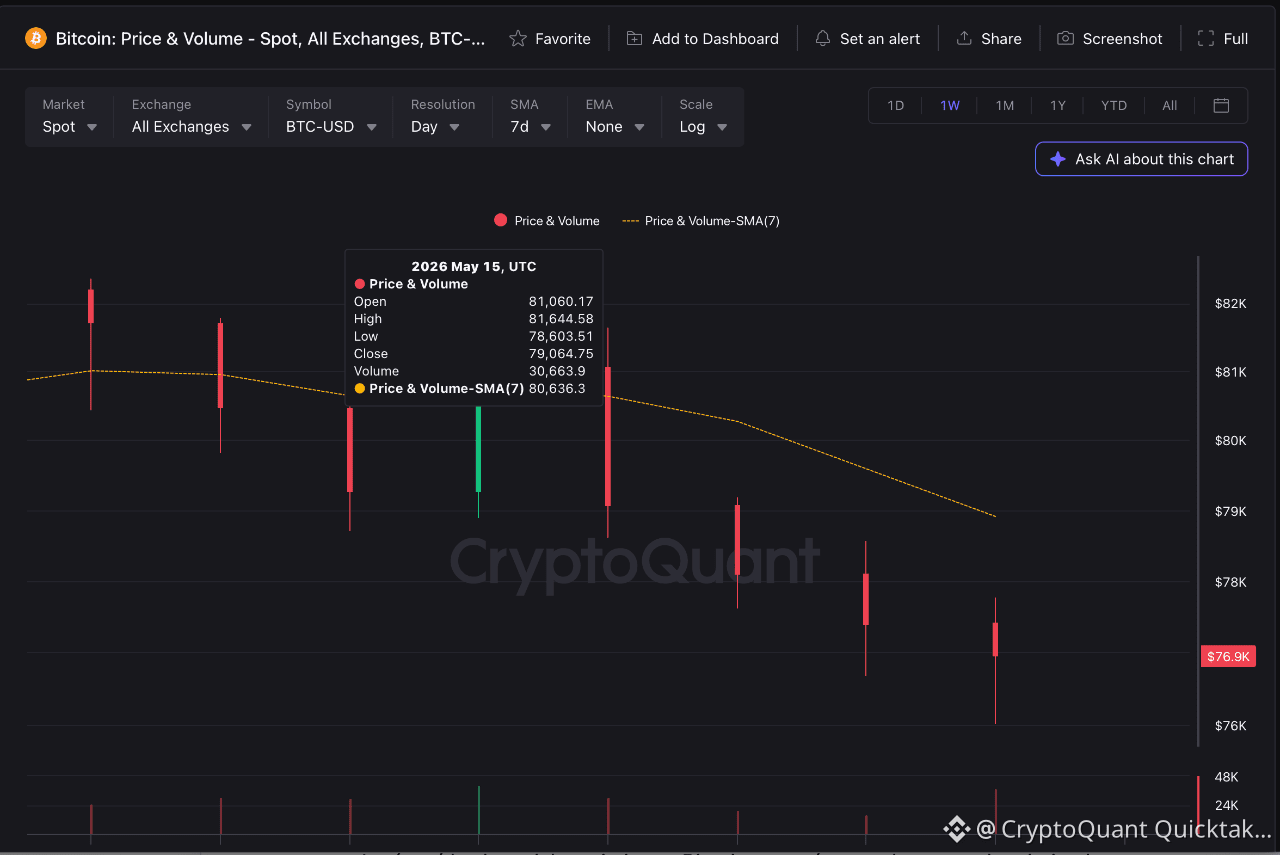
The differential signal appears in spot. The metric Bitcoin: Price & Volume - Spot, All Exchanges shows that Spot Volume moved from 30,663.9 BTC on May 15 to 20,010.58 BTC on May 16 and to 16,092.32 BTC on May 17. Between Friday and Sunday, it contracted by 47.52%
During that stretch, BTC fell from $79,064.75 to $76,572.92, a drop close to 3.15%. On May 18, Spot Volume rebounded to 37,817.49 BTC, but after the main correction
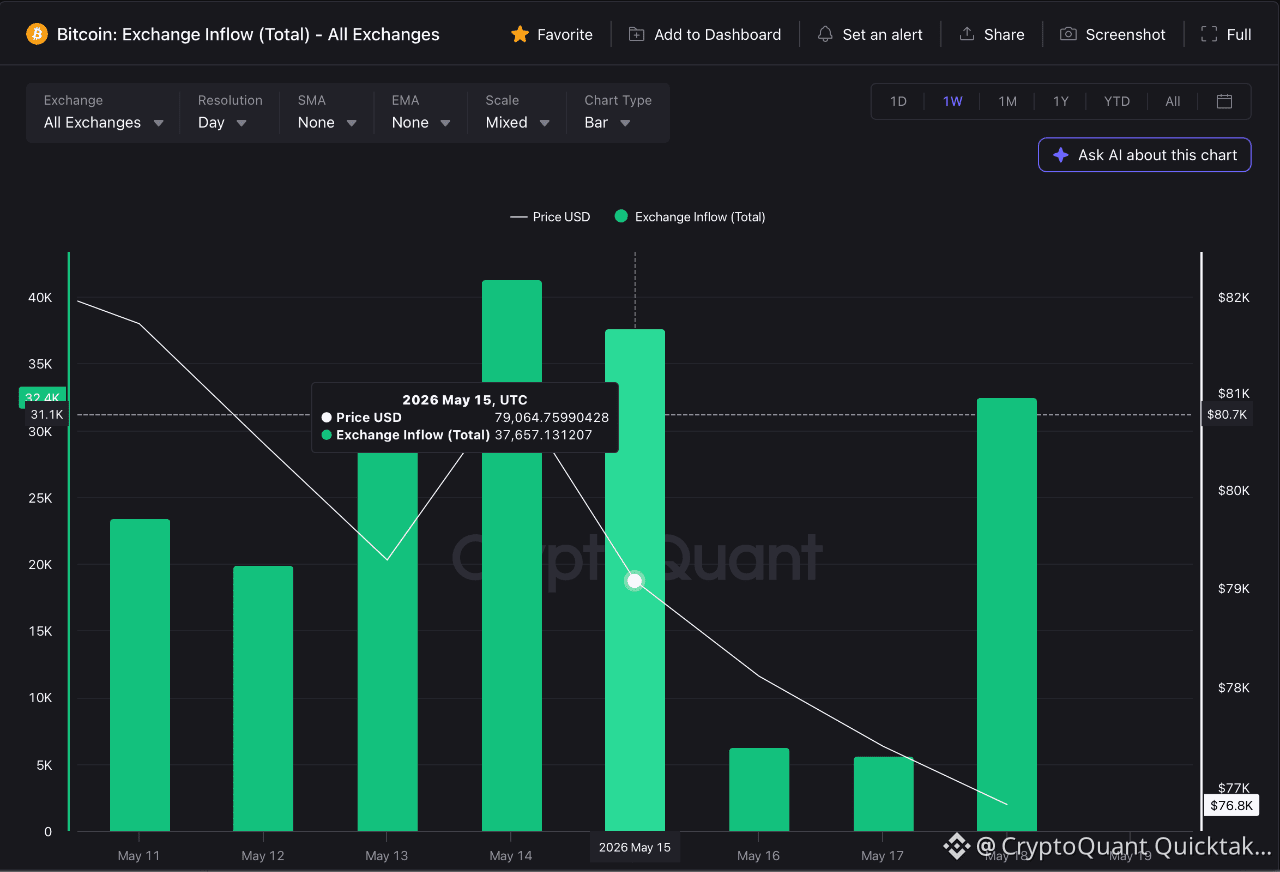
The strongest confirmation is in the metric Bitcoin: Exchange Inflow (Total) - All Exchanges. Between May 15 and May 17, around 49,577 BTC entered exchanges: 37,657.13 BTC on May 15, 6,283.88 BTC on May 16 and 5,636 BTC on May 17. The largest flow coincided with the strongest bearish pressure; afterward, flows and drops were smaller
This type of elevated inflow into exchanges is usually associated with potential selling pressure when it coincides with a price drop. By size, the May 15 flow suggests activity from large participants, but the central point does not need to rely on cohorts: the relevant data is that a large amount of BTC entered exchanges exactly during the period of greatest weakness
The reading is clear: BTC did not fall because of a massive futures closing. It fell because spot lost absorption, received visible selling pressure in the flows toward exchanges and did not find enough demand. Large sales were carried out, visible in the flows toward exchanges
If BTC loses $76,285, where there is an appreciable daily support, the next relevant area would be near $73,817, where another daily support sits
Written by Carmelo_Alemán