
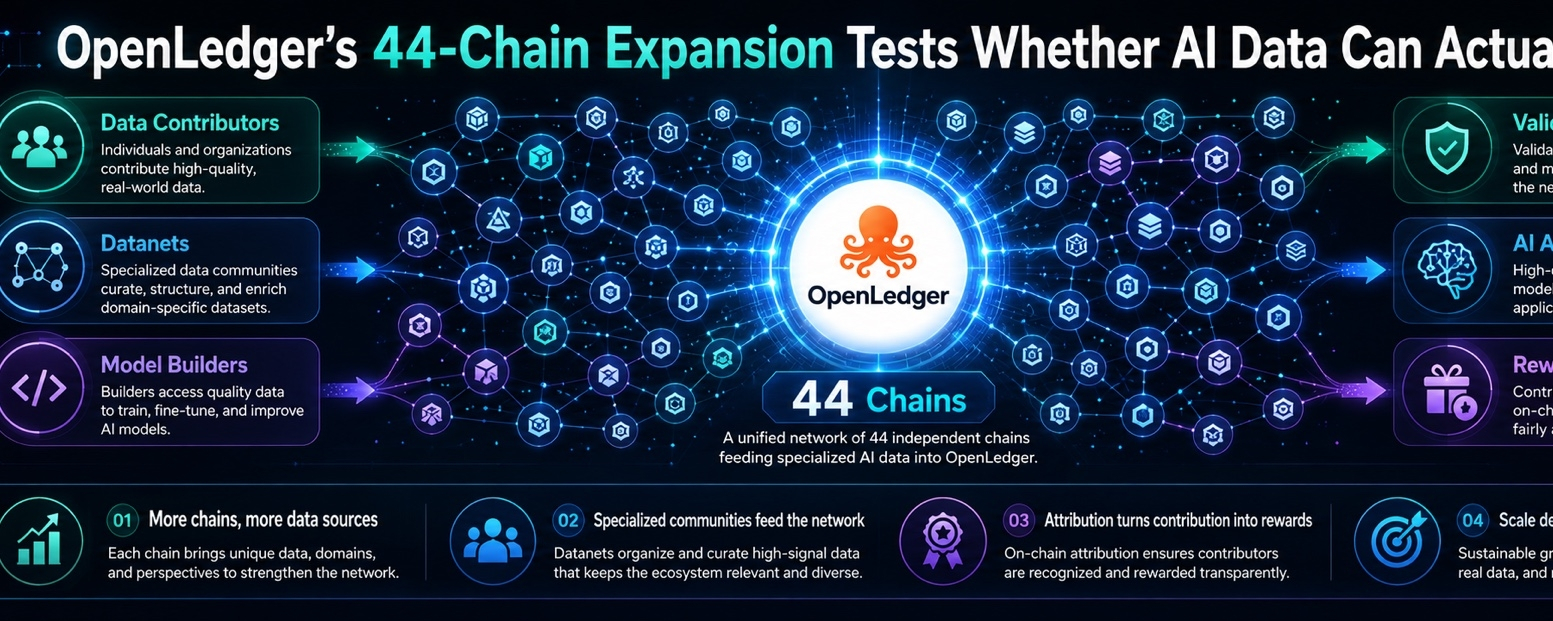
OpenLedger is trying to scale through 44 chains, and I’ll be honest, my first reaction to that kind of claim is usually a sigh.
I’ve seen this before. A project starts talking about multi-chain reach, the graphics get bigger, the ecosystem map fills up with logos, and everyone pretends that distribution has already turned into adoption. Most of the time, it has not. It is just noise with better formatting.
But OpenLedger is a little more complicated than that.
The project is not just trying to move liquidity from one chain to another and call that growth. That would be the tired version. The more interesting part is that OpenLedger is built around AI data, attribution, model creation, and rewards. That means its scaling problem is not only technical. It is social. It is economic. It is messy. It needs people to contribute useful data, builders to shape that data into models, validators to keep the junk out, and users who actually come back after the campaign rewards dry up.
That is a grind.
And maybe that is why the 44-chain angle matters. Not because the number is impressive. Big numbers are cheap in crypto. I’ve watched projects with massive partner lists slowly fade into silence because nobody had a reason to use them after the first announcement. The real question is whether those 44 chains give OpenLedger access to different kinds of contributors, different behaviors, different communities, and different data pools that would be hard to reach from one chain alone.
AI does not grow well inside a narrow room. It needs variety. It needs ugly, specific, hard-to-organize information. It needs local context. It needs niche expertise. It needs people who know things that do not show up neatly in public datasets.
That is where OpenLedger has a real angle.
If someone contributes data, improves a model, validates information, or helps build a useful AI layer, OpenLedger wants that work to be visible and tied back to rewards. That sounds obvious when you say it out loud, but the AI market has spent years doing the opposite. People create knowledge. Communities generate behavior. Developers clean things up. Then the value gets swallowed somewhere higher up the stack.
OpenLedger is trying to make that extraction harder to ignore.
I’m not saying it has solved the problem. That would be too generous. Attribution is brutally hard. Anyone who has spent time around data markets knows how quickly things get dirty. Bad data slips in. Copied data gets repackaged. Low-effort contributors learn how to farm systems. Some inputs only become valuable when mixed with other inputs, which makes reward distribution a nightmare. The theory always looks cleaner than the machine.
Still, the idea is worth watching because it goes after a real pain point.
The 44-chain structure could help OpenLedger because the best contributors are not all sitting in one ecosystem. Some are in DeFi-heavy communities, watching on-chain activity every day and understanding liquidity patterns better than most dashboards. Some are in gaming ecosystems, where AI agents and character logic could actually have a reason to exist. Some are creators who care less about block times and more about ownership, licensing, and whether their work gets recycled without credit. Some are developers building small automation tools in public while the rest of the market chases whatever narrative is trending this week.
Those people do not all move together.
Crypto is fragmented by nature. Every chain has its own language, rituals, wallets, incentives, and little tribal habits. It is annoying, but it is also where the opportunity sits. If OpenLedger can plug into those separate rooms without forcing everyone into one hallway, then 44 chains stop being a vanity metric and start becoming distribution infrastructure.
But here’s the thing: users do not care about infrastructure when it gets in their way.
Nobody wants to spend half an hour bridging, switching networks, checking gas, signing weird transactions, and praying the interface does not break just to contribute data or use an AI model. Power users might do it. They have been trained by pain. Normal users will not. They leave. Quietly. No angry post, no feedback form, just gone.
So OpenLedger’s multi-chain push only works if most of that friction disappears into the background. The user should feel like they are contributing, building, validating, or earning. They should not feel like they are doing unpaid QA for a half-finished cross-chain setup.
That is where I’m watching closely. Not the announcement. Not the chain count. The moment where a normal user can interact with OpenLedger across networks and not feel the machinery grinding under the floorboards.
Because growth creates its own problems. More chains mean more access, sure. They also mean more maintenance, more points of failure, more scattered liquidity, more support headaches, and more places where the user experience can break. Crypto people love expansion until expansion turns into operational debt.
I’ve seen projects get crushed by their own map.
OpenLedger has to avoid that. Each chain should have a reason to exist inside the ecosystem. A gaming-heavy chain should not be treated the same as a DeFi-heavy chain. A creator-focused community should not be approached like a liquidity farming crowd. If the project just spreads the same message everywhere, the whole thing starts to feel thin.
The better version is uneven. One chain becomes useful for AI agents. Another brings data contributors. Another supports creator attribution. Another gives builders a cheap place to test. Another develops a specific type of Datanet. It does not have to be neat. Real ecosystems rarely are.
That is probably the most human part of the OpenLedger thesis: it does not need one perfect use case to carry everything. It can grow through small, awkward, specialized loops.
A dataset here. A model there. A group of contributors testing one niche. A developer wiring an AI tool into an app. A few validators filtering garbage. A reward cycle that actually makes sense. Then another one. Then another.
Slow at first. Maybe painfully slow.
But if it works, it becomes harder to dismiss.
I’m tired of broad AI claims in crypto. Most of them sound like someone threw three buzzwords into a pitch deck and waited for the market to do the rest. “AI plus blockchain” means almost nothing now. It has been stretched too thin. The projects that survive will probably be the ones that get painfully specific.
OpenLedger’s best chance is not to become AI for everyone. That is usually where projects lose their shape. Its better path is to become useful for people building specific AI systems where data ownership, contribution tracking, and rewards actually matter.
A market model needs different inputs than a game agent. A local-language dataset has different problems than a legal research model. A creator-rights system needs different incentives than a DeFi automation tool. These are not the same users. They should not be forced into the same story.
That is why 44 chains could matter, but only if OpenLedger lets different communities create different value inside the same underlying system.
The project’s strongest promise is that contribution does not have to disappear. If someone brings useful data, they should not be treated like background material. If someone validates quality, that work should count. If a community helps build a model that becomes valuable, the value should not float away from them forever.
That is the clean version.
The dirty version is harder. People will try to farm rewards. People will upload junk. People will copy datasets. People will chase incentives without caring about quality. Every open system invites this. OpenLedger will have to prove that its attribution and reward logic can handle the abuse, not just the happy path.
That is usually where the market separates real infrastructure from nice documentation.
I’m looking for the moment this actually breaks. Not because I want it to fail, but because every serious system breaks somewhere. The question is whether it breaks early, visibly, and fixably, or whether the cracks get hidden under more announcements.
There is also the token problem. There is always a token problem. Price attracts the loudest attention, even when it tells the least complete story. Traders will watch charts, unlocks, volume, and momentum. That is normal. But if OpenLedger wants to be more than another rotating ticker in the AI narrative, the important signals have to come from inside the product.
Are Datanets being used?
Are contributors returning?
Are models improving because of the data?
Are builders actually integrating this into something useful?
Are rewards going to people who added real value, or just to whoever learned how to farm fastest?
Those questions matter more than the chain count.
A 44-chain ecosystem gives OpenLedger more surface area. That is good. It also gives the project more ways to look busy without proving depth. That is the trap. Crypto is full of activity that feels alive until you look closer and realize it is mostly recycled incentives moving from one campaign to the next.
OpenLedger has to show something heavier than motion.
The real opportunity is hidden in the fragmentation. Crypto communities are scattered, but they are not empty. They hold behavior, knowledge, liquidity patterns, gaming cultures, creator networks, developer experiments, and strange little pockets of expertise. OpenLedger is trying to turn that scattered material into AI infrastructure with attribution attached.
That is ambitious. Also exhausting.
Because doing it properly means dealing with all the boring parts nobody wants to talk about. Data quality. User friction. Reward design. Cross-chain complexity. Developer tooling. Community trust. Abuse prevention. Actual demand. The stuff that does not fit nicely into a launch post.
Maybe that is why I find the project more interesting than the usual multi-chain pitch. Not because I trust the number 44. I do not trust numbers like that on their own. I trust repeated usage, visible contribution, and systems that still function after the first wave of attention leaves.
OpenLedger could scale faster through 44 chains if each chain becomes a real entry point for useful AI work. Not just wallets. Not just transactions. Work. Data added. Models trained. Agents used. Rewards earned. Quality checked. Builders sticking around because the infrastructure saves them time or gives them something they cannot easily build alone.
That is the version that has a pulse.
The weaker version is easy to spot. More logos. More posts. More vague talk about ecosystem growth. More noise. We have all seen that movie, and the ending is usually quiet.
So the question I keep coming back to is simple: can OpenLedger turn 44 chains into 44 sources of actual contribution, or is this just another big map waiting to collect dust?