
Overview
Bitcoin (BTC) continues to trade in a period of heightened uncertainty as investors weigh macroeconomic risks against strong long-term accumulation trends. While recent price action has been relatively weak, underlying on-chain metrics suggest that institutional and long-term investor conviction remains intact.
The market is currently navigating a critical phase where short-term volatility is being driven primarily by macroeconomic developments, while long-term participants continue to position for the next stage of the cycle.
1. Price Action and Technical Structure
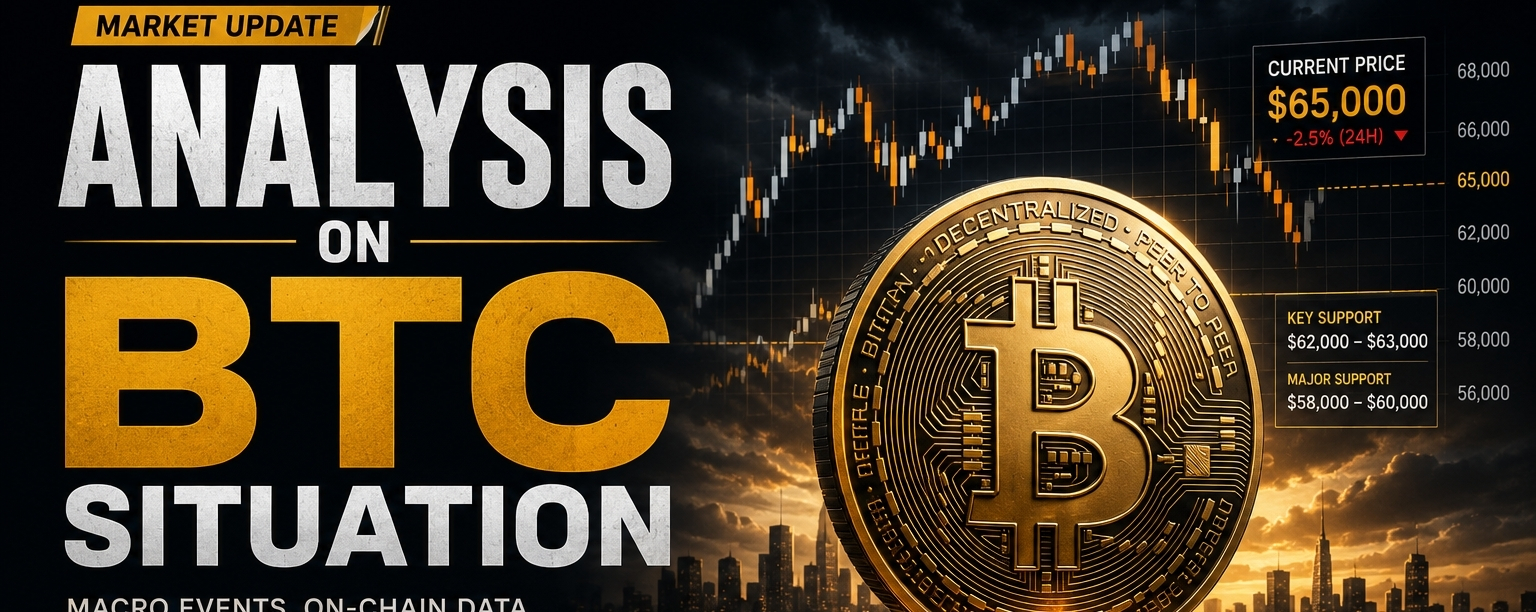
Bitcoin is currently trading within a narrow range between approximately $64,881 and $65,040, reflecting a modest decline of around 2.5% from recent local highs.
Following a brief move toward the $66,340 area, BTC failed to sustain upward momentum and entered a consolidation phase. Notably, the recent pullback has occurred alongside declining trading volume, suggesting that selling pressure lacks strong conviction rather than indicating a major structural breakdown.
Key Technical Levels
Support Zones
$62,000–$63,000: Initial support area in the event of increased selling pressure.
$58,000–$60,000: Major cycle support zone monitored by long-term investors.
Resistance Zones
$66,350: Immediate resistance level.
$67,000: Psychological resistance area that could come into focus if bullish momentum returns.
At present, Bitcoin remains range-bound, awaiting a catalyst capable of determining its next directional move.
2. Macroeconomic Focus: Federal Reserve Policy
One of the primary factors influencing market sentiment is the upcoming Federal Reserve interest-rate decision and accompanying policy guidance.
Although the market largely expects rates to remain unchanged, investors are closely monitoring economic projections and commentary from policymakers for clues regarding the future direction of monetary policy.
Throughout the year, expectations for multiple rate cuts have gradually weakened as inflation concerns have remained persistent. This shift has created a more cautious environment for risk assets, including cryptocurrencies.
Higher-for-longer interest rates typically reduce liquidity and encourage investors to favor lower-risk assets, limiting speculative capital flows into digital asset markets.
As a result, Bitcoin's short-term direction remains closely tied to broader macroeconomic developments and expectations surrounding future monetary policy.
3. Institutional and Long-Term Holder Activity
Despite recent market weakness, on-chain data continues to highlight strong accumulation behavior among long-term participants.
Long-term holders have reportedly accumulated significant amounts of Bitcoin throughout June, suggesting that conviction remains strong beneath the surface despite negative sentiment and short-term volatility.
Corporate adoption also remains a notable supporting factor. Public companies and institutional entities continue to maintain substantial Bitcoin exposure, reinforcing the perception of Bitcoin as a strategic long-term asset rather than a purely speculative instrument.
While short-term traders remain focused on macroeconomic uncertainty, long-term participants appear to be taking advantage of lower prices to increase exposure.
4. Market Sentiment
Market sentiment remains heavily depressed.
The Crypto Fear & Greed Index is currently positioned within the Extreme Fear category, reflecting elevated caution among market participants.
Historically, periods of extreme fear have often coincided with local market bottoms or accumulation phases. However, sentiment indicators should not be viewed as standalone signals and must be evaluated alongside broader market conditions.
For now, investor confidence remains fragile, and volatility is likely to remain elevated until greater clarity emerges regarding monetary policy and institutional flows.
5. Potential Market Scenarios
Scenario A: Hawkish Outcome
If policymakers maintain a strongly hawkish stance and signal that restrictive monetary conditions may persist longer than expected, Bitcoin could experience additional downside pressure.
In this scenario, a retest of the $62,000–$63,000 support zone becomes increasingly likely.
Scenario B: Neutral to Dovish Outcome
If policymakers indicate improving inflation conditions or leave the door open to future policy easing, risk assets could respond positively.
Under this scenario, Bitcoin may attempt to reclaim the $66,350 resistance level and potentially challenge the $67,000 area.
Conclusion
Bitcoin currently sits at the intersection of short-term macroeconomic uncertainty and strong long-term accumulation trends.
While recent price action remains cautious, there is little evidence that the broader market structure has been fundamentally damaged. Instead, the market appears to be consolidating as investors await greater clarity on monetary policy, liquidity conditions, and institutional participation.
The next major move will likely be determined by macroeconomic developments rather than crypto-specific news. Until clearer signals emerge, traders and investors should expect continued volatility and place greater emphasis on risk management rather than attempting to predict short-term market swings.
For long-term participants, the key areas to monitor remain institutional capital flows, accumulation trends, and Bitcoin's ability to maintain critical support levels during periods of market stress.