

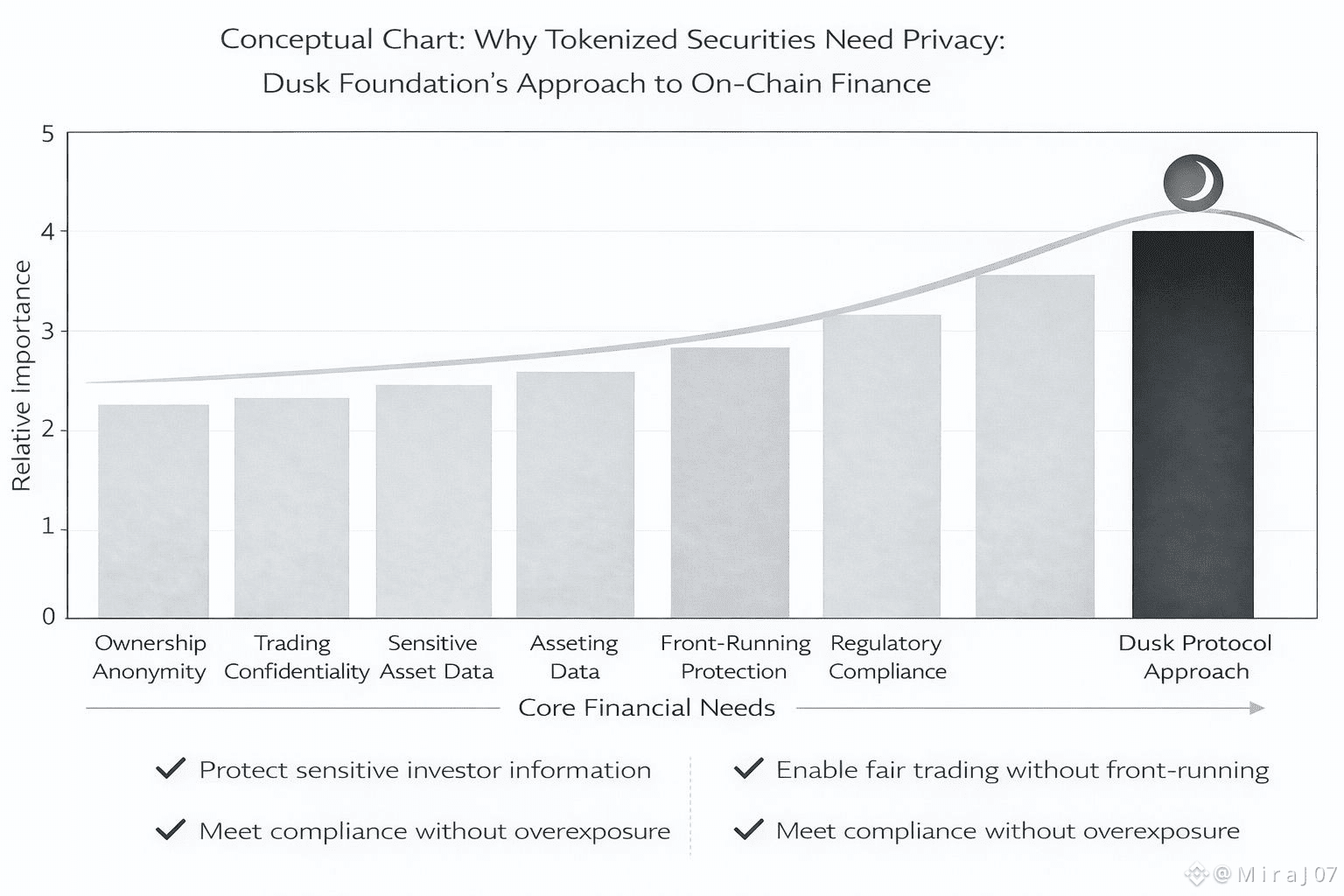
 Tokenization isn’t failing because blockchains can’t move assets it’s failing because they can’t protect them.
The crypto industry loves to talk about tokenized securities like they’re inevitable: stocks on-chain, bonds on-chain, funds on-chain, global markets running 24/7 with instant settlement. But if you look closely at why most tokenization experiments stall, the problem is rarely the issuance itself.
The real obstacle is what happens after issuance: trading, settlement, compliance, and confidentiality.
Securities markets don’t just need transparency. They need privacy the functional kind that makes institutions comfortable, strategies defensible, and compliance enforceable. This is where Dusk Foundation’s approach becomes unusually important.
Securities Are Not Tokens They Are Legal Agreements
A memecoin can be transferred freely. A security cannot.
Securities are wrapped in rules:
who is allowed to buy
who is allowed to hold
where it can be traded
when it can be transferred
how ownership must be recorded
what disclosures must exist
how audits are performed
Most blockchains treat assets like simple balances. Tokenized securities are not simple balances. They are regulated financial instruments with constraints that must be enforced without breaking market functionality.
Dusk is building for that reality, not for the fantasy of “everything liquid, everything public.”
The uncomfortable truth: public blockchains turn securities into public intelligence.
In public DeFi, transparency is celebrated. In securities markets, transparency without control becomes a liability.
If tokenized securities run on fully transparent chains, anyone can track:
cap tables
investor concentration
treasury allocations
fund accumulation behavior
insider trading signals
institutional strategy shifts
This creates problems that don’t exist in traditional markets because TradFi is confidential by default. Investors don’t broadcast their positions. Companies don’t expose shareholder movements in real time. Funds don’t publish their rebalancing strategies to competitors.
A public blockchain does.
That’s why tokenized securities need privacy not as ideology, but as operational survival.
Why Tokenized Securities Need Privacy (Beyond “User Protection”)
1) Cap Table Confidentiality
For issuers, the cap table is sensitive. Public visibility creates:
competitive intelligence leaks
strategic vulnerability during fundraising
social pressure and manipulation risks
investor privacy violations
Tokenization can’t scale if every company is forced to publish ownership data like a live dashboard.
2) Market Integrity
Public positions become attack surfaces. In open ledgers, sophisticated actors can:
front-run accumulation
manipulate thin liquidity
target large holders
coordinate pressure campaigns
exploit predictable flows
Privacy reduces predatory behavior by removing exploitable signals. This is not hiding wrongdoing it’s preventing markets from being gamed.
3) Institutional Participation
Institutions do not operate in environments where every trade reveals intent.
A fund that buys quietly in TradFi cannot buy quietly on a fully transparent chain. The moment it starts accumulating, the market reacts. That creates slippage, increases costs, and destroys strategy performance.
Without privacy, tokenized securities remain retail-only experiments.
4) Compliance Without Surveillance
Regulation is not a demand for public exposure. It’s a demand for enforceable rules.
The best systems don’t force everyone to disclose everything. They allow:
audits when justified
disclosures to authorized entities
enforcement without public doxxing
This is the logic of modern finance: confidentiality plus accountability.
Tokenized securities need the same.
Dusk Foundation’s Core Insight: Selective Disclosure, Not Anonymity
Dusk doesn’t treat privacy as invisibility. It treats privacy as controlled visibility.
This is the key distinction.
With selective disclosure, participants can prove statements like:
“This investor is eligible.”
“This transfer respects jurisdiction rules.”
“This asset is under lock-up.”
“This trade meets compliance requirements.”
without exposing full identity details, holdings, or transaction history to the public.
This is privacy that regulators can accept because it preserves enforceability.
A practical example: tokenized equity transfers
Imagine a tokenized equity that can only be held by verified investors in approved jurisdictions.
On most chains, enforcing that means:
centralized whitelist contracts
heavy permissioning
intrusive identity exposure
limited composability
On Dusk’s approach, compliance can be enforced through proofs:
eligibility is verified
restrictions are respected
ownership remains confidential
the network still validates correctness
That is how tokenized securities can behave like real securities.
Privacy is also what protects issuers from becoming prey
Issuers are not just worried about privacy they’re worried about manipulation.
If a company’s tokenized equity is publicly traded with transparent cap table flows, attackers can:
map major holders
coordinate price attacks
pressure investor confidence
exploit treasury movements
Privacy becomes a shield against hostile market behavior, making tokenized markets less fragile.
Tokenized securities also require private settlement
Settlement is where real-world finance becomes serious.
In TradFi, settlement is confidential. Participants don’t broadcast:
trade size
counterparty identity
settlement terms
custody flows
A public blockchain settlement layer breaks this norm instantly.
Dusk’s vision of confidential settlement ensures:
trades settle deterministically
ownership updates correctly
sensitive details remain protected
compliance remains provable
This is the only way to make tokenized securities feel like a real financial instrument instead of a public experiment.
The Future of On-Chain Finance Is Not Fully Public It’s Selectively Provable
The next era of tokenization won’t be won by chains that shout “transparency.” It will be won by chains that quietly deliver:
confidentiality for participants
enforceability for regulators
market integrity for traders
safety for issuers
scalability for institutions
Dusk Foundation’s approach is built for exactly this world.
It recognizes that privacy isn’t a luxury feature it is the operating system of real finance.
Conclusion: Tokenization Needs Privacy to Become Real
Tokenized securities are often presented as a technology problem. In reality, they are a market design problem.
If tokenized markets force issuers and investors into permanent public exposure, adoption will never reach scale. Dusk’s privacy-first, compliance-ready framework offers a path where securities can live on-chain without breaking the rules that make securities markets functional.
The future of finance isn’t invisible.
It’s verifiable, enforceable, and confidential by design.
Transparency builds trust in open networks, but confidentiality builds stability in capital markets and the networks that can deliver both will define the next generation of on-chain finance.