

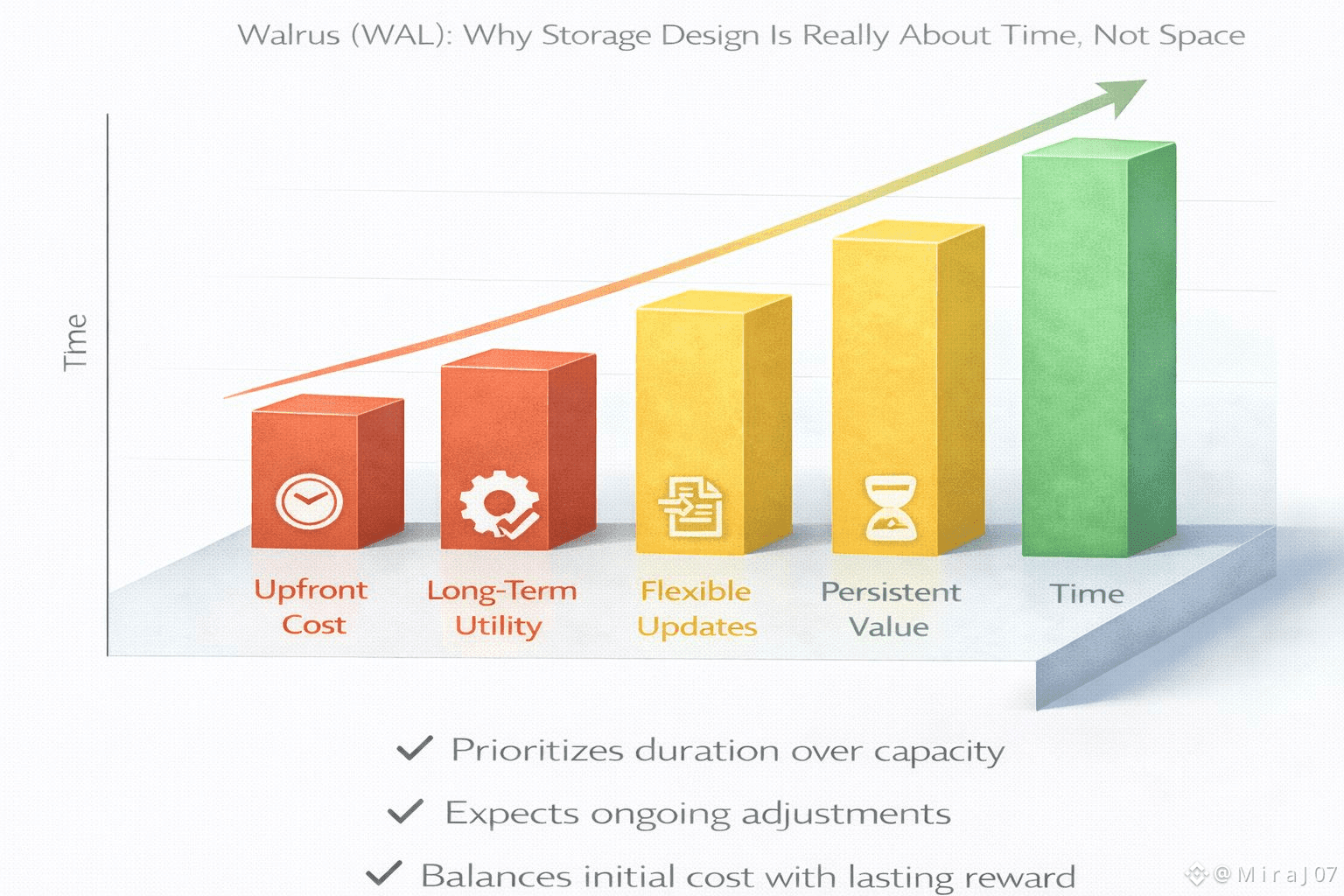
Storage is usually explained as space. The real problem is time.
Most storage conversations start with volume: how much data can be stored, how cheaply, with how many replicas, across how many nodes. These are spatial questions. They look measurable, scalable, and technical.
But storage systems don’t fail because they run out of space.
They fail because time changes everything:
incentives decay,
attention fades,
applications disappear,
recovery windows close,
responsibility evaporates.
That’s why storage design is really about time, not space and it’s the correct lens for understanding Walrus (WAL).
Space answers “where is the data?” Time answers “will it still matter when needed?”
Spatial thinking produces metrics like:
replication factor,
node count,
storage capacity,
geographic distribution.
Time thinking produces different questions:
Will this data still be usable in 6 months?
Who maintains it when demand drops?
How early does degradation become visible?
Can recovery happen before urgency becomes irreversible?
Most storage systems are engineered for space and marketed with space. The hard part time is where trust is won or lost.
Time is the hidden adversary of every decentralized system.
Over time:
rewards change,
validators reprioritize,
maintenance becomes optional,
repair is postponed,
redundancy quietly thins.
Nothing dramatic happens. That’s the danger. Storage rarely collapses in a single event. It degrades like a relationship: slowly, quietly, and then suddenly beyond repair.
Space-based designs don’t notice this drift early enough. Time-based designs assume it from the start.
The most important storage guarantee is not persistence it’s recoverability over time.
Data can “exist” and still be unrecoverable in practice:
too expensive to retrieve,
too fragmented to assemble,
too slow to matter,
too disputed to trust.
Recoverability is time-sensitive. It has an expiration date. The cruel part is that users usually discover the expiration only after it passes.
Walrus is designed to prevent recoverability from silently expiring.
Most systems optimize for today’s retrieval, not tomorrow’s accountability.
When storage is designed around present conditions:
it assumes monitoring stays strong,
it assumes incentives remain attractive,
it assumes teams remain active,
it assumes repair remains rational.
But time breaks assumptions. When attention fades, silence becomes cheaper than action, and responsibility diffuses into “the network.”
Walrus treats this as the baseline scenario, not an edge case.
Walrus designs storage like a long-term obligation, not a short-term service.
Time-first storage must answer:
What happens when nobody is watching?
What happens when the app that created the data is gone?
What happens when the data becomes evidence in a dispute?
What happens when incentives weaken but retrieval becomes urgent?
Walrus emphasizes:
early visibility of degradation,
enforceable incentives against neglect,
repair behavior that stays rational under low demand,
accountability that doesn’t vanish with time.
This is storage engineered for the long horizon where real value lives.
As Web3 matures, time becomes the real scaling problem.
Storage increasingly supports:
governance legitimacy,
financial proofs and settlement artifacts,
application state and recovery snapshots,
compliance and audit trails,
AI datasets and provenance.
These datasets are valuable because they persist across years. But time introduces new threats:
legal scrutiny,
disputed history,
shifting economic conditions,
changing participant incentives.
A storage protocol that scales space but fails time is not scalable infrastructure. It’s a short-lived convenience.
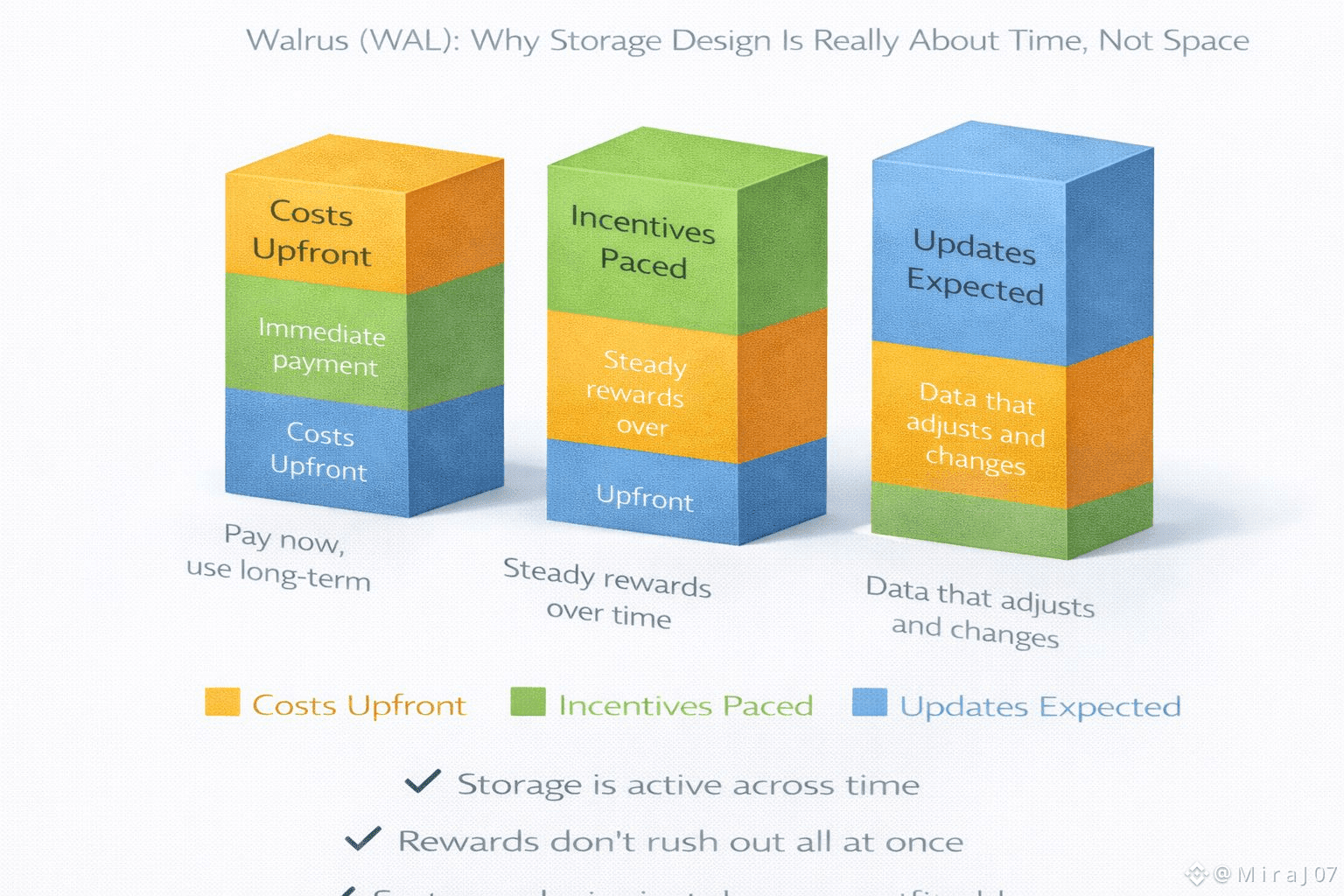 Walrus aligns with the reality that time is the true scaling frontier.
I stopped asking how much storage a network has.
Because capacity is not the hard part anymore.
I started asking:
What does this system look like in a bear market?
What does it look like after the original builders leave?
What does it look like when data becomes evidence?
What does it look like when users return years later needing proof?
Those questions measure time resilience the only kind of resilience that matters.
Storage design is really the art of preventing late regret.
When storage fails, it rarely fails today. It fails by revealing that the last safe day was months ago when repair was cheap, signals were visible, and action was still possible.
That’s why time is the real battlefield:
can the system force action early?
can it surface decay before irreversibility?
can it keep responsibility alive longer than attention?
Walrus earns relevance by treating these questions as the foundation of storage, not the footnotes.
Space keeps data somewhere. Time decides whether it still counts.
A storage system can store data across thousands of nodes and still lose history through neglect, drift, and unusability. What survives isn’t what was stored it’s what remained recoverable and defensible across time.
That is the true purpose of storage design.
Scaling storage is easy; scaling responsibility across time is the real engineering challenge.

