

 Plasma scaling isn’t “trustless magic” it’s a carefully engineered system where validator incentives determine whether users stay safe.
In rollup narratives, the word “validator” often means someone verifying proofs or challenging fraud. Plasma works differently. Execution happens off-chain, commitments are posted on-chain, and user safety relies on a combination of cryptographic proofs and economic enforcement.
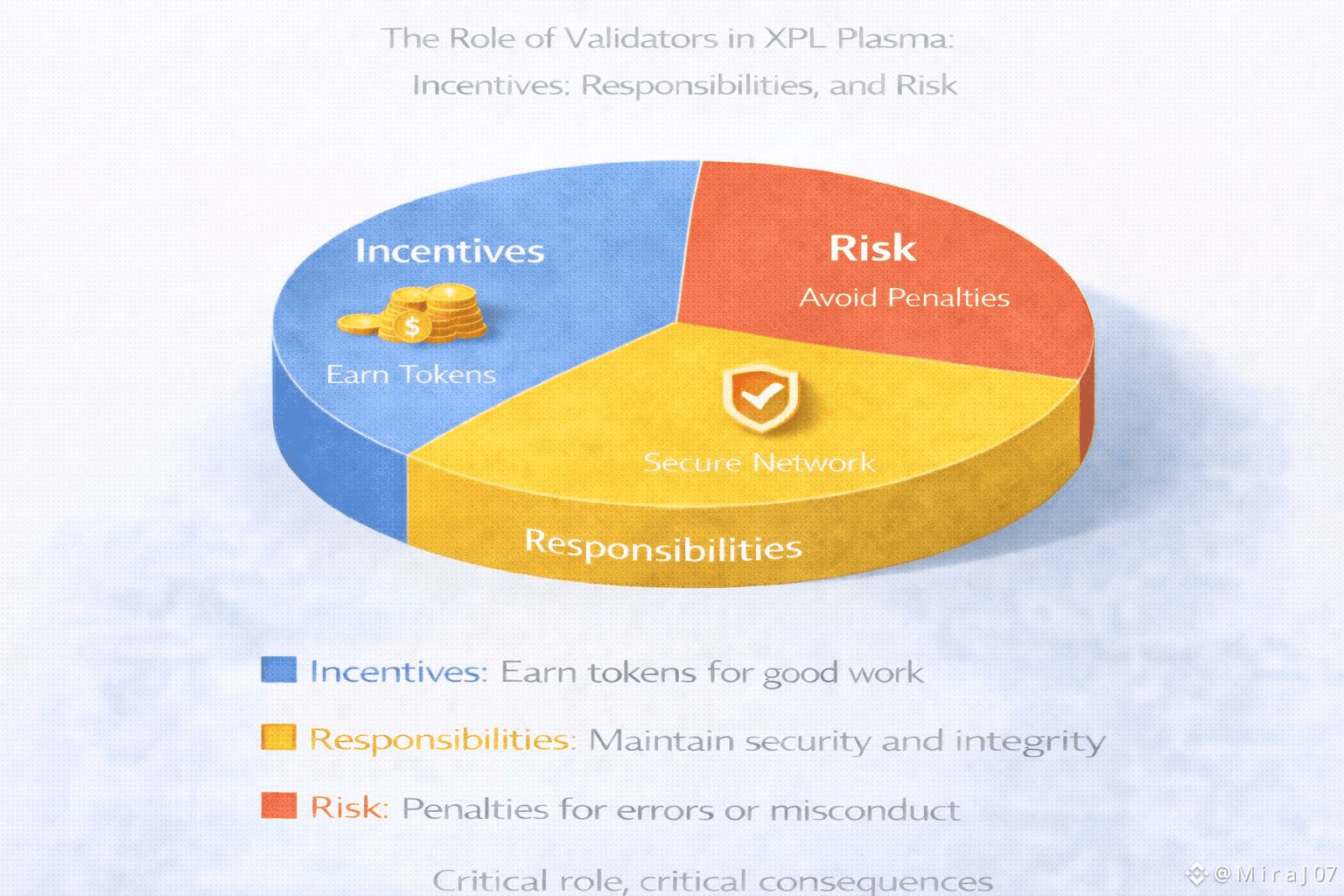
In XPL Plasma, validators are not just passive observers. They are the economic backbone that keeps the chain honest, available, and dispute-ready.
To understand XPL Plasma’s security, you don’t start with throughput.
You start with validator behavior.
Validators exist because Plasma must assume adversarial conditions.
Plasma systems are designed around worst-case thinking:
the operator could censor
the operator could publish invalid state
data could become temporarily unavailable
exits could be spammed
users might not monitor continuously
Validators are the distributed counterweight to these risks. Their job is not only to “sign blocks,” but to ensure the system remains contestable, enforceable, and economically secure.
1) What validators actually do in XPL Plasma
Validators are responsible for keeping the chain credible both technically and economically.
In a Plasma-based architecture, validators usually carry out various network support services, including:
verification of state commitments to Ethereum
checking transaction validity according to protocol rules
invalid transitions, or state roots with inconsistencies
for fraudulent egress and preparation of challenges
supporting data availability signals (encouraging users to reconstruct state)
supporting liveliness through continuous network involvement
in decision-making processes or updates to parameters if it applies
Their role is better defined by continuous risk monitoring, not just the production of blocks.
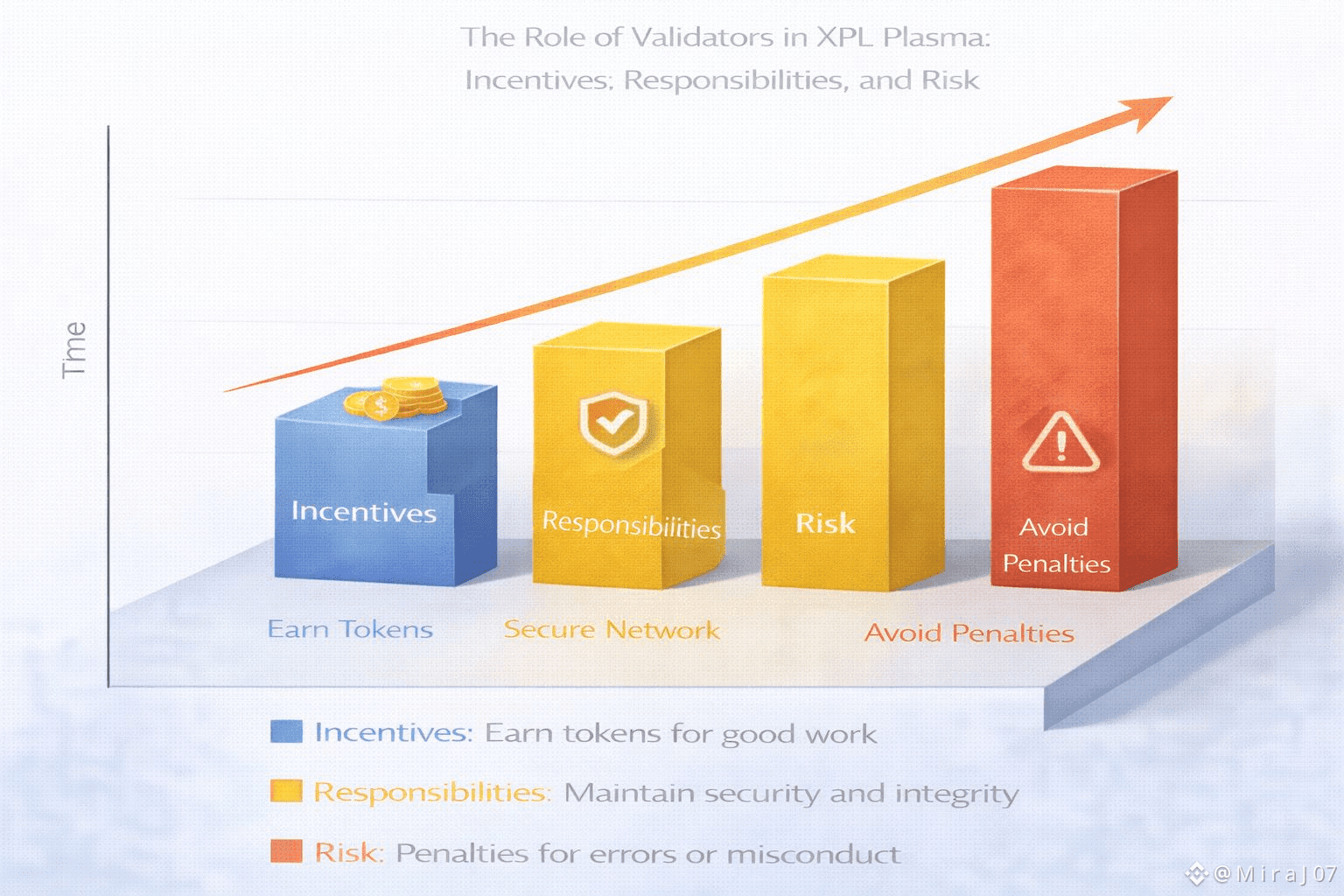
2) Incentives: Why validators remain honest
The plasma, as described, also requires incentive alignment, as it is not capable of sustaining constant L1 enforcement.
Validators are generally incentivized for:
network participation (availability and accuracy)
security monitoring (fraud attempt detection)
data availability for supportive evidence (state availability)
invalid exits when malicious claims arise
the integrity of the off-chain execution layer The overriding principle is this: validators need to earn more protecting the system than they can by exploiting it.
In XPL Plasma’s case, the economic design must make it irrational to collude, censor, or allow fraud to pass unchallenged.
3) Responsibilities: what happens if validators fail
The most dangerous failure mode in Plasma is not theft it’s silence.
Plasma security is based on the assumption that fraudulent behaviour will be challenged. If the validators never act, the system is open to:
invalid exits being finalized
state commitments being accepted without scrutiny
operator's ill-behavior unchecked
users losing confidence and triggering mass exits.
systemic liquidity and reputation collapse
For this very reason, validator responsibility is not optional.
It is the enforcement layer that keeps Plasma honest.
4) Risk: what validators themselves are exposed to
Validators bear the risks of operation, capital, and reputation.
Validator risk generally involves:
Operational risk
downtime penalties
failure to timely monitor exits
missed challenge windows
inability to access data at times of stress
Risk of capital
slashing (if implemented) of provable misbehaviour
Opportunity cost of locked stake
volatility of token exposure
Adversarial risk
Targeted attacks includes DDoS, censorship pressure.
attempts at bribery
social engineering attacks on infrastructure
Reputational risk
losing delegations
being excluded from trusted validator sets reduced influence on governance Plasma validators are not just earning yield; they are underwriting system integrity.
5) The operator–validator relationship: balancing speed and accountability
XPL Plasma must preserve high throughput without concentrating power.
A Plasma operator can execute fast because it isn’t constrained by L1 execution limits. But that speed introduces a temptation: centralized control.
Validators balance the operator in the following ways:
auditing promises
Commit
Enforcing Challenge Readiness
Ensuring the operator cannot rewrite history undetected.
to provide credible exit safety for users
This relation is equivalent to:
a high-speed exchange (operator)
monitored by regulators and auditors (validators)
This creates performance with accountability.
6) Why validators are critical during “bank-run” moments
The exit mechanism is only as strong as the validator layer that protects it.
In panic scenarios:
many users attempt exits
malicious actors try to exploit congestion
fraudulent claims increase
data availability can be stressed
Validators become the emergency infrastructure that:
prioritizes fraud detection
challenges invalid exits
keeps the system verifiable under load
maintains user trust during volatility
This is the moment Plasma architecture is tested and where validator quality becomes the difference between survival and collapse.
7) The long-term outcome: validators become the credibility layer for Plasma-based finance
If XPL Plasma succeeds, validators will be seen less like miners and more like risk managers.
In mature financial markets, the most valuable infrastructure isn’t just trading speed it’s settlement trust.
Validators in XPL Plasma represent:
continuous verification
dispute readiness
economic enforcement
system credibility
This is what allows Plasma to scale aggressively while still giving users the most important guarantee:
you can always exit with your funds.
Speed creates value, but enforcement creates trust. In Plasma systems, validators are the invisible workforce that turns throughput into credibility.