
Dusk Network is basically trying to solve one uncomfortable truth: public blockchains are too public for most real financial activity.
Dusk In normal markets, privacy isn’t some optional add-on. It’s foundational. Firms can’t broadcast their positions, trading intent, counterparties, settlement details, or cap-table movements to the entire world in real time. That level of transparency doesn’t create “fairness” — it creates predictable attack surfaces: front-running, strategy leakage, copy-trading, and surveillance. Dusk is building a chain where confidentiality is part of the base logic, while still keeping the system verifiable and usable for regulated workflows.
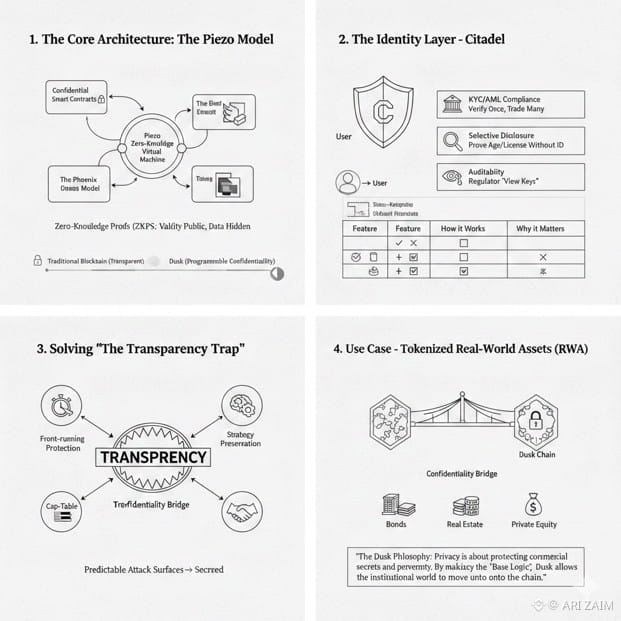
Dusk What makes Dusk feel different from a lot of “privacy chain” talk is that it doesn’t treat privacy like a single switch you flip. It treats privacy like an engineering discipline you design around. Their core idea is: you can have a public network that still supports confidential activity, and you can do it in a way that doesn’t become a black box. That “privacy + auditability” balance is why they keep anchoring the narrative around regulated assets, compliant DeFi, and tokenized real-world instruments — the stuff that collapses on fully transparent rails.
Dusk Behind the scenes, the project has been moving toward a modular structure, and that’s a big deal for how they plan to scale adoption. Instead of forcing everything into one monolithic chain, the direction is more like: keep settlement and security strong at the base, make execution flexible, and leave room for deeper privacy computation as the system matures. The settlement layer is where finality and staking live; execution layers can evolve faster without constantly destabilizing the core. That’s the kind of architecture choice you usually see when a team is aiming for long-term infrastructure rather than short-term hype.
Dusk A practical part of that strategy is meeting developers where they already are. Dusk’s EVM path is essentially an “easy on-ramp” so builders can deploy familiar contracts with familiar tools while the broader ecosystem forms. It’s not the end vision — it’s the adoption bridge. The deeper vision is where Dusk tries to earn its keep: privacy models and transaction logic designed for financial constraints, not just anonymous transfers.
Dusk Two names you’ll see come up a lot in their technical story are Phoenix and Zedger. The simple way to think about Phoenix is that it’s their privacy-forward transaction model — the machinery for making transfers and smart-contract style behavior work without exposing everything on-chain. Zedger is where the project leans into the reality of securities and regulated assets: it’s aimed at workflows like whitelisting, controlled transfers, and cap-table style reconstruction when legally required. That’s a very “finance-native” problem framing: not “hide everything always,” but “keep sensitive information private while allowing the right disclosures at the right time.”
Dusk And then there’s the “grown-up” side of building networks: operations. When projects move from theory to production, it’s not just code anymore — it’s monitoring, wallet hygiene, infrastructure security, upgrade procedures, and incident response. Dusk has publicly communicated operational events around bridge services in the past, and whether someone views that as a red flag or a maturation moment depends on how they interpret it. My read: the important signal is not “nothing ever happens,” because that’s unrealistic; it’s whether the project has the discipline to detect issues, act quickly, communicate clearly, and harden systems afterward. Infrastructure projects don’t get judged by how perfect their slide decks are — they get judged by how they behave when real conditions hit.
Dusk As for the project’s token, the most useful way to think about it (purely in the context of the project) is as the network’s working fuel and security lever. DUSK is meant to underpin staking, validator incentives, and network fees — the mechanics that keep settlement final and the chain secure. Like many projects that began life in the Ethereum era, Dusk has also had representations off-chain or on other chains historically, but the long-term “project story” centers on native network utility: validators secure the chain, users pay for execution, and the system’s economics are designed to keep that loop running for years rather than months.
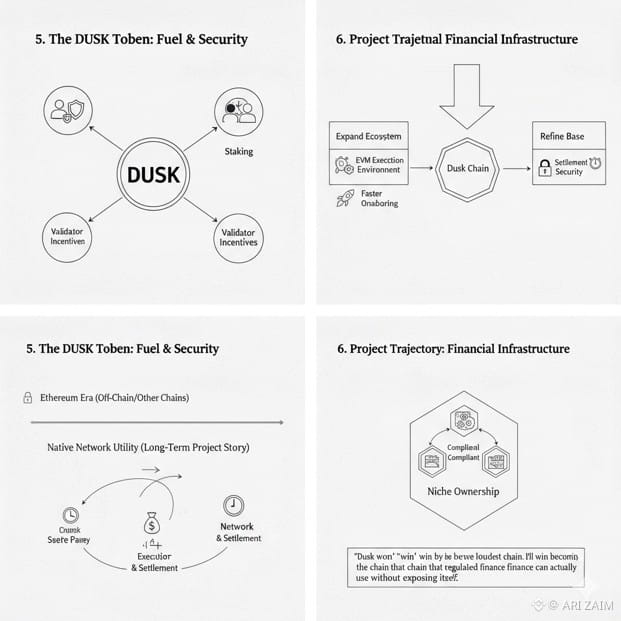
Dusk Where it all seems to be heading is pretty consistent: expand the ecosystem around the EVM execution environment for faster onboarding, keep refining the settlement/security base, and push further into the niche they actually want to own — confidential, compliant financial infrastructure. If they pull that off, Dusk won’t “win” by being the loudest chain. It’ll win by becoming the chain that regulated finance can actually use without exposing itself.
Dusk is playing a slower, harder game than most. Privacy plus compliance plus finality isn’t an easy combo, and it’s not something you can fake with branding. But if crypto is ever going to host real markets at meaningful scale, it needs more than transparent ledgers and vibes — it needs infrastructure that respects how finance really works. Dusk is betting that the future doesn’t belong to the most visible chain, but to the chain that lets serious activity happen quietly, correctly, and verifiably.
