

I’ve said this before, and I’ll say it again: Web3’s biggest problem was never just the tech. It was the experience of walking into it.
Most people don’t bounce because they hate ownership, wallets, tokens, or digital assets in some deep philosophical sense. They bounce because the whole thing often feels annoying right out of the gate. Too many products greet you like you’ve already done the reading. Connect this. Sign that. Understand these three tokens. Figure out why gas matters. Learn the local slang while you’re at it. It’s a terrible way to meet normal people.
That’s why Pixels matters.
Not because it “solves onboarding” in some grand, chest-thumping way. It doesn’t. Let’s not get carried away. But it does something most Web3 games still fail to do: it lets people settle in before hitting them with the machinery underneath.
That sounds small. It isn’t.
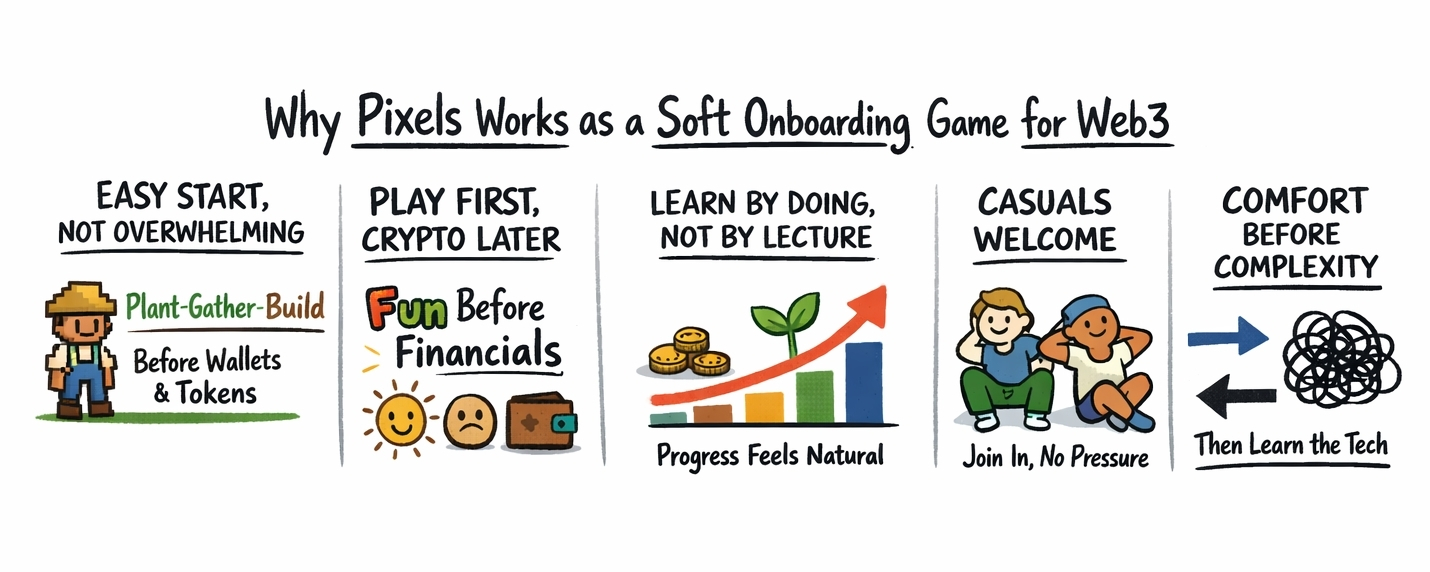
Pixels works because it doesn’t feel like an onboarding funnel wearing a game costume. It feels like a game first. A light one, sure. A simple one in a lot of ways. But that’s exactly the point. It gives you something familiar before it asks you to care about the system behind it. And in Web3, that’s rare enough to stand out.
The real onboarding failure in this space has always been psychological more than technical. People love pretending it’s a tooling problem. Better wallet UX. Faster chains. Lower fees. Cleaner sign-in flow. Fine. All useful. But none of that matters if the first ten minutes still make a new user feel like they’re one wrong click away from doing something stupid.
That’s the actual friction. Not just buttons. Anxiety.
Pixels lowers that anxiety by using a format people already understand. You walk around. You gather resources. You plant things. You complete tasks. You return later and make a bit more progress. Nothing about that is revolutionary. Good. It shouldn’t be. Sometimes the smartest design choice is not inventing some weird new interaction model just so the product feels “innovative.”
Honestly, a lot of Web3 projects would benefit from being less obsessed with looking novel and more obsessed with being readable.
Pixels is readable.
That’s a huge advantage because familiarity does heavy lifting. When someone opens a farming game, they more or less know how to behave. Not perfectly, obviously. But enough. Enough to relax a little. Enough to stop scanning the room for traps. Enough to ask the right early question, which is not “How do I optimize this economy?” but “Alright, what do I do first?”
That difference matters more than people admit.
Most Web3 games ask for economic awareness too early. They want users to understand value before they understand play. That’s backwards. A player shouldn’t have to care about token logic before they’ve even formed a basic relationship with the world. If anything, the world should earn that interest over time. Pixels gets closer to that sequence than most.
It leads with routine. Small progress. Low-stakes interaction. That’s not flashy, but it’s effective.
And farming games are weirdly perfect for this kind of thing. Think about it. They’re built around loops that almost explain themselves. Plant. Wait. Harvest. Upgrade. Repeat. You don’t need a whitepaper for that. You don’t need a lecture about ownership primitives or incentive alignment. You just do the thing, and the system starts making sense through repetition.
That’s where Pixels gets clever.
It’s not just hiding Web3 behind cute visuals and cozy pacing. It’s teaching players the basic logic of digital systems without forcing them to sit through the usual nonsense. You start to understand resource flow, scarcity, time-based production, task prioritization, and the way incentives subtly shape behavior. Not because the game stops to explain it. Because you feel it while playing.
That’s how people actually learn.
Not from a giant wall of text. Not from a roadmap deck. Definitely not from some painfully polished explainer full of startup jargon. They learn by doing something a few times and noticing what happens.
Pixels gives them that runway.
And that’s what I mean by soft onboarding. It’s not “easy mode.” It’s not dumbed down. It’s not shallow by definition. It just means the first hour feels safe enough for people to keep going. The game isn’t barking instructions at you while also quietly pressuring you to become a part-time market analyst. It lets you breathe.
That’s important because most people do not want to be onboarded into Web3. They just want to play something decent.
This is where a lot of teams get confused. They think users need to be sold on the future before they’ll engage with the product. No. Usually the opposite. People engage first when something feels natural, then they become more open to the infrastructure behind it. Adoption is usually boring before it becomes meaningful. That’s just how it works.
Nobody wakes up hoping to be “educated” by a wallet-connected ecosystem.
They want a reason to care.
Pixels offers one by making the first interaction feel normal. Maybe even a little cozy. And that matters because comfort is often the missing step between curiosity and retention. If the early experience feels tense, overly financial, or full of hidden obligations, most users won’t stay long enough to understand anything deeper.
Retention is the real tutorial. Always has been.
If someone comes back five times, they learn. If they leave after ten minutes, all the elegant token design in the world is irrelevant. Dead on arrival. Pixels seems to understand that better than projects that are far more ambitious on paper.
Now, does that mean Pixels is some flawless model for Web3 gaming? Of course not.
Let’s not pretend a soft entry solves the harder problems waiting underneath. It doesn’t. Once players get comfortable, the same old tensions still show up. Who’s here to play? Who’s here to earn? Who’s here to optimize every second until the game starts feeling like unpaid spreadsheet labor? That stuff doesn’t vanish because the onboarding is friendlier.
If anything, success at onboarding makes those structural problems more important, not less.
Because then the question becomes: okay, you got people in. Now what?
Can the economy stay healthy once more users start pushing on it? Can reward systems support play without swallowing it whole? Can a game remain socially alive once efficiency-minded behavior starts dominating the culture? These are not side issues. They’re central. And Web3 games keep relearning that the hard way.
Still, onboarding is where most of them fail first. So it matters when one gets that part mostly right.
Another thing Pixels gets right is that it allows people to be casual. That sounds almost too basic to praise, but in Web3 it’s a genuine strength. A lot of ecosystems end up rewarding only the most intense participants. The grinders. The early insiders. The people willing to learn every edge case and squeeze every system. Everyone else starts feeling like background noise.
That’s bad design if you’re trying to build an actual world.
Games need casual users. They need drifters, decorators, social players, part-time returners, curious lurkers, people who just like being around. Those users make the place feel inhabited. When a game only really values maximizers, it starts getting cold. Less like a world, more like a machine. Pixels, at least early on, feels more open than that.
And that openness matters for skeptical users too.
Let’s be honest: a lot of players hear “Web3 game” and immediately assume the worst. Cash grab. Thin gameplay. Economy first, fun later. Sometimes they’re wrong. Sometimes they’re dead right. The reputation didn’t come from nowhere. So if your goal is to reach people outside the existing bubble, you can’t open with a pitch deck disguised as game design.
Pixels doesn’t. That’s one of its smartest choices.
It gives skeptical players something they can judge on normal terms. Is this readable? Is it pleasant? Do I understand the loop? Do I want to come back tomorrow? Those are real questions. Grounded questions. Once players start there, they’re far more likely to explore the rest.
That’s why I keep coming back to the word “soft.” Not weak. Not vague. Soft in the sense that the edges aren’t immediately hostile. Soft in the sense that the player isn’t being shoved into financial seriousness before they’ve even developed muscle memory. Soft in the sense that the product understands a basic truth: most people need to feel comfortable before they feel curious.
Web3 still struggles with that. Badly.
There’s also a broader lesson here that goes beyond Pixels. Builders in this space spend way too much time talking about onboarding like it’s a technical hurdle and not enough time treating it like an emotional one. But the emotional part is where users make the decision to stay or leave. Do they feel stupid? Do they feel behind? Do they feel pressured? Do they feel like they need to care about ten systems at once? If yes, they’re probably gone.
So what should other Web3 games learn from this?
First, stop leading with the economy. I get why teams do it. The economic layer is often the thing they’ve spent the most time designing. It’s the part investors ask about. It’s the part communities love to speculate on. But a player’s first concern is much simpler: is there anything here I actually enjoy doing?
If the answer is no, your token doesn’t save you.
Second, use familiarity without being embarrassed about it. Not every product needs to reinvent interaction. Familiar genre language is useful because it gives players confidence early. That confidence buys you attention. Attention buys you time. And time is what lets deeper systems become understandable.
Third, don’t confuse complexity with depth. This one drives me nuts. A product is not deep just because it’s difficult to parse. Sometimes it’s just messy. Real depth usually reveals itself over time. It doesn’t need to scream from the first screen.
And fourth, make room for people who aren’t trying to become full-time operators inside your game. Casual players are not dead weight. They are part of what makes a game feel human.
Pixels isn’t important because it proves farming games belong on-chain or because it magically cracks mass adoption. That’s too neat. Too clean. Reality’s messier than that. It matters because it shows that the path into Web3 doesn’t have to feel like administrative labor. It can start with something ordinary. Something understandable. Something that doesn’t immediately ask the user to pick a side in the future-of-the-internet debate.
That’s a bigger lesson than it might seem.
People usually adopt new systems through habit before belief. They do the thing because it feels easy enough, useful enough, or interesting enough. Then, later, they realize they’ve become comfortable with ideas that once felt foreign. That’s how real onboarding happens. Quietly. Through behavior.
Pixels gets that.
And honestly, more Web3 products should.