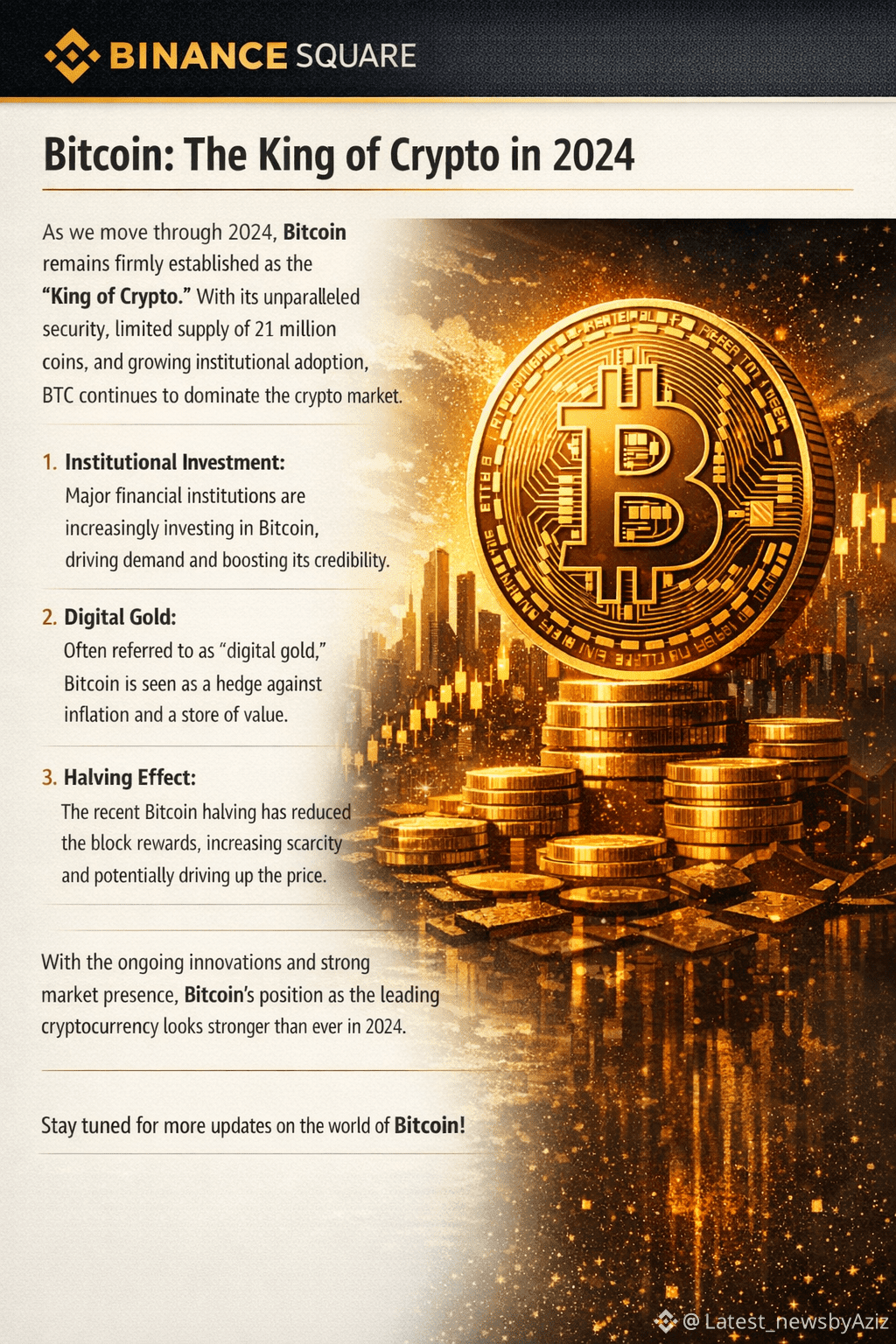
$BTC Btc 2025: From Digital Asset to Global Financial Anchor
By Binance Square Contributor
Bitcoin has always moved in cycles — of price, perception, and purpose. In 2025, however, Bitcoin is no longer just moving in cycles; it is maturing into infrastructure. What began as a peer‑to‑peer experiment has evolved into a global financial asset that governments, institutions, and everyday users can no longer ignore.
A New Phase of Bitcoin Adoption
The biggest shift around Bitcoin today is not its price — it is its position. Bitcoin has transitioned from a speculative instrument into a strategic asset. Spot Bitcoin ETFs, institutional custody solutions, and regulated on‑ramps have dramatically reduced friction for large capital to enter the market. This has changed market behavior: volatility still exists, but liquidity is deeper and participation is broader.
Retail users are also evolving. Instead of asking “Is Bitcoin real?” the question has become “How does Bitcoin fit into my financial plan?” Long‑term holding, dollar‑cost averaging, and self‑custody education are now mainstream ideas rather than niche crypto concepts.
Bitcoin as Digital Property
One of the most important narratives gaining strength is Bitcoin as digital property. Unlike fiat currencies, Bitcoin cannot be printed, frozen, or diluted by policy decisions. Its fixed supply of 21 million coins creates a form of scarcity that mirrors — and in some ways surpasses — physical assets like gold.
In regions facing currency devaluation or capital controls, Bitcoin is increasingly viewed as a neutral, borderless store of value. This use case is not theoretical anymore; it is practical, lived, and growing.
Mining, Energy, and Sustainability
Critics have long targeted Bitcoin’s energy usage, but the conversation has matured. Bitcoin mining is becoming more efficient and increasingly aligned with renewable and stranded energy sources. In many cases, mining now acts as a buyer of last resort for excess energy, improving grid stability rather than harming it.
This evolution reframes mining from a cost to a tool — one that incentivizes cleaner energy infrastructure and innovation.
The Role of Bitcoin in a Multi‑Chain World
Despite the rise of smart‑contract platforms, Layer‑2 solutions, and tokenized ecosystems, Bitcoin’s role remains unique. It does not compete on features; it competes on trust. Security, decentralization, and immutability remain its core strengths.
With Layer‑2 technologies like the Lightning Network continuing to improve, Bitcoin is expanding its utility without compromising its base‑layer integrity. Payments, micro‑transactions, and cross‑border transfers are becoming faster and cheaper while maintaining Bitcoin’s security model.
What Comes Next?
Bitcoin’s future is unlikely to be explosive in the way early cycles were — and that is a sign of success. Maturity brings stability, resilience, and integration. Bitcoin is steadily embedding itself into global finance, not as a replacement for everything, but as a foundation that strengthens the system.
The real question for #2025Prediction is no longer whether Bitcoin will survive, but how deeply it will be woven into everyday economic life.
$BTC is not just an asset anymore.
It is an idea whose time has arrived.
Disclaimer: This article is for informational purposes only and does not constitute financial advice.