
Introduction: The Evolution Challenge in Blockchain Design
Blockchain technology has evolved rapidly over the past decade, introducing decentralized ledgers, programmable smart contracts, and open financial systems that operate without centralized intermediaries. These innovations have enabled new forms of coordination, ownership, and value exchange on a global scale.
Despite this progress, many blockchain protocols still rely on largely static designs. Fixed incentive schedules, rigid fee structures, and slow governance processes remain common, even as the environments these systems operate in become increasingly dynamic.
Crypto markets change quickly. User behavior shifts, liquidity moves across chains, risk conditions fluctuate, and new use cases emerge faster than most governance mechanisms can realistically respond. This mismatch between static protocol parameters and real-world conditions often leads to inefficiencies, degraded user experience, and long-term sustainability challenges.
APRO proposes a different approach. Instead of treating protocols as static infrastructure, it frames them as adaptive systems—capable of responding to measurable outcomes over time while remaining transparent, decentralized, and governance-constrained. Rather than replacing governance, APRO aims to complement it by reducing operational friction and improving systemic resilience.
What Is APRO?
APRO can be described as an Adaptive Protocol for Real-world Optimization. Its core objective is to enable decentralized systems to refine their behavior over time using transparent feedback mechanisms.
Traditional protocol design often assumes that parameters defined at launch will remain effective indefinitely. APRO challenges this assumption by emphasizing adaptability as a first-class design principle.
At a high level, APRO is built around three core ideas:
Continuous performance monitoring based on on-chain and protocol-relevant data
Modular optimization components that manage specific system functions
Governance-defined boundaries that limit how automated adjustments can occur
Together, these elements allow protocols to evolve gradually and predictably, without requiring constant manual intervention or frequent governance votes for minor operational changes.
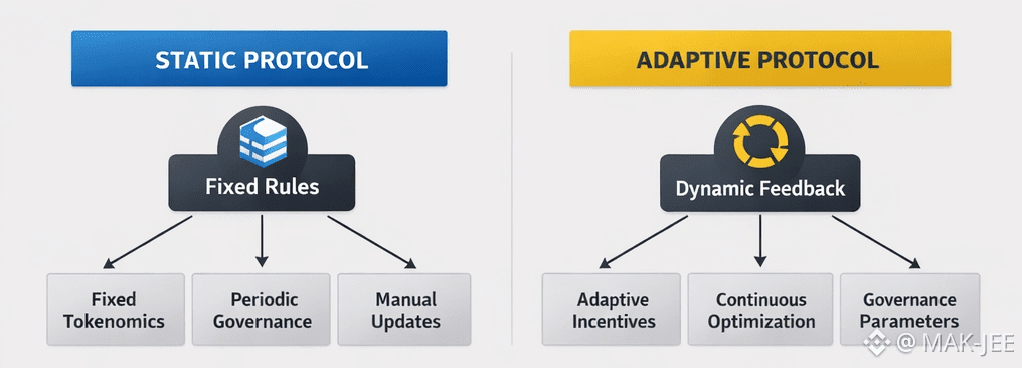
Comparison between fixed-parameter systems and APRO-style feedback-driven systems
The Core Problems APRO Addresses
1. Static Incentive Structures
Many blockchain protocols rely on predetermined reward schedules to attract users and liquidity. While these incentives can be effective during early growth phases, they often fail to adapt as network conditions change.
Over time, static incentives may encourage short-term behavior, capital cycling, or extractive participation rather than sustained contribution. Once rewards decline or market conditions shift, user engagement can drop sharply.
APRO introduces the concept of adaptive incentives. Instead of distributing rewards solely based on fixed formulas, incentive allocation can respond to observed outcomes such as:
User retention over time
Consistency of activity rather than raw volume
Quality of network participation and usage patterns
This allows protocols to align incentives more closely with long-term health rather than short-term metrics.
2. Governance Scalability
Decentralized governance is a foundational principle of blockchain systems, but it does not scale easily. As protocols grow, governance participation often declines due to complexity, time requirements, and voter fatigue.
When every minor parameter change requires a formal vote, decision-making slows and governance becomes less accessible to the broader community.
APRO separates governance into two complementary layers:
Strategic governance, where the community defines objectives, risk tolerances, and acceptable parameter ranges
Operational optimization, where the protocol adjusts parameters within those predefined limits
This structure preserves decentralization while allowing systems to operate more efficiently on a day-to-day basis.
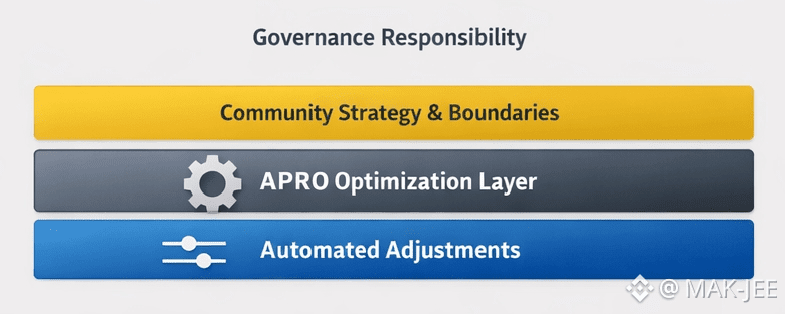
Community strategy → APRO optimization layer → Automated parameter adjustments
APRO’s Adaptive Architecture
APRO is designed as a modular framework, not a single monolithic system. Each module focuses on optimizing a specific function within the protocol.
Examples of potential modules include:
Liquidity management
Fee calibration
Incentive allocation
Risk exposure control
Because these modules operate independently, updates and improvements can be implemented incrementally. This reduces upgrade risk and allows protocols to experiment with optimization strategies without disrupting core functionality.
Modularity also improves transparency, as each component’s behavior can be monitored, audited, and evaluated separately.
Feedback Loops as a Core Mechanism
At the heart of APRO is a continuous feedback loop. Rather than relying on predefined reactions to specific events, the system operates through ongoing evaluation and adjustment.
A simplified APRO feedback cycle looks like this:
1. Data collection from protocol activity and relevant metrics
2. Performance evaluation against defined objectives
3. Incremental parameter adjustment within governance-approved bounds
4. Outcome monitoring to assess impact and stability
This approach prioritizes gradual optimization over abrupt changes, helping maintain system stability while still allowing meaningful adaptation.
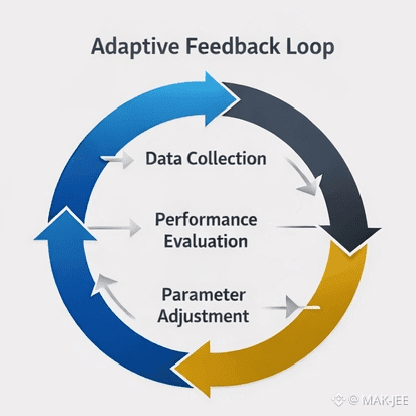
Observe → Evaluate → Adjust → Monitor
Token Utility Within an APRO Framework
In an APRO-based system, tokens are designed to support participation, accountability, and alignment rather than purely speculative behavior.
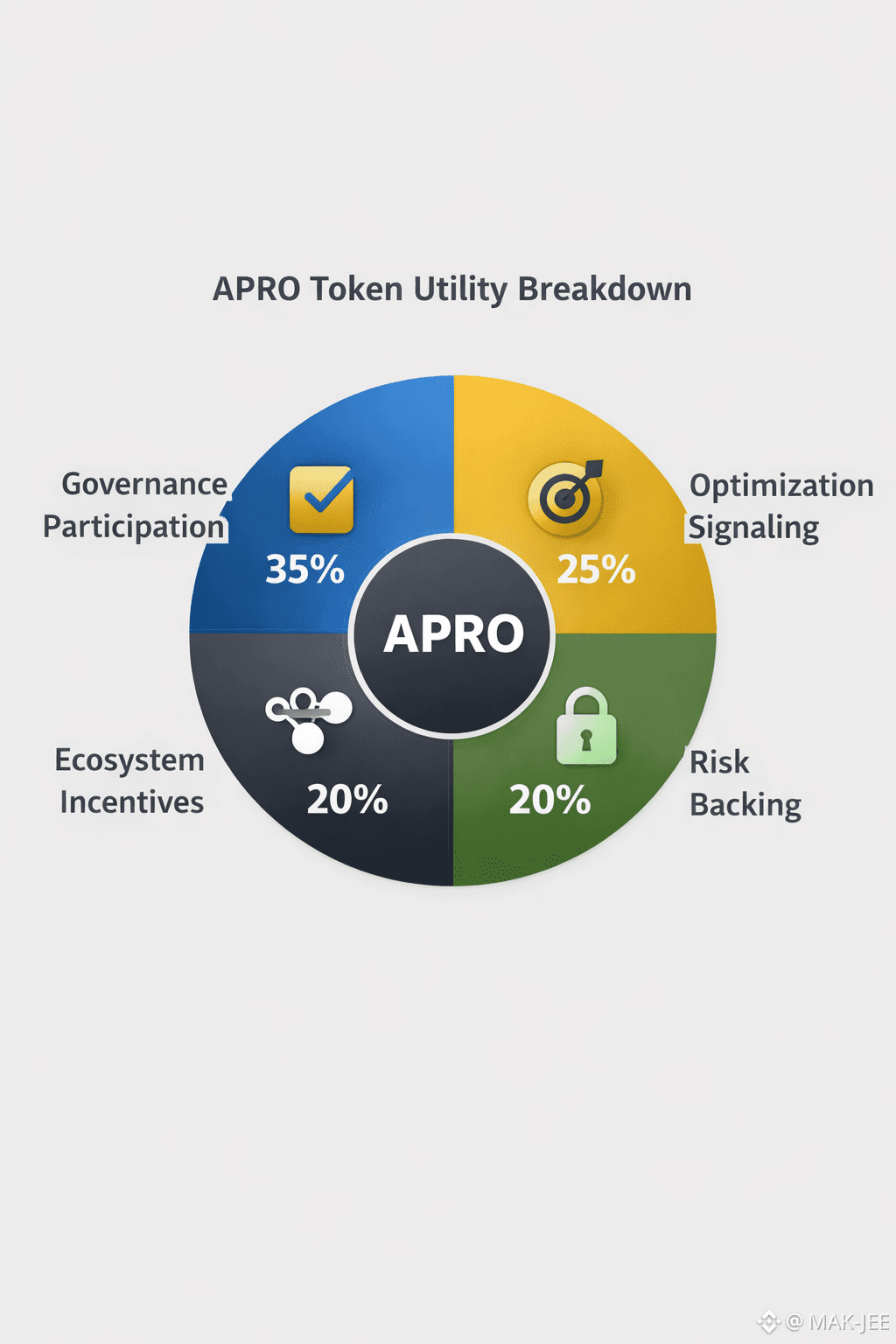
Potential token utility may include:
Governance anchoring, where token holders define optimization limits and objectives
Signal weighting, allowing participants to express confidence in certain system behaviors or strategies
Risk alignment, where stakeholders share responsibility for protocol outcomes
This model encourages informed, long-term engagement by linking token utility to the health and performance of the system itself.
Implications for DeFi Ecosystems
Beyond Yield-Centric Models
Much of early DeFi growth was driven by aggressive incentive programs designed to attract liquidity quickly. While effective in the short term, many of these models proved difficult to sustain once incentives declined.
APRO enables performance-based optimization, allowing protocols to balance growth with capital efficiency, risk management, and long-term stability. Rather than maximizing headline yields, systems can optimize for resilience and consistent utility.
Cross-Protocol Learning Potential
APRO also introduces the possibility of shared learning across multiple protocols. By aggregating anonymized performance data:
Protocols can identify broader ecosystem trends
Risk patterns may become easier to detect
Optimization strategies can improve collectively
This opens the door to more cooperative, data-informed infrastructure development across decentralized ecosystems.
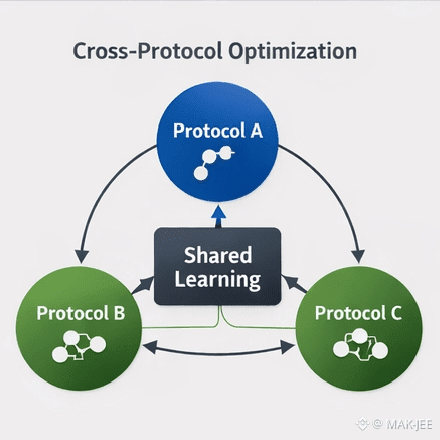
Multiple protocols connected through an APRO framework
Risks and Design Considerations
Adaptive systems are not without challenges. Key considerations include:
Increased complexity, requiring clear dashboards and transparent reporting
The risk of over-adjustment if boundaries are poorly defined
Dependence on accurate, secure, and manipulation-resistant data inputs
Addressing these risks through careful design, auditing, and governance oversight is essential for long-term credibility and adoption.
Conclusion: APRO as a Design Framework
APRO represents a shift in how blockchain systems can be designed—from static infrastructure to responsive, feedback-driven protocols. By embedding adaptability while preserving decentralized governance, APRO offers a potential path toward more resilient and sustainable blockchain ecosystems.
Rather than positioning itself as a standalone solution, APRO functions as a design framework—one that could influence how future protocols are built, governed, and optimized as decentralized systems continue to mature.

