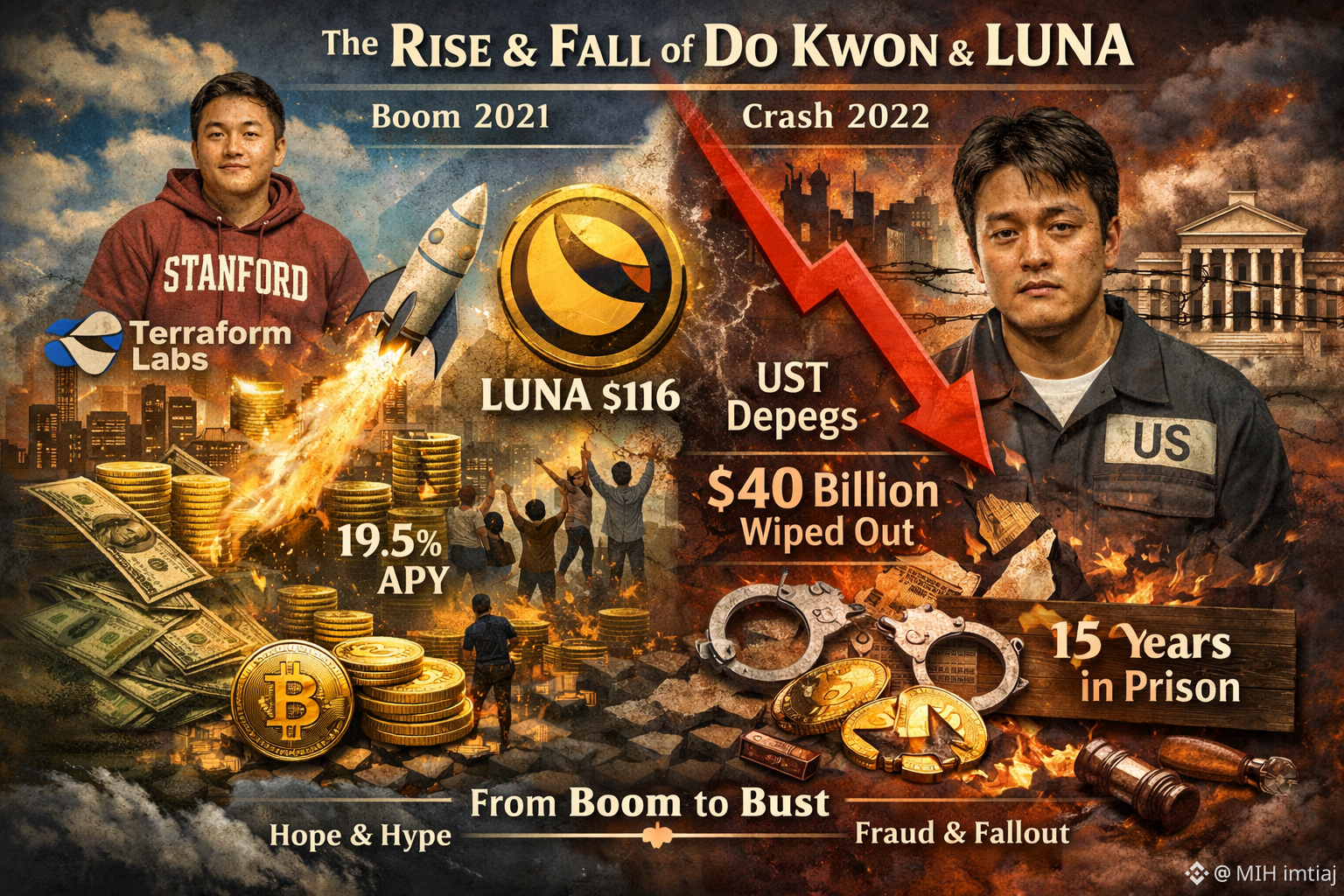
Few stories in crypto history reflect such a dramatic rise and catastrophic fall as that of Do Kwon and LUNA$LUNA . Once hailed as the future of decentralized finance, Terra has since become one of the most painful lessons the crypto industry has ever witnessed.
The Early Years: A Brilliant Mind Takes Shape
Do Kwon was born in 1991 in Seoul, South Korea. From an early age, he stood out as a top student, attending Daewon Foreign Language High School before moving to the United States. He later gained admission to Stanford University, where he studied computer science.
After graduating, Kwon worked as a software engineer at Microsoft, but the pull of entrepreneurship soon brought him back to South Korea, determined to build something of his own.
His first major venture was Anyfi, a peer-to-peer mesh networking startup. While it didn’t achieve mass adoption, it laid the groundwork for his deep dive into blockchain technology.
Terraform Labs: The Vision Takes Form
In 2018, Do Kwon co-founded Terraform Labs alongside Daniel Shin. Their goal was ambitious: to create a blockchain ecosystem that could power real-world payments through decentralized stablecoins.
The launch of the Terra blockchain and its native token LUNA$LUNA quickly drew attention. Venture capital firms poured in more than $200 million, and Terra rapidly became one of the most talked-about projects in crypto.
UST and Explosive Growth
Between 2020 and 2022, Terra entered its golden era. The team introduced TerraUSD (UST), an algorithmic stablecoin designed to maintain its dollar peg through a burn-and-mint mechanism tied to LUNA.
The ecosystem’s growth was supercharged by Anchor Protocol, which offered nearly 19.5% APY on UST deposits. Millions of investors flooded in, chasing what seemed like a low-risk, high-yield opportunity.
By April 2022, LUNA surged to nearly $116, cementing Terra’s place among the top crypto projects in the world.
May 2022: The Collapse
The turning point came suddenly. More than $2 billion in UST was withdrawn from Anchor, while liquidity was simultaneously removed from Curve pools. The pressure was too much.
UST lost its dollar peg.
The Luna Foundation Guard sold off its Bitcoin reserves in a desperate attempt to defend the system—but the reserves were quickly exhausted.
UST plunged to mere cents.
Within days, nearly $40 billion in market value evaporated, impacting over one million investors worldwide.
The crypto market watched in disbelief.
Arrest and Legal Fallout
In March 2023, Do Kwon was arrested in Montenegro after attempting to travel using a forged passport. What followed was a prolonged extradition battle between the United States and South Korea.
2024–2025: Judgment Day
In 2024, Terraform Labs filed for Chapter 11 bankruptcy. A U.S. jury found both Terraform Labs and Do Kwon guilty of securities fraud, imposing civil penalties exceeding $4.5 billion.
By 2025, the final chapter unfolded:
Do Kwon pleaded guilty to wire fraud and conspiracy
Admitted he misled investors about the stability of UST
Agreed to forfeit $19 million in assets
Sentenced to 15 years in federal prison
The presiding judge described the case as
> “a fraud of generational scale.”
Final Thoughts
Terra is no longer just a failed project—it is a lasting warning. High yields, bold promises, and charismatic founders mean nothing without sustainable fundamentals.
The fall of LUNA will forever stand as a reminder in crypto history:
when stability is engineered without real backing, it is only an illusion.