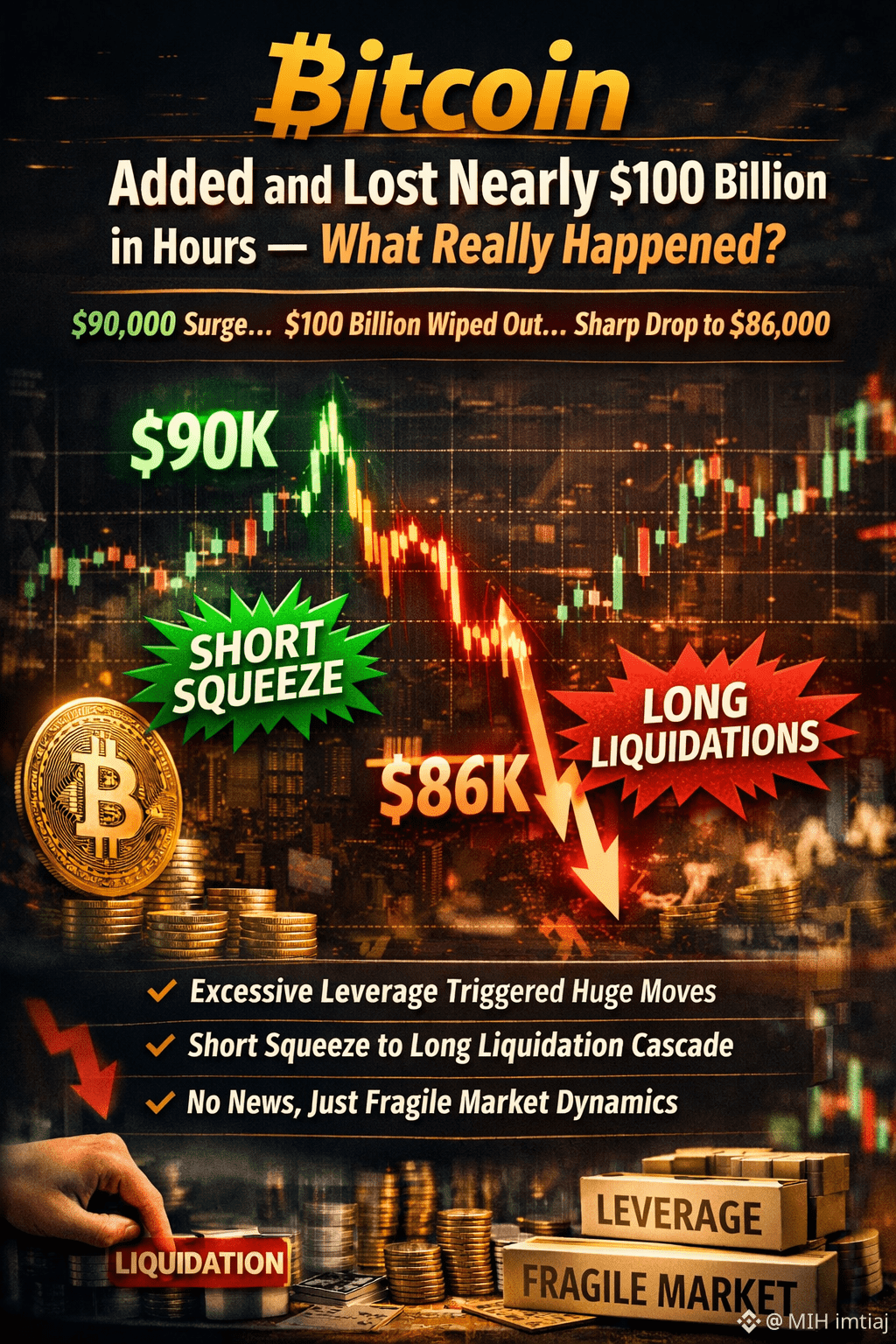
On December 17, Bitcoin experienced one of the most dramatic intraday swings of the month. Within just a few hours, nearly $100 billion in market capitalization was added and then wiped out.
In less than an hour, Bitcoin$BTC surged more than $3,000, briefly reclaiming the $90,000 level. The excitement, however, didn’t last long. Price quickly reversed and fell back toward the $86,000 zone.
What made this move stand out is that no breaking news, macroeconomic data, or regulatory developments triggered it. Instead, the volatility was driven by internal market dynamics — mainly excessive leverage, crowded positions, and thin liquidity.
---
A Short Squeeze Sparked the Initial Rally
The $90,000 level is more than just a psychological milestone. It was also an area packed with leveraged short positions.
As Bitcoin pushed higher toward this zone, short positions began getting force-liquidated. Since closing a short requires buying Bitcoin, this created a rapid feedback loop that pushed price even higher.
Liquidation data shows that roughly $120 million in short positions were wiped out during the spike. This type of move is known as a short squeeze, where forced buying — not genuine spot demand — drives price higher.
On the surface, the breakout looked strong. Under the hood, however, the market structure was fragile.
---
From Fake Breakout to Long Liquidation Cascade
Once Bitcoin$BTC briefly held above $90,000, momentum traders rushed in, expecting a confirmed breakout. Many of these positions were highly leveraged longs, opened during a period of low liquidity.
But without sustained spot buying, the rally failed. Price stalled, rolled over, and began moving lower.
As key intraday support levels broke, exchanges started liquidating long positions at scale. More than $200 million in long positions were wiped out, flooding the market with sell orders and accelerating the decline.
This is why the drop was faster and more aggressive than the initial rally. Within hours, Bitcoin erased most of its gains.
---
Positioning Data Exposes a Fragile Market
Trader positioning data from major exchanges paints a clear picture of market instability.
On Binance, the share of top traders holding long positions jumped sharply. However, position-size data showed low conviction — many traders were long, but with relatively small exposure, suggesting speculation rather than strong directional belief.
On OKX, position ratios shifted aggressively after the volatility began, indicating that larger players were rapidly adjusting risk, hedging exposure, or buying into forced sell-offs.
This combination — crowded positioning, high leverage, weak conviction, and thin order books — creates the perfect environment for violent price swings.
---
On-Chain Activity and the Role of Market Makers
During the volatility, on-chain data showed large market makers such as Wintermute moving Bitcoin between exchanges.
While these transfers coincided with the price swings, they do not point to manipulation. Market makers routinely move assets during periods of stress to manage inventory, provide liquidity, and adjust risk exposure.
The entire move can be explained by well-known market mechanics: liquidation clusters, leverage cascades, and shallow liquidity. There is no clear evidence of coordinated manipulation or insider-driven activity.
---
What This Means for Bitcoin Going Forward
This episode highlights a structural weakness that still exists in the Bitcoin market.
Leverage remains elevated, liquidity can vanish quickly during fast moves, and price action around key levels is often driven by forced liquidations rather than fundamentals.
Bitcoin’s long-term value did not change during these hours. There was no shift in adoption, network security, or macro conditions. The volatility reflected market fragility, not a change in outlook.
Until leverage resets and positioning becomes healthier, similar sharp moves remain a real risk. This time, Bitcoin didn’t surge and crash because of news — it moved because leverage turned price against itself.
👉 Follow for more deep dives into Bitcoin market structure, leverage dynamics, and real-time crypto analysis.
#bitcoin #BTC #CryptoNews #CryptoAnalysis