
Last weekend, I was helping my younger cousin assemble a mechanical keyboard.
Everything seemed finished. Every switch was in place. Every screw was tightened. The cable worked. The computer recognized the device instantly.
But when we pressed the keys, nothing happened.
After twenty minutes of checking the hardware, we found the problem.
A thin plastic membrane, no thicker than a sheet of paper, had been installed upside down.
The keyboard wasn't broken.
It simply refused to complete the circuit.
That tiny layer wasn't producing any input.
It was deciding whether input could exist at all.
For some reason, that moment stayed with me while I was reading about Newton.
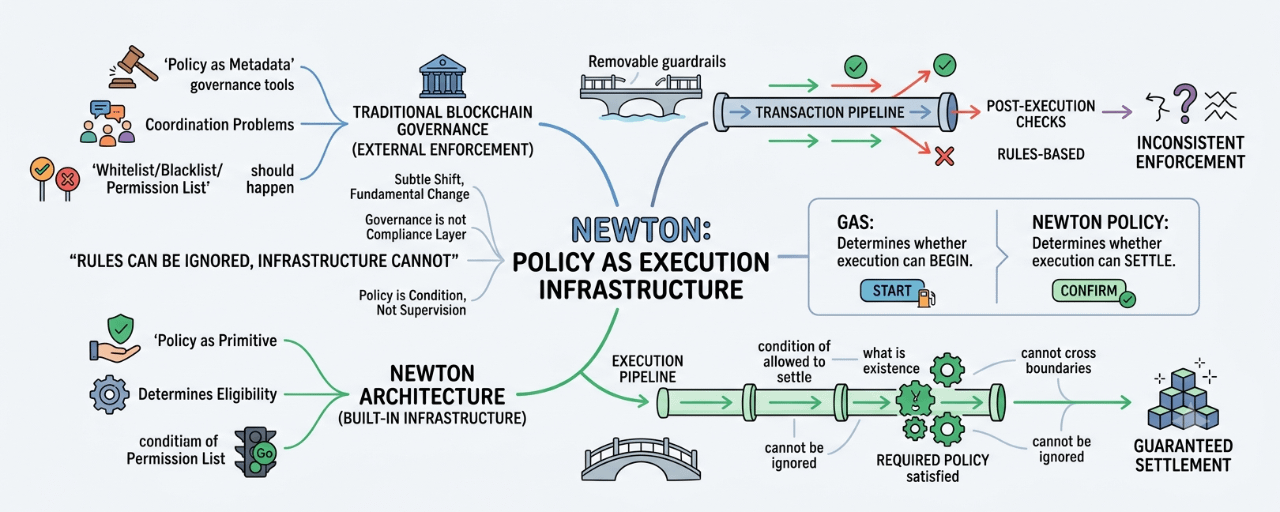
Most blockchain protocols still treat policy as something that surrounds execution.
A whitelist.
A blacklist.
A permission list.
A compliance rule.
These are usually viewed as governance tools that decide who should be allowed to participate, while the transaction pipeline remains responsible for execution.
@NewtonProtocol starts from a different architectural assumption.
For Newton, policy isn't metadata attached to execution. It is an execution primitive. Instead of surrounding the transaction pipeline, policy becomes one of the conditions inside it.
A transaction isn't something that exists first and gets checked afterward.
It only becomes eligible for settlement if the required policy is satisfied before execution reaches its final state.
That sounds like a subtle architectural difference.
I don't think it is.
It changes what policy actually means.
Traditionally, governance tells participants what should happen.
Newton turns policy into infrastructure that determines what is allowed to settle.
Those are fundamentally different roles.
Rules can be ignored.
Infrastructure cannot.
A bridge doesn't rely on drivers remembering where the guardrails should be.
The guardrails don't supervise the bridge.
They define the boundaries within which crossing is even possible.
Newton applies the same principle to blockchain execution.
Policy is no longer an external document waiting to be enforced consistently by applications or operators.
It becomes part of the machinery that determines whether a transaction can move through the execution pipeline at all.
We already accept this principle elsewhere in blockchain.
Gas isn't governance.
Nobody questions whether gas should be optional because it is built directly into execution.
Without gas, execution never begins.
Newton extends the same architectural principle.
Gas determines whether execution can begin.
Policy determines whether execution can settle.
That distinction matters because governance failures rarely happen when policies are missing.
They happen because policy usually lives outside execution. Once enforcement depends on applications, operators, or independent systems, consistency becomes a coordination problem instead of a property of the protocol itself.
Newton removes much of that uncertainty by embedding policy directly into the transaction pipeline.
Instead of asking whether someone remembered to enforce governance correctly after the fact, the protocol asks a more fundamental question before settlement:
Does this transaction satisfy the required policy?
If the answer is no, there is nothing left to govern because the transaction never becomes part of the settled state.
Viewed this way, Newton isn't introducing another compliance layer.
It is redefining the role of policy inside blockchain architecture.
Policy stops describing how transactions should behave.
It becomes part of the infrastructure that determines whether transactions can exist as settled state in the first place.
That feels like a much deeper shift than adding another security mechanism.
It is governance evolving from a set of rules into a condition of execution itself.
