

@KITE AI Grant programs are having a moment again, and not just because builders like free money. Over the last year the idea of “agentic” software—systems that can act on a user’s behalf—moved from research demos into everyday product talk. The excitement is real, but the practical problem is plain: if an agent can browse, book, buy, and deploy, who pays, and how do you keep that power from turning into a mess? Kite positions itself as a payment and identity layer built for autonomous agents, and the Kite Foundation’s job is to turn that big claim into working developer reality.

The timing helps explain why people are watching. Kite’s September 2, 2025 update: $18M Series A led by PayPal Ventures and General Catalyst, pushing total funding to $33M. A big round doesn’t guarantee a strong ecosystem—but it definitely raises the bar on what people expect next. Once there’s real runway, the grant strategy stops being a nice-to-have and becomes part of how a project proves it can produce durable tools rather than a short burst of attention. Binance Research’s brief dated November 6, 2025 puts it bluntly: today’s internet was built for people, not autonomous agents that need identity, trust, and payment rails.
What stands out in Kite’s public materials is how directly they budget for developer activity. The tokenomics cap supply at 10 billion KITE and allocate 48% to “Ecosystem and Community,” described as funding airdrops, liquidity programs, and other initiatives meant to expand participation and reward contributions. Another 20% goes to “Modules,” and the language there matters: those tokens are framed as support for developer grants and performance-based rewards, plus the build-out of AI services that improve the network’s intelligence and accessibility. These documents also push a shift toward revenue-driven rewards tied to real service usage, not endless inflation, a promise builders will want to test.
I’m wary of ecosystems that equate “more builders” with “more innovation.” Many grant programs fail in a predictable way: too many tiny checks, too little follow-through, and no honest story about what happened after the splashy announcement. The more interesting choice here is that Kite tries to link rewards to behavior over time. In the whitepaper, participants accumulate rewards in a “piggy bank,” but claiming them early permanently ends future emissions to that address. It’s a blunt mechanism, and it could frustrate people who need liquidity, yet it also discourages the pattern where incentives are treated like a quick rebate instead of a long-term commitment.
The modular structure is the second lever. Kite describes modules as semi-independent communities that provide specialized environments while still settling back to the Layer-1 chain. If you’ve watched grant committees drown in proposals across wildly different domains, this design hints at a practical fix. Instead of one central body trying to judge everything, modules can host domain-specific standards, reviewers, and milestone templates that match what “good” looks like in that niche. A data-focused module can ask for reproducible pipelines; an agent marketplace module can demand strong permissions and clear failure modes.
There’s also deliberate friction around eligibility. The whitepaper says builders and AI service providers must hold KITE to be eligible to integrate into the ecosystem. In a vacuum, gatekeeping sounds unfriendly. In grant practice, it can reduce spam. When applications are free and consequence-free, you get a flood of low-effort submissions that waste reviewer time and crowd out serious work. Requiring some stake doesn’t guarantee quality, but it forces an applicant to accept a small, upfront cost, which tends to surface who is serious about shipping.
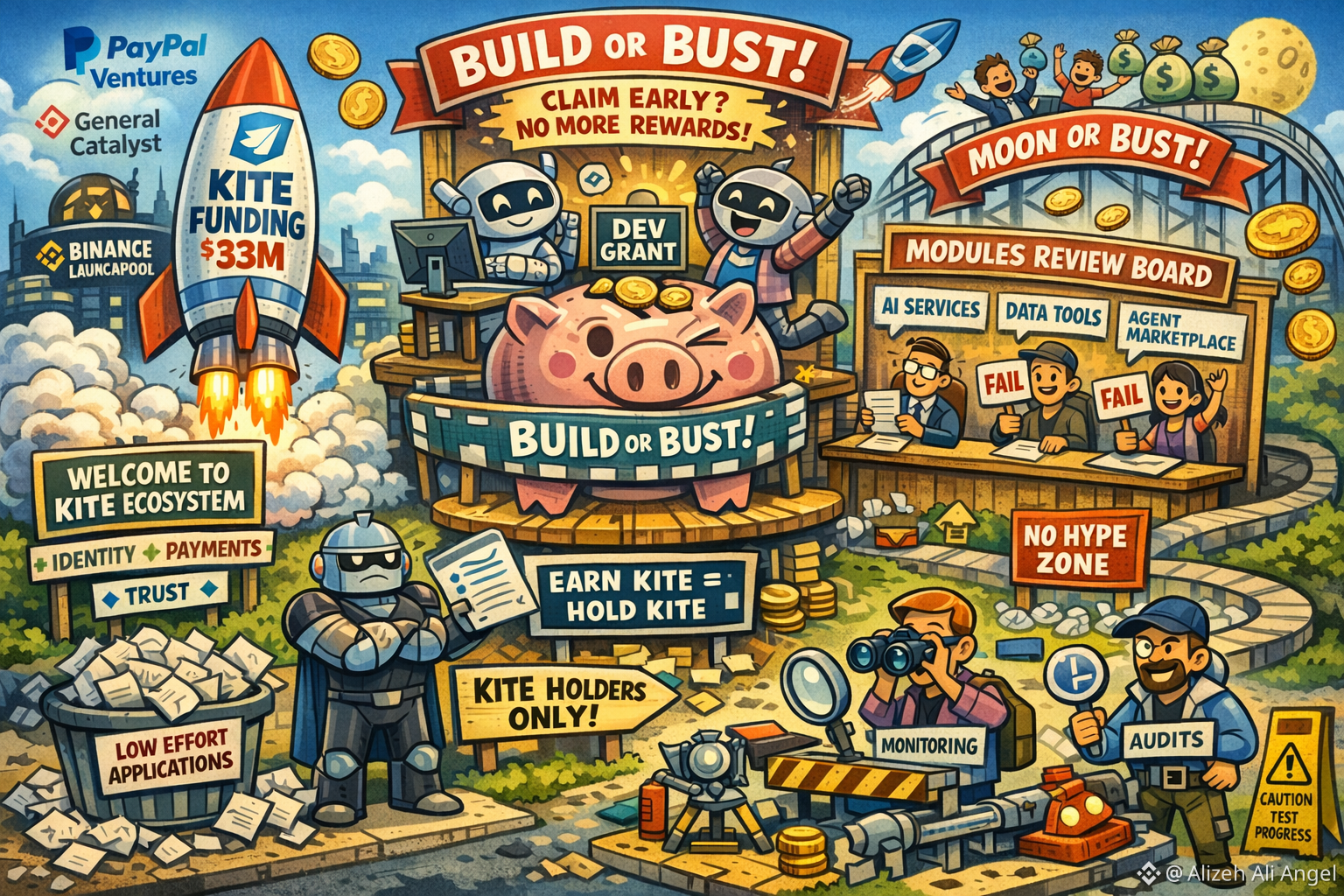
The grants only matter, of course, if they point at something concrete. Binance Research describes Kite as aiming to solve identity, trust, and scalable payments for agents, including programmable governance rules—think spend limits per agent—and fast micropayments. This is where a careful grant program can be surprisingly strict. It can prioritize uncomfortable edge cases where an “agent” looks more like an attacker, and it can fund the boring stuff that makes failures visible early: monitoring, audit tooling, integration tests, and clear incident playbooks. If a developer can’t explain how their system fails, they probably shouldn’t be paid to scale it.
Recent market events make that discipline harder, not easier. A news report on November 3, 2025 noted the Foundation saying it was finalizing its airdrop feature after Kite’s listing on Binance Launchpool and the start of spot trading. Listings expand the crowd fast, and fast crowds love simple narratives. In that environment, grants can drift toward whatever gets the loudest applause, or toward short-term metrics that look impressive but don’t translate into reliability. The Foundation’s validator program also talks about performance standards, a culture worth protecting in grants. The healthier path is slower: staged funding, public milestones, and renewals tied to shipped code and real usage.
If this strategy succeeds, it will look quiet from the outside. The best signal won’t be the number of grants announced. It will be a visible pipeline where small experiments graduate into reliable modules, and where incentives are transparently tied to real service transactions and protocol revenues. The open question is whether the Foundation will keep saying “no” when it should—and whether builders will accept that, knowing the upside is a sturdier ecosystem over time.

