
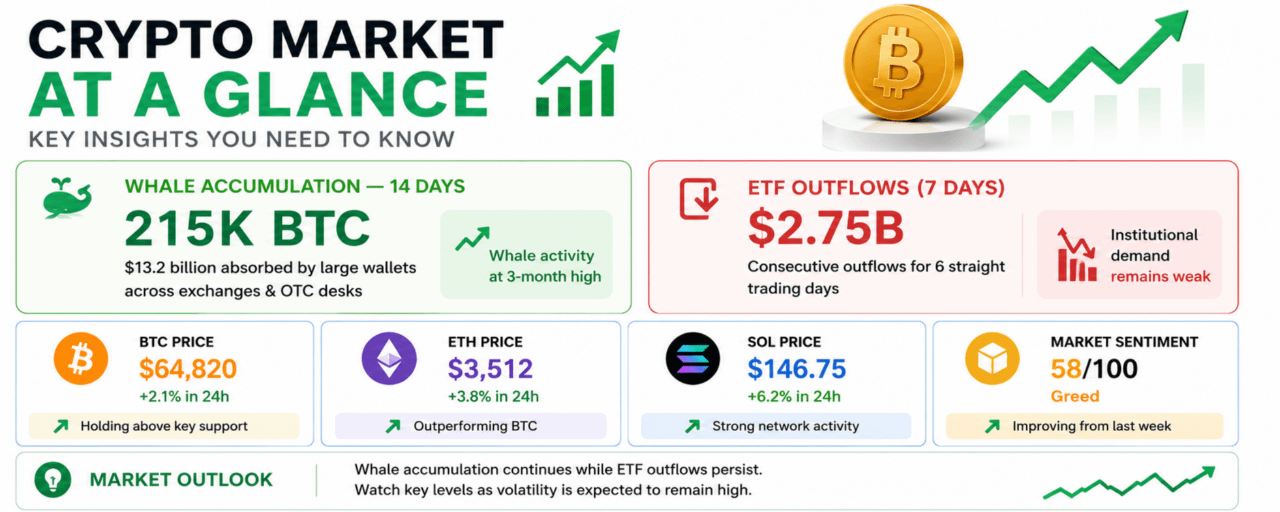
The Divergence That Matters
Large $BITCOIN holders just added more than 270,000 BTC — worth approximately $16.7 billion — over the past two weeks. This aggressive accumulation came at the exact same time that US spot Bitcoin ETFs recorded their worst monthly outflows since launch.
The $4.06 billion in June ETF redemptions pushed the products into the red for 2026 as a whole for the first time. This simultaneous institutional selling and whale accumulation is what Bitfinex analysts describe as a "familiar pattern" — one that has appeared near prior cycle lows where long-term holders take coins from sellers before any recovery reaches price.
The Whale Accumulation Signal — What the Data Shows
Large wallet holders added more than 270,000 BTC over the two-week period, according to Bitfinex analysts who shared the data with CoinDesk on Friday. The buying was not coming from US spot desks — the spot premium, a gauge of how aggressively US buyers are bidding, stayed negative throughout the accumulation period.
This rules out the possibility that the whale buying was simply the same institutional demand that flows through ETFs expressed differently.
Who Is Buying? The negative spot premium combined with 270,000 BTC in large wallet accumulation points to a specific buyer profile:
Global over-the-counter (OTC) buyers
Direct wallet purchasers
High-net-worth individuals
Crypto-native funds
Non-US institutional allocators
These buyers are absorbing supply that US ETF redemptions are putting into the market. The mechanism is precisely what Bitfinex identifies as the historical cycle-bottom pattern: long-term holders take coins off sellers at depressed prices before any recovery reaches the price level — building the supply tightening that eventually supports a price recovery once selling pressure exhausts itself.
The ETF Divergence — June's Record Outflows in Context US spot Bitcoin ETFs shed $4.06 billion** in June — the worst month since their January 2024 launch, exceeding the previous record of **$3.56 billion set in February 2025.
Key ETF Data Points: Metric Value June Outflows $4.06B Previous Record $3.56B (Feb 2025) YTD Status Negative for 2026 Daily Inflow (Thu) $221M (first >$200M since May) Outflow Streak 10 days (ended Thursday) Weekly Outflows 6 consecutive weeks Thursday's $221 million** inflow — the first daily total above **$200 million since early May — ended a 10-day outflow streak but does not by itself reverse the structural picture that six consecutive weeks of net redemptions has established.
The Analytical Significance The divergence between ETF outflows and whale accumulation is the most analytically significant data point of the current recovery attempt. Prior cycle lows have consistently featured this same split:
Retail and institutional products reflecting peak pessimism and redemptions
Large, patient holders using the resulting supply availability to build positions
The 270,000 BTC absorbed by large wallets in two weeks represents over $16 billion in demand that did not show up in ETF flow data — illustrating that aggregate market demand is substantially higher than the ETF outflow headline suggests.
Solana's Divergence — The One Major That Held Up Solana is the exception among major assets. SOL has risen approximately 15% since early June even as Bitcoin touched 21-month lows.
What's Driving Solana? Protocol upgrades boosting network efficiency
120% surge in on-chain transfers of tokenized real-world assets (RWA) to $8.53 billion
Tokenized stock momentum validating the fundamental demand layer
The RWA transfer growth validates the tokenized stock momentum that drove SOL's earlier outperformance and adds a fundamental demand layer to what otherwise might appear to be a relative strength anomaly in a broadly weak market.
The Altcoin Cycle Pattern Bitfinex analysts noted that altcoins tend to sell off first and recover first relative to Bitcoin — a historical pattern that would make Solana's early outperformance consistent with cycle dynamics rather than an idiosyncratic exception.
If the pattern holds, SOL's relative strength may be a leading indicator of broader altcoin recovery — not just an isolated narrative play.
The L2 Collapse — Optimism and the Base Effect Not every altcoin fits the early-recovery narrative. Optimism and other Ethereum layer-2 tokens are trading near record lows after Base — Coinbase's competing L2 network — dropped Optimism's shared technology stack.
What Happened? Base removed the fee-capture mechanism that had underpinned the investment thesis for OP token holders
The defection eliminates the argument that Optimism's technology would benefit from Base's user growth and transaction fees
OP token left without the fundamental demand driver that had supported its valuation above record lows
The Key Difference The Optimism situation illustrates the difference between Bitcoin and Ethereum L2 tokens in the current environment:
Asset Type Nature of Decline Whale Impact Bitcoin Macro-driven, broad institutional de-risking Whales can absorb Optimism (OP) Thesis-driven — investment case changed Whales cannot offset Bitcoin's bear market is macro-driven. Optimism's decline is thesis-driven — the investment case itself has changed.
The Next Pivot — June CPI and Warsh's Sintra Signal The macro catalyst that would convert whale accumulation into price recovery is the next inflation reading.
Current Macro Landscape: May CPI: Ran hot at 4.2% — providing data foundation for the Fed's hawkish June dot plot
Oil Prices: Declining toward $70
June Payrolls: Miss at 57,000
Fed Chair Warsh: Commented at ECB's Sintra forum that "inflation risks have already eased"
What a Soft CPI Could Mean: Warsh's comment gave risk assets a small lift — the first indication that the Fed may be beginning to acknowledge the disinflationary signals. A softer June CPI print would:
Start to shift the rate-path narrative that has weighed on Bitcoin throughout H1 2026
Provide macro permission ahead of the Fed's next meeting
Complement the whale accumulation, UTXO profitability crossover, and options market normalization
All the pieces are in place — whale accumulation, supply tightening, and improving on-chain metrics. The missing link is macro confirmation.
What This Means for You For BTC Holders: The accumulation phase appears active among smart money
Historical patterns suggest this setup precedes recovery
Macro data (June CPI) will likely determine the timing
For SOL Traders: SOL's divergence is fundamentally backed (RWA growth + upgrades)
Could be a leading indicator for altcoin recovery
Watch for continued RWA momentum
For OP Holders: The investment thesis has changed structurally
Whale accumulation alone may not save it
Re-evaluate fundamental drivers
For Everyone: DYOR — this is not financial advice
Manage risk — volatility remains high
Watch macro — CPI and Fed moves will be key
Final Thoughts The divergence we're seeing — ETFs selling while whales buy — is not new. It's a pattern that has played out multiple times in Bitcoin's history, always near cycle bottoms.
The question is not whether whales are accumulating. They clearly are.
The question is: When will macro conditions align to trigger the next leg up?
June CPI data may hold the answer.
Are you accumulating, waiting, or watching? 👇
