

@KITE AI There’s a moment in every token story when the talk shifts from “who’s building” to “who’s paying,” from early optimism to the plain rules that keep a network alive. For Kite’s KITE token, that moment is Phase Two, where fees, governance, and network security are meant to stop being roadmap language and become daily routine. It’s trending now because Kite’s visibility jumped with a major exchange spotlight: Binance let users farm KITE through Launchpool starting November 1, 2025, and listed KITE for spot trading on November 3, 2025 at 13:00 (UTC).
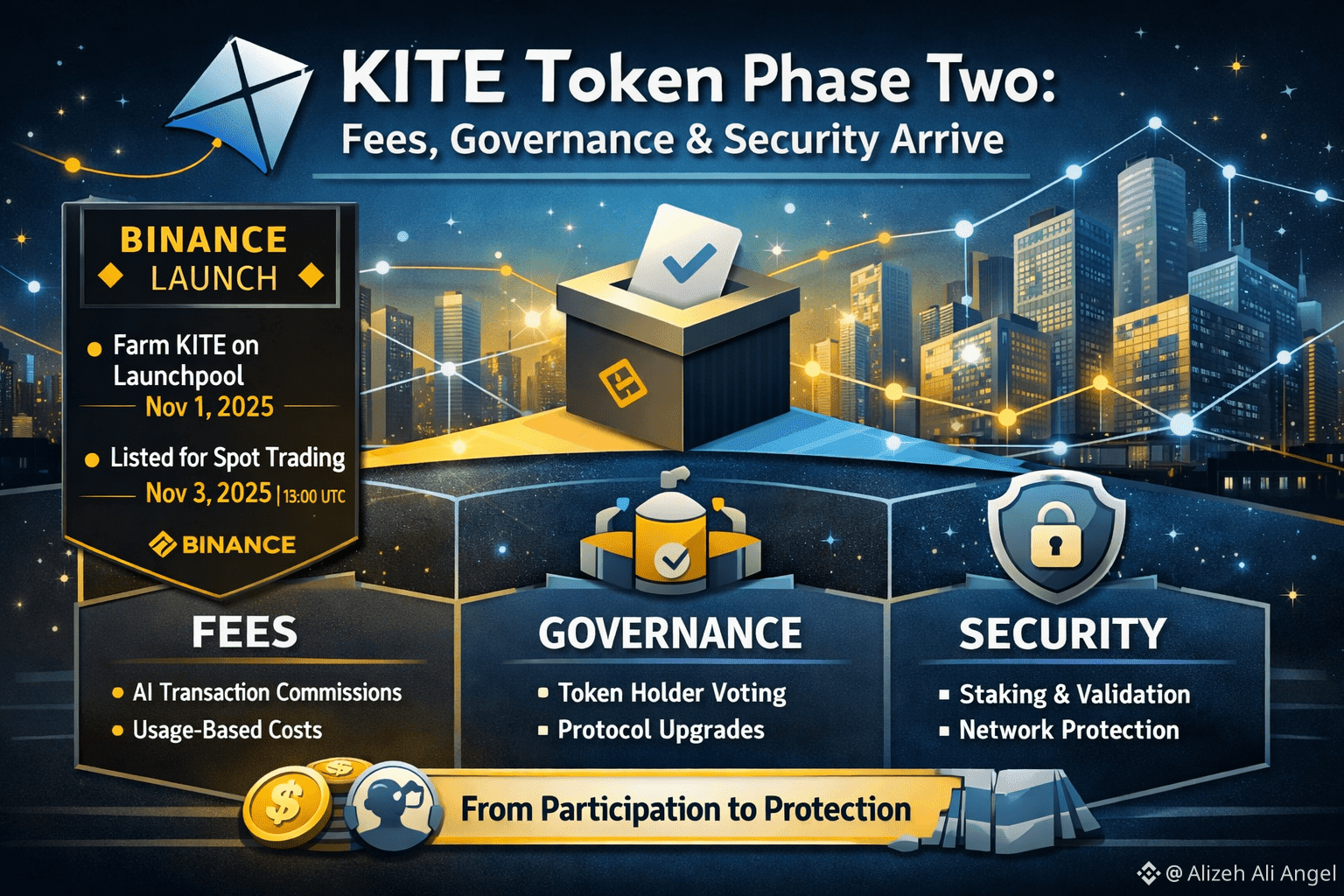
Kite’s own framing is straightforward: KITE utility is staged. Phase One focuses on participation, module activation, and incentives; Phase Two adds staking for security, governance, and fee-related functions. That sequence is familiar in crypto, but it lands differently here because Kite is built around a premise that’s both practical and a little unsettling: software agents will increasingly act like economic actors, paying for data, buying services, and moving money while humans try to keep sensible limits.
Phase Two is three conversations bundled into one. The first is fees, and it’s the most practical. Kite describes a model where a portion of fees from AI service transactions is collected as commission for modules and the network, tying economics to actual usage rather than endless token emissions. I respect the honesty of that: if nobody uses the network, there shouldn’t be a financial fairytale that says otherwise. But it also forces uncomfortable choices. Agents thrive on repeatable, predictable costs; if fees wobble, agents stall and humans end up back in the loop.
The second conversation is governance, which is where networks start to reveal their culture. Kite points to token-holder voting on protocol upgrades, incentive structures, and module performance requirements. Voting is not automatically legitimacy. It can be slow, noisy, and dominated by whoever has the time, the capital, or the coordination advantage. The question that matters most isn’t whether people can vote, but what they’ll be willing to say no to. Should a popular module get special rules, or should the base layer stay uniform even if that slows growth?
The third conversation is security, and it punishes wishful thinking. Kite positions staking as a way to secure the network, with validators locking tokens and delegates staking to support specific modules. As soon as you put agents in the loop for moving value, you’re basically inviting trouble in new forms: permissions get misconfigured, keys get compromised, integrations snap, and attackers show up to test every edge case. Staking can reduce intentional abuse, sure—but it also needs to handle everyday screw-ups and make sure the system doesn’t reward “more volume” over “better outcomes.”
What makes this phase worth watching is how tightly these threads are supposed to braid together. Fees are not just revenue; they’re an incentive signal. Governance is not just voting; it’s how the network defines acceptable risk. Staking is not just yield; it’s the price of credibility when real payments are involved. The optimistic read is that Kite is aiming for a loop where real usage funds real security, and where the people most exposed to the system’s health have a meaningful say in its direction. The skeptical read is that aligning those interests is harder than any diagram suggests.
One detail I keep circling back to is how quickly “permission” becomes a product. If staking gates can validate or run modules, the network may become safer, but also more exclusive. If governance pays you more for locking up longer, it can cut down on short-term flipping—but it can also make it harder for new people to get involved. You’ll see whether it’s working in the little design decisions, not in some big “vision” post over the next few months.
Zooming out, the timing makes sense. AI tooling is racing ahead, and stablecoin payments are quietly becoming the most normal thing crypto has produced for everyday settlement. Kite’s whitepaper leans into stablecoin-native settlement and programmable constraints as a way to let organizations delegate spending authority without giving agents unlimited freedom. If that’s the ambition, Phase Two is not a cosmetic upgrade. It’s the point where Kite has to prove it can be boring on purpose.
Phase Two shouldn’t be treated like a victory lap. It’s closer to a set of tests that will run in public, with money on the table and attention that doesn’t always reward nuance. The best outcome is almost dull: fees that are predictable, governance that is legible, and security that is strong enough that users stop thinking about it. If Kite can reach that kind of boring, the token becomes less of a narrative object and more like infrastructure—something you notice only when it breaks.

