

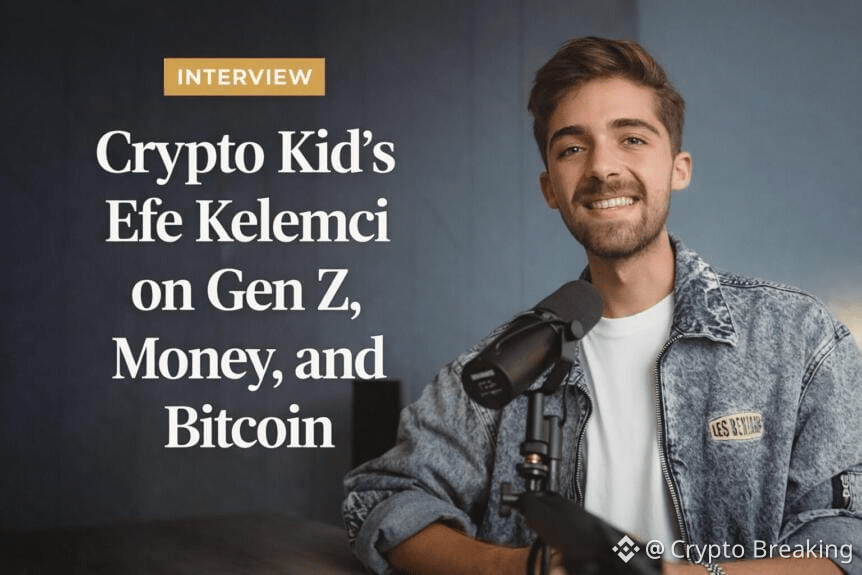
We met Efe Kelemci, co-founder of Crypto Kid, during Bitcoin MENA in Abu Dhabi, where he spoke on the panel “The Gen Z Awakening” (Proof of Work Stage, Tuesday, December 9, 2025, 3:00–3:30 pm), alongside Madeline Morning (Moderator), Rohan Hirani (BitcoinQuant), and Fin Creighton (Bitcoin Success School).
Kelemci is a teen Bitcoiner, macro analyst, and educator who started exploring crypto at 12 while still in school in the UAE. Today, he helps run Crypto Kid, a channel that’s grown into a community of more than 100,000 followers combined.
A few days after the conference, we sat down in Efe’s studio at The Moon’s office in Dubai Media City for an audio interview. What follows is an edited, narrative-style Q&A, built from that conversation.
Listen to the full interview (audio): You can also hear the complete conversation on our YouTube channel here: https://youtu.be/QyopSq4_UlM
From musical theatre to markets

Before crypto, Kelemci’s world revolved around performance. He was a musical theatre and voice actor from a young age, and he loved the adrenaline of being on stage.
He also noticed something early: creative work was demanding, and often financially uncertain.
He recalls looking at friends pursuing drama school and auditions, working hard but not getting paid well. That pushed him to think differently. If he wanted long-term independence, he would need “a business, an income, the capability of investing and producing.”
Then the pandemic hit, and everything paused.
With shows stopped, he started searching YouTube for finance videos, curious about how to invest the money he had made from voice acting. That led him to macro voices and crypto research, and to the moment that pulled him into the rabbit hole.
“I found an analyst by the name of Raoul Pal… he was talking about Ethereum… and that immediately took my interest. I fell into the rabbit hole of cryptocurrency.”
He discovered technical analysis, and for him it felt like the first “real” skill he could learn and apply immediately.
“My issue with school was… it’s all theory, but you can’t really use it. With technical analysis, I could learn it, apply it to the charts, trade, and make money.”
By 13, he says he was spending serious time studying charts after school. And because Dubai had an active crypto scene, he started attending meetups and conferences, often as the youngest person in the room.
That’s where the shift happened.
“I understood the importance of Bitcoin… and how Bitcoin is going to be the remedy for our broken financial system. From that point onwards, I started taking profits only in Bitcoin.”
Why money is the missing subject in school
Kelemci’s obsession with Bitcoin wasn’t just about price. It was about the question most people never ask until much later: what is money, really?
In his view, it’s strange that society pushes everyone toward earning money, yet rarely teaches how money works.
“If money is the ultimate goal in capitalist society, it’s strange that in school you’re not taught about money. You’re not taught on how to do your taxes… the history of money… you just have this paper that you earn and you transact with.”
He credits part of his curiosity to his family environment. His father worked in the FMCG sector and would talk about the economy and global events, which helped Efe build context and ask deeper questions.
When he did, he didn’t like what he found.
“There’s a central bank that can just press a button and print trillions… money devalues… wages go up, but not at the same pace as inflation. You end up becoming poorer and poorer.”
For him, that’s the point where Bitcoin stopped being “an investment” and became a lens on the world.
“I know that the dollar is going to collapse and I want to secure my future.”
Bitcoin as an “education tool” beyond finance
One of the most interesting parts of the conversation was how he describes Bitcoin as something bigger than money.
He claims learning Bitcoin helped him understand political and philosophical concepts too, from free-market principles to the difference between economic schools of thought.
“When I studied Bitcoin… I got the grasp of political concepts… it opened my eyes to what’s really going on in the world.”
His message is not just for young people, but also for parents.
“I strongly urge kids and parents to teach their kids about Bitcoin… you get good saving habits to hedge yourself against inflation… and it can make you become financially free at a much earlier age.”
How he’d explain Bitcoin to a complete beginner
If he had to explain Bitcoin to a 16-year-old who has never invested, Kelemci wouldn’t start with blockchain jargon. He’d start with questions.
“You go to school, you go to work, what is it that you end up working for? They’ll say money… okay, what is money? What is the history of money? What’s the dollar backed by?”
His point is simple: Bitcoin looks “obvious” only after you understand the problem.
“So many people are unaware of the problem. Bitcoin doesn’t stand out as a solution because they don’t know there’s a problem.”
He also framed it in a way young people instantly understand, using the cultural reference of “the Matrix,” that moment where you choose to see the system clearly.
“It’s shocking that the money we transact with is backed by absolutely nothing.”
Gen Z, digital money, and the freedom question

Kelemci believes younger generations are naturally more open to innovation, because they didn’t grow up locked into one “default” worldview.
“Older generations… it’s hard to escape propaganda… younger people are more pragmatic, more open to innovation.”
At the same time, he’s skeptical that most Gen Z investors truly understand what they’re buying.
“They’re buying it because it’s cool… but they don’t fully get why it can be the future.”
When the conversation moved to digital money, he made a clear distinction between systems that are merely digital, and systems that are permissionless.
“Freedom is the key word… you can use stablecoins and you can use CBDCs, but that would mean everybody knows exactly how much money you have… government entities can control exactly what you spend your money on.”
His core belief is that access to finance should not be conditional on identity or beliefs.
“No matter what you believe in… you should be able to participate in finance… if you can’t, in most cases, if you live in poverty, you can’t escape poverty.”
His Bitcoin outlook for 2026 and beyond
Kelemci follows cycles, but not in a simplistic way. He argues Bitcoin’s supply schedule matters, but that altcoins behave differently because their dynamics are tied more directly to liquidity and broader business cycles.
“Bitcoin operates in its four-year supply and demand cycles… altcoins don’t share the same economics.”
On Bitcoin for 2026, he expects volatility, but also sees macro conditions potentially reducing the chance of a deep 2021-style collapse.
“I see Bitcoin potentially dipping into the 65 to 70k range… consolidate… from Q4 onwards, we can start slowly moving up again.”
For major altcoins, his base case is higher prices, but later.
“I think altcoins will take the spotlight in 2027… they’re more sensitive to liquidity.”
Dubai’s influence: optimism, entrepreneurship, and speed
Kelemci grew up in the UAE, living in Sharjah before spending the past years in Dubai. He says the environment mattered.
“I grew up in a city… very pro entrepreneurship, very pro innovation… everybody wants to achieve more.”
For him, Dubai’s visible transformation over time reinforces a belief that rapid progress is possible, and he draws a parallel with crypto’s short history.
“In 17 years, there’s been a huge change… crypto has only been around for 17, 18 years… but it’s done wonders.”
What he wants to build next
Despite a large audience, Kelemci says most of his viewers are older than he is.
“My demographic is between 25 to 60… I don’t really get many young people watching.”
That’s what he wants to change: more youth-focused content, possibly more short-form, mixing entertainment and education.
“I want the Crypto Kid YouTube channel to become a platform for young people to learn about Austrian Economics and Bitcoin. Study money and why it’s broken. And enable them to start saving early and correctly.”
His advice to young people starts with fundamentals: invest in skills first.
“It’s very important to invest into skills and knowledge… build a business around it… with that income, put a little bit into Bitcoin for the next 20 years without selling.”
And his definition of success has matured too.
“It’s about being able to wake up, do something you enjoy, with a team or friends you enjoy working with… and make enough money to live the life you want.”
One piece of advice for young people feeling financially lost
Kelemci ended on a message that felt less like finance, more like mental health.
“Don’t drown yourself in social media content that make people appear as they’re doing insanely well… don’t compare yourself. Everybody has their own life and their own path.”
Money matters, he says, but it’s not the whole story.
“Money isn’t everything. It’s an enabler… if you can do something you truly love… I think you’ve made it.”
This article was originally published as Crypto Kid’s Efe Kelemci on Gen Z, Money, and Bitcoin on Crypto Breaking News – your trusted source for crypto news, Bitcoin news, and blockchain updates.

