
Introduction: Why AI Hallucinations Matter in Web3
Artificial intelligence is becoming deeply embedded in crypto infrastructure. From automated trading strategies and DeFi analytics dashboards to AI-powered research assistants and on-chain agents, machine learning models are increasingly influencing financial decisions.
However, one major limitation persists: AI hallucinations.
A hallucination occurs when an AI system generates information that appears accurate and confident but is factually incorrect, fabricated, or unverifiable. In casual use cases, this may simply be inconvenient. In crypto markets—where decisions can move capital instantly—it can be costly.
As AI tools become more autonomous in Web3, the industry needs something stronger than “better prompts” or “bigger models.” It needs a trust layer.
That is where Mira Network introduces a fundamentally different approach: instead of trying to eliminate hallucinations inside the model, it builds a decentralized system to verify AI outputs before they are relied upon.
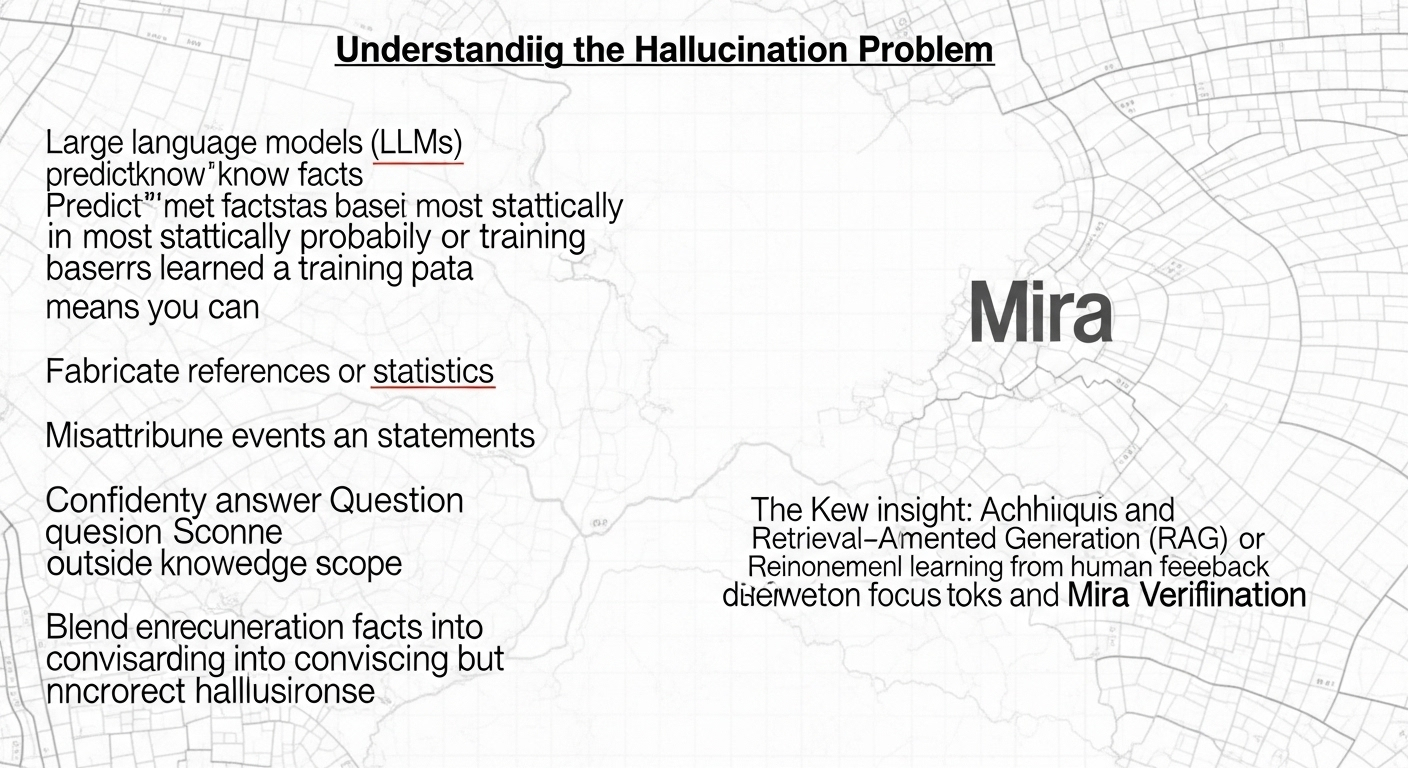
Understanding the Hallucination Problem
Large language models (LLMs) do not “know” facts in the traditional sense. They predict the most statistically probable next word based on patterns learned from training data. This means they can:
Fabricate references or statistics
Misattribute events or statements
Confidently answer questions outside their knowledge scope
Blend unrelated facts into convincing but incorrect responses
Even advanced techniques like Retrieval-Augmented Generation (RAG) or reinforcement learning from human feedback reduce but do not eliminate hallucinations.
The key insight: generation and verification are different tasks.
Most AI systems focus heavily on generation. Mira focuses on verification.
Mira Network’s Core Philosophy: Verify, Don’t Just Generate
Mira Network acts as a decentralized verification layer for AI outputs. Instead of trusting a single model’s response, the system breaks the output into smaller factual claims and validates them using distributed consensus.
This mirrors how blockchains validate transactions:
One node proposing a transaction is not enough
Multiple independent validators must confirm it
Finality is achieved through consensus
In this model, truth is not assumed — it is verified.
How the Decentralized Verification Process Works
1. Claim Decomposition
When an AI generates an answer, the system divides it into atomic claims.
For example:
“Ethereum transitioned to Proof of Stake in 2022, reducing its energy consumption significantly.”
This becomes:
Ethereum transitioned to Proof of Stake in 2022
The transition reduced energy consumption significantly
Each claim is evaluated independently.
This granular structure prevents entire responses from being accepted blindly and increases precision.
2. Distributed Validator Network
Instead of relying on one central authority, multiple independent nodes evaluate each claim.
These validators may include:
Specialized AI verification models
Retrieval systems referencing credible datasets
Domain-specific validators
The system aggregates their assessments and determines whether a claim is:
Verified
Refuted
Uncertain
Because validators operate independently, the risk of shared bias or correlated errors decreases.
3. Incentives and Accountability
Decentralization alone is not enough. Incentives must align.
Verification nodes can build reputation over time. Nodes that consistently provide accurate evaluations strengthen their credibility, while inaccurate participation can reduce rewards or standing within the network.
This crypto-economic design encourages accuracy without requiring centralized control.
4. Transparency Through Verifiable Records
Verification outcomes can be recorded in tamper-resistant formats. This creates:
An audit trail
Timestamped validation
Accountability for each verification decision
In Web3 ecosystems, where transparency is a foundational value, this design is particularly relevant.
Why Decentralization Is a Strategic Advantage
The decentralized approach provides multiple structural benefits:
Diversity of Validation
Different validators may rely on different models or data sources. This diversity reduces the chance that the same hallucination spreads across the entire system.
Reduced Single-Point-of-Failure Risk
Centralized verification systems can introduce bias, censorship concerns, or operational bottlenecks. A decentralized network distributes responsibility.
Scalable Trust Infrastructure
As AI usage grows, demand for verification will increase. A decentralized validator market can scale dynamically with demand, similar to blockchain validator ecosystems.
Practical Implications for the Crypto Community
The impact of hallucination-resistant AI is especially meaningful in digital asset markets.
1. AI Trading Systems
If an AI misinterprets regulatory news or fabricates a macroeconomic event, automated trading systems could react incorrectly. Verification layers can flag unsupported claims before trades are executed.
2. DeFi Risk Assessment
AI tools analyzing collateral ratios, tokenomics, or governance proposals must be precise. Claim-level verification reduces the likelihood of inaccurate metrics influencing decisions.
3. On-Chain AI Agents
As autonomous agents begin interacting directly with smart contracts, verification acts as a safeguard before capital-moving actions occur.
Comparison With Traditional Approaches
1. Larger AI Models
Main Strength: Improves overall accuracy by using more data and computing power.
Key Limitation: Expensive to build and maintain, and still does not fully eliminate hallucinations.
2. Human Moderation
Main Strength: High reliability and expert judgment.
Key Limitation: Not scalable, slow, and costly for real-time crypto use cases.
3. Retrieval-Augmented Generation (RAG)
Main Strength: Grounds responses in external data sources.
Key Limitation: Dependent on data quality and can still misinterpret information.
4. Decentralized Verification (e.g., Mira Network)
Main Strength: Distributed validation, transparent consensus, and incentive-aligned accuracy.
Key Limitation: Adds latency and coordination complexity.
Challenges and Considerations
No system is without trade-offs. Important considerations include:
Additional computational overhead
Latency from multi-node consensus
Governance design to prevent manipulation
Domain-specific expertise requirements
Transparency about these factors is essential for responsible implementation.
The goal is not absolute perfection but measurable reduction in risk.
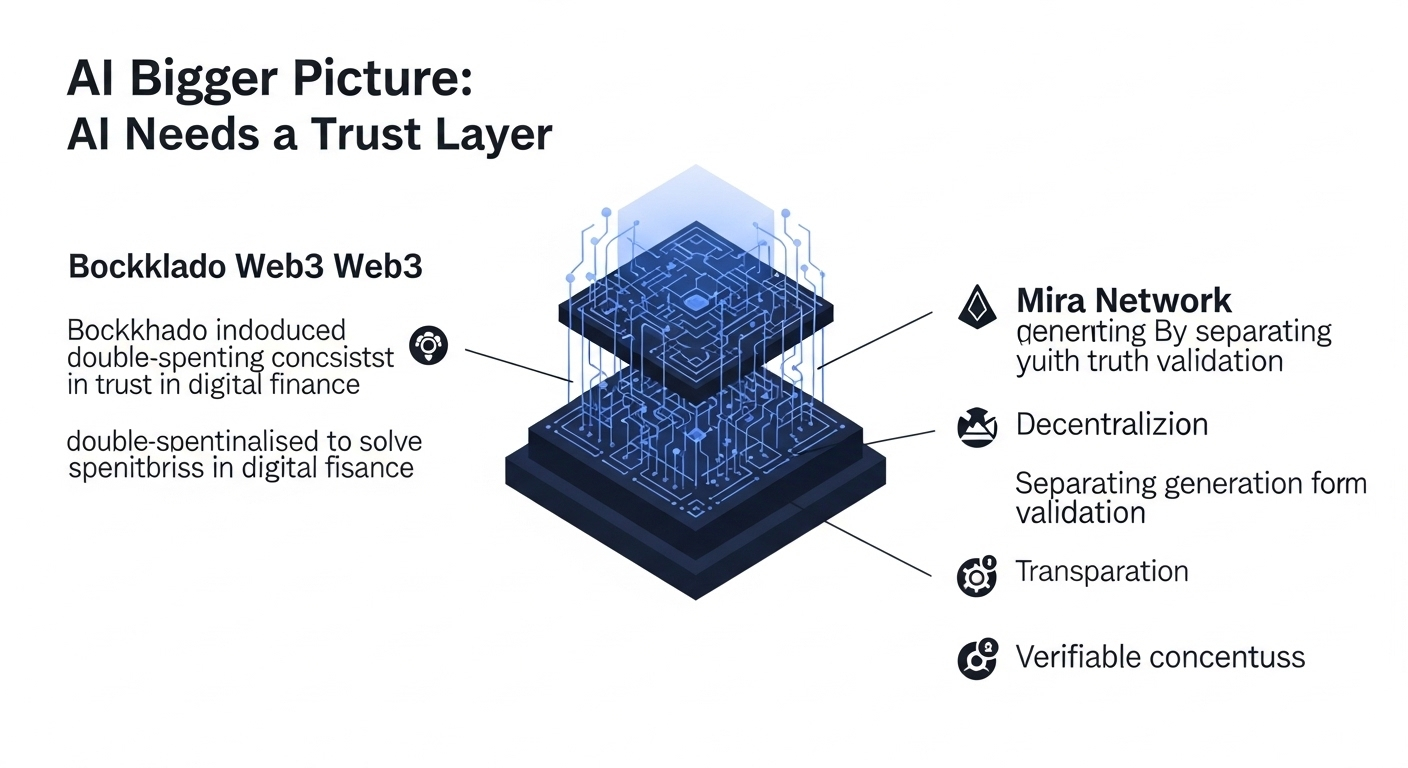
The Bigger Picture: AI Needs a Trust Layer
Blockchain technology introduced decentralized consensus to solve double-spending and trust issues in digital finance. AI faces a parallel challenge with truth verification.
By separating generation from validation, Mira Network applies Web3 principles to AI reliability:
Decentralization
Incentive alignment
Transparency
Verifiable consensus
This approach aligns naturally with crypto-native infrastructure, where trust minimization is foundational.
Conclusion: Building Responsible AI for Web3
AI hallucinations remain one of the largest barriers to deploying intelligent systems in high-stakes environments. In crypto markets, where speed and automation are critical, relying on unverified AI outputs is risky.
A decentralized verification layer offers a pragmatic path forward. By breaking outputs into claims, validating them through distributed consensus, and aligning incentives for accuracy, Mira Network introduces a new trust architecture for AI.
For the Binance Creator Pad community and the broader Web3 ecosystem, the message is clear:
The next phase of AI adoption will not be defined solely by smarter models — but by verifiable truth.
As decentralized finance matured through transparent consensus mechanisms, decentralized AI verification may become the foundation for safer, more reliable intelligent systems across the digital asset landscape.
@Mira - Trust Layer of AI
#Mira
$MIRA
