I remember the first time I saw a printing press in a museum and thought about how it didn't just move ink but moved the world. We are told AI is that same caliber of lightning in a bottle but if I am being honest it feels more like a very expensive very confident intern who lies to your face. We are stuck in this purgatory where a model can write a sonnet about a toaster but cannot be trusted to handle a medical script or a legal brief without a human chaperone holding its hand. The industry is obsessed with scale as if throwing more GPUs at the problem will magically fix the fact that these models are fundamentally broken at the level of reliability. You either get a model that is consistent but narrow and biased or you get one that is broad but hallucinates wildly because it is trying to reconcile a thousand conflicting truths at once. It is the classic precision-accuracy trade off that has plagued engineering for centuries and right now we are losing the battle.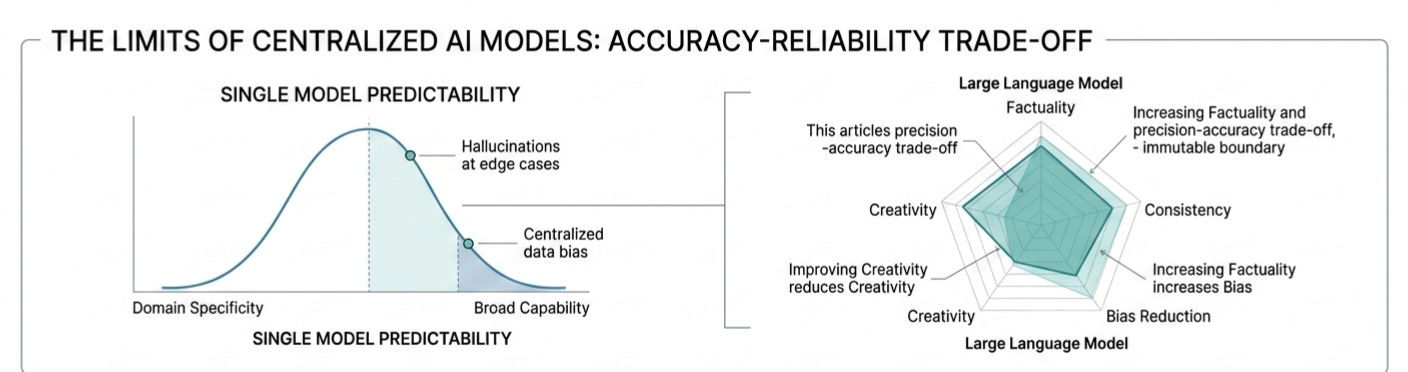
I have spent enough time in the trenches to know that fine tuning is not the silver bullet everyone claims it to be. You can take a model and beat it into submission within a narrow domain but the moment it hits an edge case or needs to learn something new it falls apart like a house of cards. The bone deep reality is that there is an immutable boundary to how good a single model can get. No matter how many trillions of parameters you stack you are eventually going to hit a ceiling where reducing bias increases hallucinations and vice versa. We keep waiting for a god model to descend from the clouds but the truth is that centralized systems are always going to reflect the limitations and perspectives of the people who curated the data. If we want something actually reliable we have to stop looking for a single source of truth and start looking for a way to let different models argue until they find common ground.
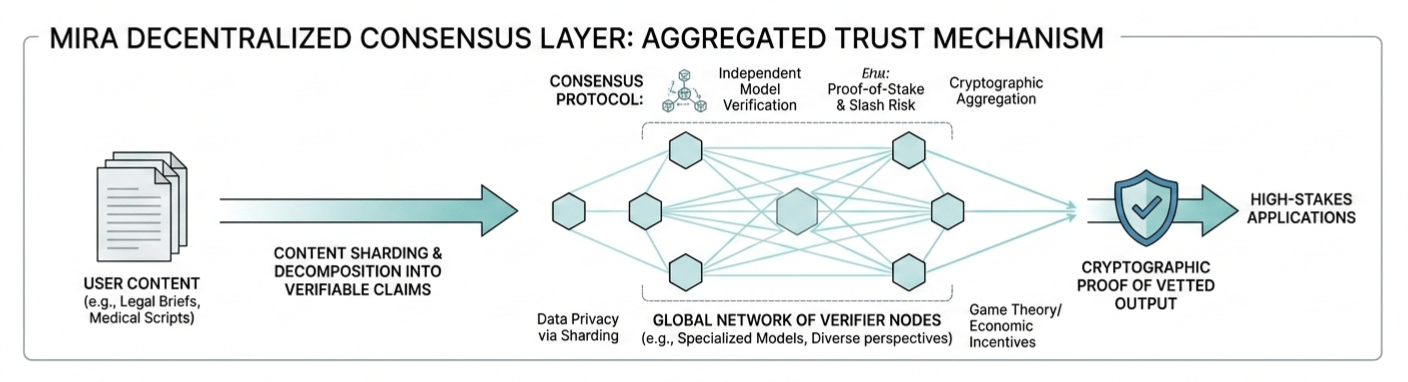
That is where Mira comes in and it is not just another wrapper or a blind play for venture capital. The idea is to build a decentralized network of verifiers that creates a consensus layer for AI output. Think of it as a jury of machines where no single entity holds the gavel. When you feed content into the system it does not just hand it over to one model to check. Instead it breaks that content down into tiny verifiable claims and scatters them across a global network of nodes. It turns a complex legal document or a block of code into a series of objective questions that different models have to answer independently. By the time the results are aggregated you have a cryptographic proof that the output has been vetted by multiple perspectives. It is a way to bridge the gap between the wild west of generative AI and the high stakes requirements of the real world.
The economics of this are where it gets interesting because let us be real if there is no money in it nobody is going to run a node. Mira uses a hybrid of staking and work where operators have to put skin in the game. If a node starts guessing or trying to cheat the system by providing random answers they lose their stake. It makes being a bad actor economically irrational because the cost of failing the consensus is higher than the reward of being lazy. As the network grows the diversity of the models increases which naturally flushes out the bias that plagues centralized systems. We are moving from a world where we trust a single black box to a world where we trust the game theory of a distributed network.
Privacy is usually the first thing that gets thrown out the window in these grand visions but the sharding mechanism here actually protects the user. Because no single node ever sees the full picture it is impossible for an operator to reconstruct your sensitive data from the fragments they are verifying. It is a system designed to be source agnostic and trustless from the ground up. We are essentially moving away from the era of digital gold where we hoard a single precious model and moving toward a world that functions like a global container terminal where the value is in the movement and verification of information across a thousand different ships at once.