
In recent days, the coordinated military attacks by the United States and Israel against Iran have generated a geopolitical escalation that is having a direct impact on global financial markets and, of course, on digital assets. This effect is especially reflected in the risky nature of cryptocurrencies, which react with greater volatility when global uncertainty increases.
📉 The immediate impact on the markets
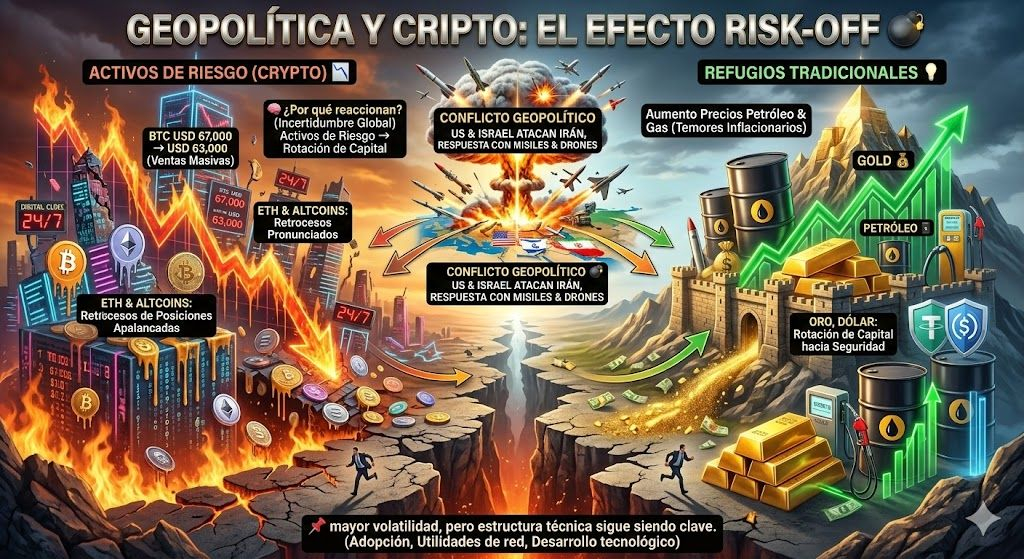
Following the attacks and Iran's response with missiles and drones, traditional markets experienced declines and strong volatility, with increases in oil and gas prices generating inflationary fears and putting pressure on global stock markets. This pressure quickly filters into risky assets like cryptocurrencies, which initially reacted with massive sell-offs.
In crypto, the following was observed:
BTC fell below levels close to USD 67,000 and even touched lows around USD 63,000 before recovering some ground.
Other major coins like ETH and certain altcoins also suffered more pronounced pullbacks due to widespread risk aversion.
🧠 Why do cryptos react?
Cryptocurrencies are considered risk assets, meaning their behavior tends to correlate with the global perception of financial risk. When unexpected global events or geopolitical escalations occur, investors tend to withdraw from assets considered more volatile, like cryptocurrencies, and rotate towards assets perceived as safer or more liquid. This can lead to initial drops in crypto prices before the market digests the shock.
A key aspect is that crypto markets never 'stop': they operate 24/7, even when traditional markets are closed. This means that these reactions can be immediate and uninterrupted, increasing intraday volatility in response to geopolitical news.
🔄 Technical and market effects
During this phase, characteristic technical movements of risk-off have been observed:
Liquidation of leveraged positions and massive liquidations when there are brief panics.
Greater correlation between crypto and traditional markets, especially stocks and commodities, when risk aversion dominates.
Rotation of capital towards stablecoins or assets perceived as safe havens in the short term.
There are precedents where the crypto market has experienced significant drops in tense geopolitical contexts, as seen in previous conflicts between nations or during global economic uncertainties, reinforcing this behavioral trend.
💡 Possible scenarios if the conflict prolongs or de-escalates
If the conflict intensifies:
Increased risk aversion pressure could continue to push prices down.
Bitcoin and other cryptos could show wider and more volatile movements, approaching important technical support levels.
Investors may seek traditional safe havens (gold, dollar) before higher risk assets.
If the conflict stabilizes or is resolved:
The reduction of uncertainty could allow recovery in risk assets.
Liquidity could return to crypto markets, alleviating selling pressure.
Some assets could benefit if there is greater capital rotation towards decentralized technologies post-crisis.
📌 Conclusion: higher volatility, but technical structure remains key
Cryptocurrencies, especially BTC, ETH, and other representative assets of the market, are affected by global geopolitical events due to their nature as risk assets. In the short term, news of conflict can increase volatility and risk aversion. However, as uncertainty is digested, the stabilization of these events may allow the market to resume other structural narratives (adoption, network utilities, technological development).
In any scenario, understanding levels of technical support and resistance, as well as the correlation with traditional markets in risk phases, will be crucial for interpreting possible movements.
⚠️This article is informative and does not constitute financial advice. Do your own research (DYOR) before making any investment decisions. ⚠️