
Trying to repair a slightly more complex home appliance, like that old washing machine that always makes strange noises, is in itself a ritual of reverence for the uncertainty of the physical world. You open it according to the manual, watching those intricate gears, belts, and motors; even with the most perfect circuit diagrams and schematics, you cannot predict which screw will strip when tightened, or which sensor will misreport due to slight dust accumulation. The gap between the logic on paper and the physical friction in reality often leaves one with a profound sense of helplessness. Because in this gray physical world, absolute certainty is a luxury, and we always try to apply perfect mathematical models to this imperfect world filled with wear and error.
Cover image: The trust gamble of physical robots: when robotic arms have a 'credit report'
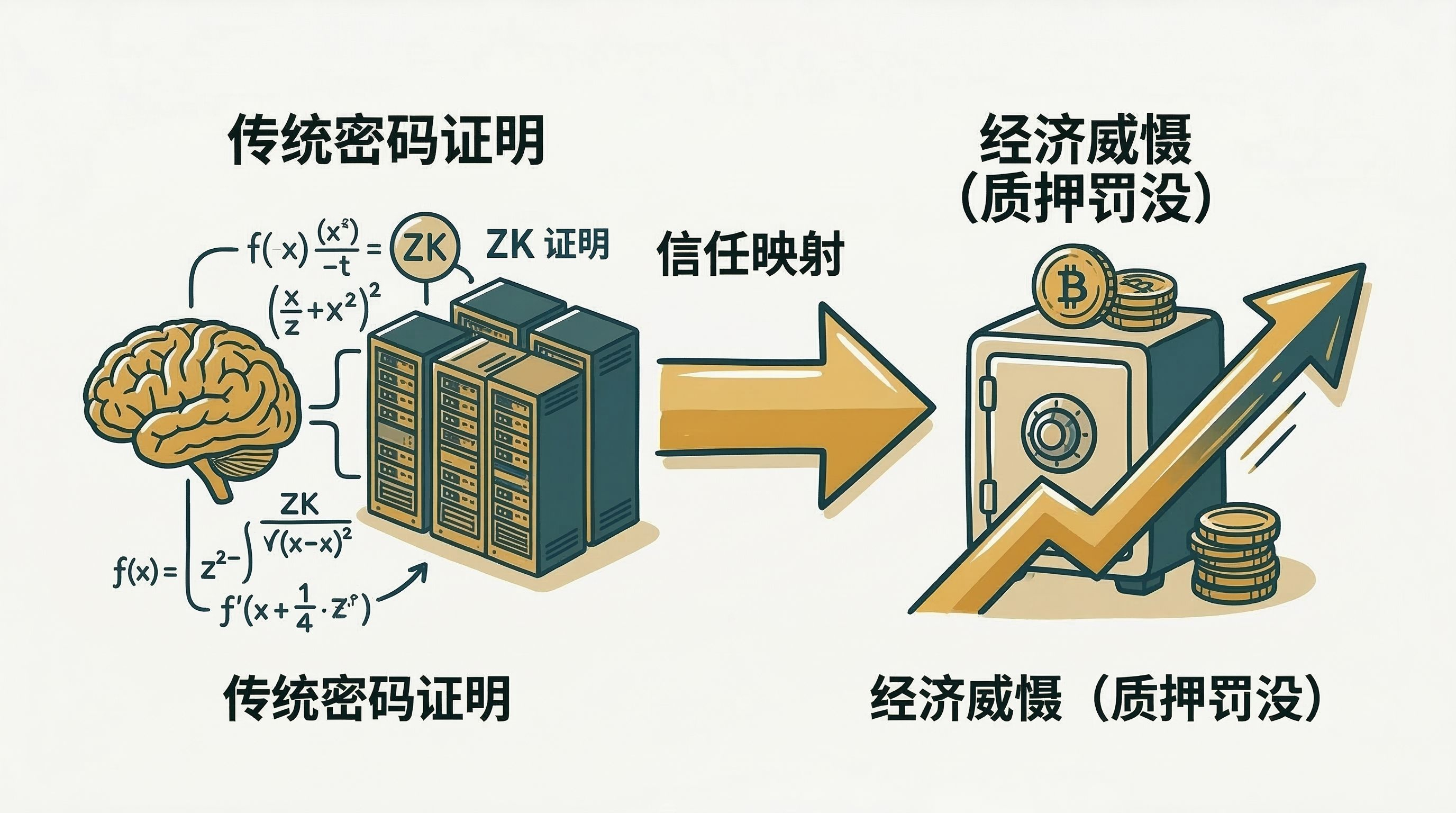
This feeling, I found a mapping in the mechanism of @Fabric Foundation . The problem they are trying to solve is how to verify the physical actions of robots in a decentralized network, but this is by no means an easy task. The traditional approach might be to use complex cryptographic proofs, such as zero-knowledge proofs, to generate deterministic proof for every physical step, but this is computationally extremely expensive and cannot completely eliminate the physical uncertainties of the real world. Fabric has chosen a path more akin to a financial game: replacing expensive cryptographic proofs with economic deterrents, namely staking penalties (Slash). Frankly, I feel this itself is a gamble, as they are directly translating the logic originally belonging to technological verification into a sociological game of trust.
This is somewhat like a credit system in the real world. When banks grant you a loan, they do not fully grasp every future transaction and potential risk; they trust you because if you default, your personal credit report will be tarnished, leading to greater, often unbearable, credit losses in the future. Fabric aims to establish such a 'credit system' in the physical network.
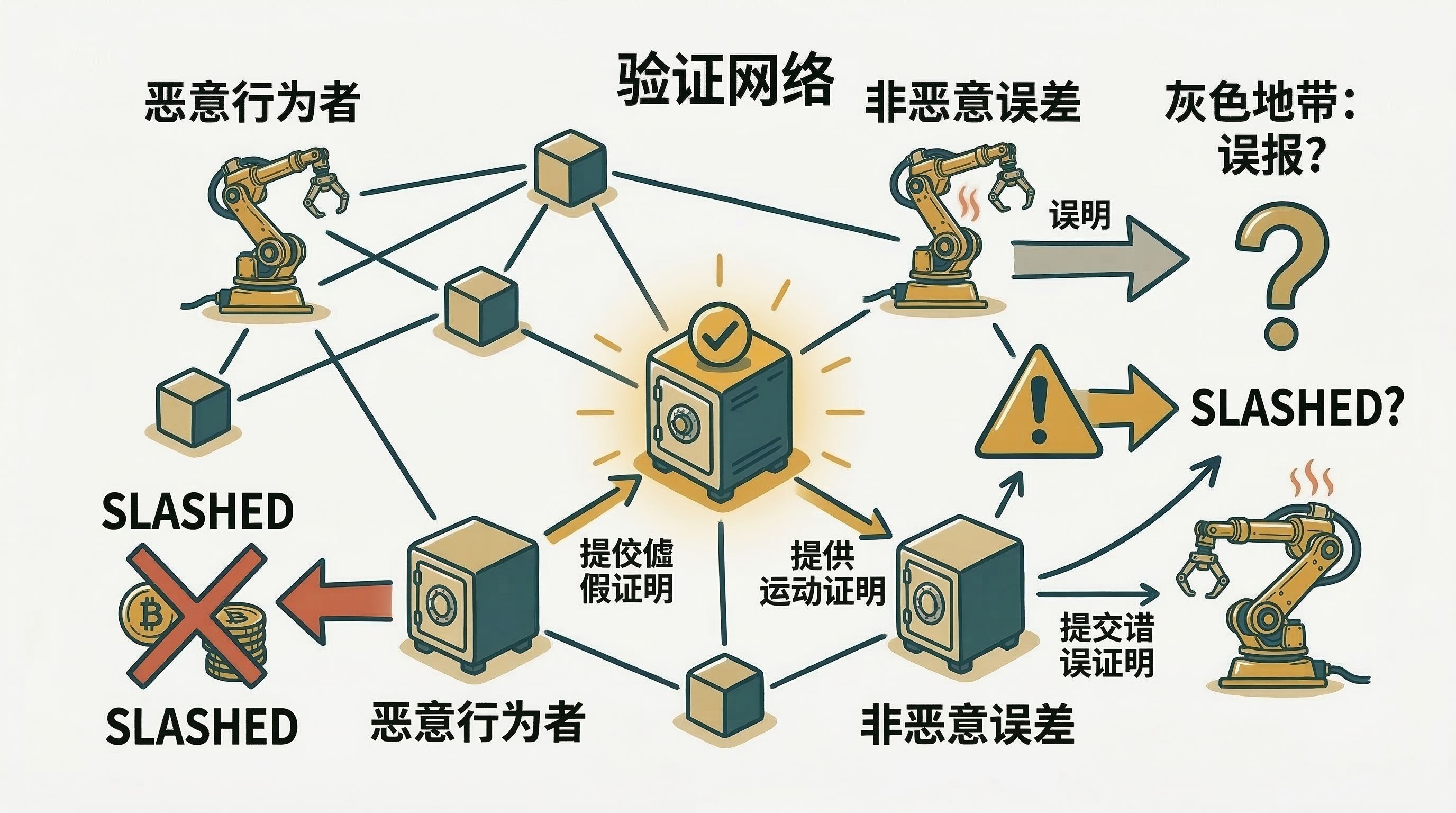
But I have a question. If the uncertainty of the physical world leads to non-malicious errors, such as a robotic arm slightly deforming in high temperatures, resulting in actions failing verification, will this 'honest' node be mistakenly Slashed? The deterministic ledger of blockchain often struggles to tolerate such gray areas, while the reality of physical processes constantly exhibits such friction. How do they distinguish between technical failures, physical errors, and malicious deception? If verification is relaxed for fault tolerance, then malicious actors will have an opportunity. It's like trying to record a physically complex process full of gray areas on a ledger that must be strictly black and white; I believe the difficulty of adjusting the parameters behind this is greater than establishing an entirely new zero-knowledge proof system.$ROBO
Moreover, even if the mechanism seems workable, who will manufacture the hardware that can be verified by Fabric? The current hardware market is highly monopolized; do large companies have the motivation to integrate such a protocol that may harm their centralized interests? Even, do these giants have the motivation to accept external protocols for staking and Slashing their nodes?
The industrial robot market is dominated by a few giants. Allowing them to open their underlying data for external protocol verification sounds a bit crazy from a business logic perspective. Even competitors are trying to establish their own closed ecosystems. My actual PNL this week barely covered the utility bills, so when looking at these lofty visions, I am more concerned about whether their business logic can be operational.
When we look at that dismantled, uncertainty-filled mechanical structure, we know that even the most perfect diagnostic report cannot fully replace the reality of operation. Fabric Foundation attempts to address this physical world's uncertainty with economic incentives, which is a bold idea. What they are building is not a technological defense line, but a psychological and financial game.
It's like betting that human nature is more reliable than technology. This may work in Web3, but in reality, when it comes to expensive hardware and life-and-death physical actions, I take a cautious approach. This is not just a mechanism issue, but a confrontation between physical laws and financial logic. Frankly, establishing such a 'physical credit system' cannot be accomplished with just a few lines of Slash code; it requires crossing a massive commercial and hardware divide and may even need to disrupt the existing industrial trust model.#ROBO
