
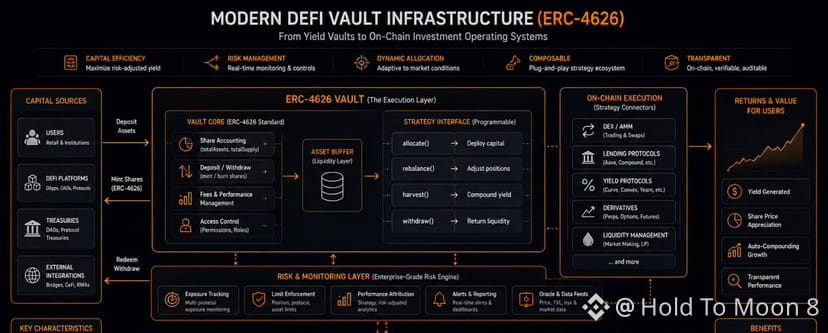
DeFi Vault Infrastructure: vaults are no longer just 'boxes to deposit assets for farming profits', but are evolving into an on-chain capital management operating system. At the heart of this shift is the ERC-4626 standard — standardizing how vaults operate, allowing for strategies, liquidity, and risk management to be programmable like a financial middleware.
In the early days of DeFi, vaults primarily operated on a pretty straightforward model: users deposit assets → the protocol automatically stakes/farms → profits are redistributed. The logic was almost fixed and heavily reliant on a single strategy. But the architecture shown indicates that modern vaults have evolved far beyond that model.
The most important point is the 'Strategy Interface'. This layer allows the vault to interact with various strategies through functions like allocate(), rebalance(), harvest(), withdraw(). This transforms the vault into a capital coordination layer rather than just a storage for assets. Capital can be automatically moved between DEXs, lending protocols, yield protocols, or derivatives depending on market conditions.
In other words, the vault operates like an 'on-chain portfolio manager'. Instead of users deciding on capital allocation, the system continuously evaluates:
Where the APY is higher, where the liquidity is deeper, what level of risk is suitable, and when to hedge or rebalance.
This creates a 'dynamic allocation logic' — a dynamic allocation logic. This is the foundation of the new generation of DeFi since the crypto market is constantly changing; APY and liquidity can reverse in just a few hours. A static vault is nearly no longer optimal.
The 'Risk & Monitoring Layer' is a crucial advancement. Previously, most vaults focused solely on maximizing profits. Now, protocols are starting to view risk management as a core component of the infrastructure. Exposure tracking, limit enforcement, and performance attribution allow the system to control exposure levels to each protocol, avoid overexposure to a single pool, automatically limit drawdowns, and track the effectiveness of each strategy in real-time.
This is a sign that DeFi is getting closer to a TradFi asset management model.
Another major change is 'real-time liquidity management'. Modern vaults do not simply lock assets and wait for yield. They must ensure:
sufficient liquidity for users to withdraw capital, optimizing capital usage, and reacting immediately to market volatility.
This makes the vault resemble a liquidity engine more than a passive smart contract.
Notably, the role of the 'Curator / Strategy Manager' is crucial. This could be a DAO, an AI agent, or a professional strategy manager. They are no longer just configuring APY but are coordinating the entire flow of capital on-chain. Thus, modern DeFi protocols are shifting from 'financial products' to 'programmable financial infrastructure'.
From a long-term perspective, the vault layer could become the 'operating system' of DeFi: managing assets, routing liquidity, controlling risk, optimizing profits, and providing an execution layer for various other applications.
At that point, value won't just lie in 'how much APY you farm', but in the quality of the capital allocation algorithm and the protocol's risk management capabilities. This is why many see ERC-4626 not just as a tokenized vault standard, but as the foundation for the next generation of asset management protocols in DeFi.
