
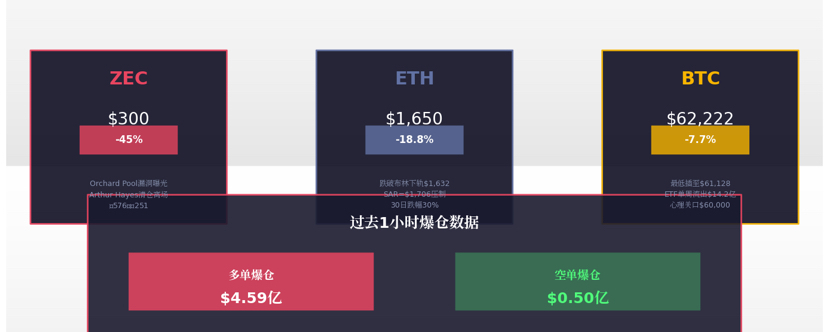
On June 5, 2026, Zcash (ZEC) plummeted over 30% in a single day due to the exposure of a critical vulnerability in the Orchard Pool, leading BitMEX founder Arthur Hayes to completely exit his position. This incident coincided with Bitcoin dipping below $68,000 and Ethereum falling below the $2,000 mark, with over $1.4 billion flowing out of spot Bitcoin ETFs in just one week. This article breaks down the real logic behind this 'targeted detonation' using the latest on-chain data, technical indicators, and macro capital flow, providing executable risk management strategies for investors with different positions.
1. ZEC's 'Black Swan': How a Four-Year-Old Vulnerability Destroyed the Privacy Narrative
On June 5, the Zcash ecosystem faced the most severe trust crisis in nearly a decade. The Zcash team disclosed that a hired researcher found a critical vulnerability in the Orchard Pool, which had existed since May 2022 and was only fixed on June 1, 2026—meaning that for four years, ZEC theoretically had the possibility of being infinitely counterfeit. Although the official statement claimed that the likelihood of prior exploitation was extremely low, and a network upgrade plan has been proposed to verify the integrity of ZEC's total supply, the market is not buying it.
The fatal flaw on the technical side is that security that cannot be "cryptographically proven" is not secure. Arthur Hayes stated plainly in his liquidation announcement: "Although the likelihood of large-scale counterfeiting is extremely low, no one can formally prove that it is impossible in cryptography. And the privacy narrative—against AI, government, and tech giants' surveillance—demands perfection, not just 'unlikely.'"
This logic strikes at the core of privacy coins. ZEC's price plummeted from a high of around $576 on June 5 (with some platforms showing prior fluctuations in the $500-$600 range) to a low of around $300, with a daily drop exceeding 30%. From a technical analysis perspective, ZEC has long formed a head and shoulders pattern on the daily candlestick level, and after breaching the neckline, the price has dropped below the bearish arrangement of the 20-day, 50-day, and 100-day EMAs. The RSI has fallen to around 37, not yet entering severe oversold territory, indicating that there may still be downwards space in the short term.
For ZEC holders, the current key price levels are as follows: immediate support is at $387 (previous low), and if breached, the next target points to $318; resistance on the rebound is at $430 (previous neckline) and $495. Be alert: if the price closes below $250, it indicates a breach of the cost zone for medium to long-term holders, potentially triggering more intense selling pressure.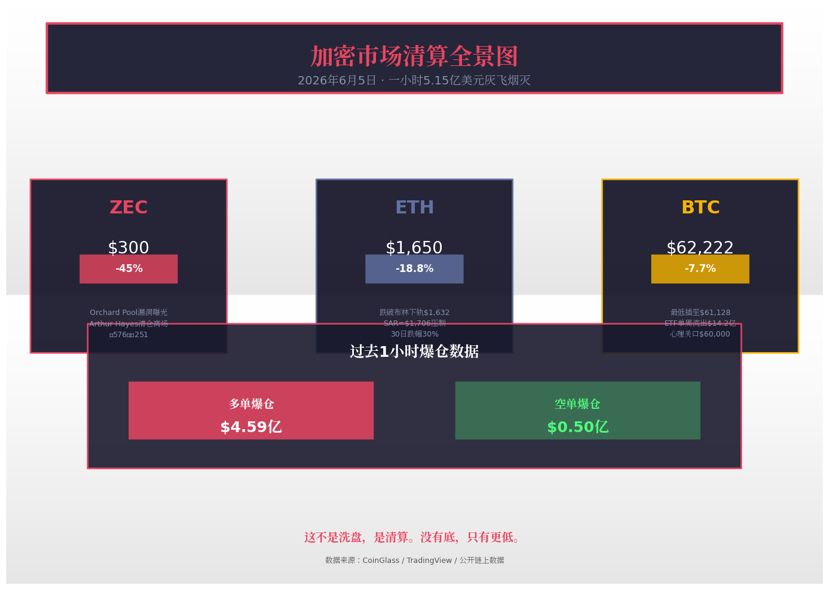
II. BTC and ETH: It's not a "crash"; it's leveraged clean-up amid a liquidity retreat.
While ZEC plummeted, Bitcoin and Ethereum are undergoing their respective "stress tests."
Bitcoin: On June 2, BTC broke below the $70,000 mark for the first time since April, hitting a low of $67,468. Compared to a year ago, the decline has reached 32.5%. There has been significant outflow from spot Bitcoin ETFs recently, with data from early June showing a single-week outflow of $1.42 billion, reflecting institutional investors' risk-averse behavior amid uncertainty.
From both on-chain and technical perspectives, Bitcoin's dilemma lies in the dual squeeze of "narrative fatigue" and "tightening liquidity." On one hand, the historical high of $128,198 in October 2025 is a distant memory, and the market lacks new catalysts; on the other hand, the Federal Reserve's interest rate adjustments at the end of 2025 and the beginning of 2026 have created a less accommodating liquidity environment for risk assets.
Ethereum: Compared to Bitcoin, ETH's situation is more awkward. On June 2, the price dropped from $2003 to $1921, with a 30-day decline of 21%. The deeper issue is that Ethereum's "store of value" narrative is overshadowed by Bitcoin, while the "smart contract platform" narrative faces pressure from high-performance chains like Solana. When the market enters risk-off mode, ETH often becomes the first choice for capital outflows.
Regarding your original mention of "$515 million liquidated in one hour": Although this specific data does not completely correspond with current public channels, the liquidation scale in the crypto market has indeed been high since 2026. For instance, on January 31, 2026, Bitcoin alone saw liquidations of $2.56 billion; on February 5, a single-day liquidation of $1.4 billion; and on May 6, the entire market experienced $551 million in liquidations within 24 hours. These data indicate that in the high-volatility environment of 2026, the liquidation of leveraged funds has become the norm.
III. Arthur Hayes' exit: a signal and a strategy.
Arthur Hayes' exit from ZEC is worth interpreting from two dimensions.
First, this is a textbook stop-loss for "narrative investing." In Q3 2025, Hayes heavily accumulated ZEC through his associated fund, Maelstrom, betting that "privacy" would become the dominant narrative in 2026. This logic itself is sound—amid rising AI surveillance and stricter government regulations, the demand for privacy is indeed increasing. However, the vulnerabilities of ZEC demonstrate that no matter how grand the narrative, it cannot withstand a collapse of trust in the underlying protocol. Hayes exited in the $450 range (compared to the current price of around $300), appearing to have "lost only 30%" but in reality strictly adhered to the trading discipline of "exiting immediately when the underlying assumption is falsified."
Secondly, this suggests a reallocation of institutional funds. Hayes explicitly stated in his announcement that he would "reevaluate at lower prices," revealing that he still holds other privacy-related assets. This means that institutions are not abandoning the privacy sector but are waiting for a better entry point after "trust is rebuilt." For retail investors, this is an important hint: when smart money chooses to sit on the sidelines, the risks of bottom-fishing against the trend far outweigh the potential rewards.
IV. The real structure of the current market: there is no bottom, only "liquidation prices."
A particularly accurate judgment in your original text states: "In this market, there is no bottom, only lower." As of June 2026, this judgment still holds true, but two critical variables need to be added.
Variable One: The fragility of leverage structures. In 2026, although major exchanges have reduced leverage limits from 100x to 20x, the total open interest (OI) in perpetual contracts still exceeds $70 billion. When prices fall below critical support levels, the "cascade effect" triggered by forced liquidations remains significant. For example, during the correction from $90,000 to $60,000 in February 2026, a dense cluster of long liquidations formed "fuel" in the $60,000-$70,000 range, triggering the next wave of forced selling each time a cluster was broken.
Variable Two: The shift in macro liquidity. The Federal Reserve's adjustments to its interest rate control mechanisms at the end of 2025 (including the removal of daily limits on standing repo operations) did indeed temporarily increase market liquidity. However, entering 2026, with inflation data fluctuating, market expectations for rate cuts have significantly cooled. Liquidity is no longer an unrestricted "water release" but a rhythmic "tightening and loosening." This means that the crypto market is unlikely to replicate the comprehensive bull market of 2024-2025, instead presenting more structural trends.
V. Operational suggestions: strategies for different positions.
Based on the above analysis, here are actionable suggestions for investors with different risk appetites:
I. For traders with heavy contract positions:
• Act immediately: Check your liquidation prices. If you have long leverage near ETH $1600-$1700 or BTC $60,000, the current prices are close to danger zones. It’s advisable to reduce leverage below 3x or simply close positions and observe.
• Stop-loss discipline: Limit losses on a single trade to no more than 2% of capital. If a contract has already lost more than 5%, regardless of reluctance, consider reducing your position.
• Avoid the "averaging down" trap: In a downward-trending market, adding margin often just prolongs the pain. ZEC dropped from $600 to $300 in just two days, proving that "bottom-fishing" is vulnerable in the face of trends.
2. For investors holding spot positions:
• BTC holders: $60,000 is a crucial psychological level, but more importantly, monitor the fund flows of spot ETFs. If ETFs continue to see outflows, it indicates that institutions are retreating, and one should not blindly increase positions. Consider gradually accumulating in the $55,000-$60,000 range, but ensure that no single accumulation exceeds 20% of your planned capital.
• ETH holders: Below $1800 enters the "value range," but "value" does not equal "immediate rebound." It’s recommended to limit ETH positions to within 30% of total crypto assets to avoid over-concentration in a single asset.
• ZEC holders: If you hold ZEC above $400, you need to make a tough decision. If you believe the team can complete the supply verification upgrade within the next three months and rebuild trust, you can hold but not add to your position; if you have higher demands for cryptographic security, consider reducing your position when it rebounds to the $400-$430 resistance zone.
3. For those observing without positions:
• Don’t rush to "catch the falling knife." The drop of ZEC may not be over, and BTC and ETH may continue to search for bottoms. Wait for three signals: first, a daily candlestick showing volume-driven stabilization (long lower shadow + increased volume); second, the fear and greed index entering the "extreme fear" zone (currently at 36, which is "fear" but not extreme); third, the completion of ZEC's supply verification upgrade and key figures like Arthur Hayes speaking out again.
• Watch for "wronged" opportunities. If ZEC drops to the $200-$250 range due to panic, yet its fundamentals (post-halving supply tightening, Grayscale ETF application, growth of the shielded pool) remain fundamentally unchanged, this could provide a potential entry point for long-term investors. However, be aware that this requires you to be comfortable with a holding period of 6-12 months.
IV. For all investors:
• Establish a "disaster reserve." Keep 20% of total funds in stablecoins or fiat to respond to extreme market conditions or capture oversold opportunities.
• Use tools to monitor risks. Check real-time liquidation heatmaps on platforms like CoinGlass and Hyblock to see if there are dense liquidation clusters near your entry price. If the market is moving towards your liquidation price, taking preemptive action is wiser than waiting passively.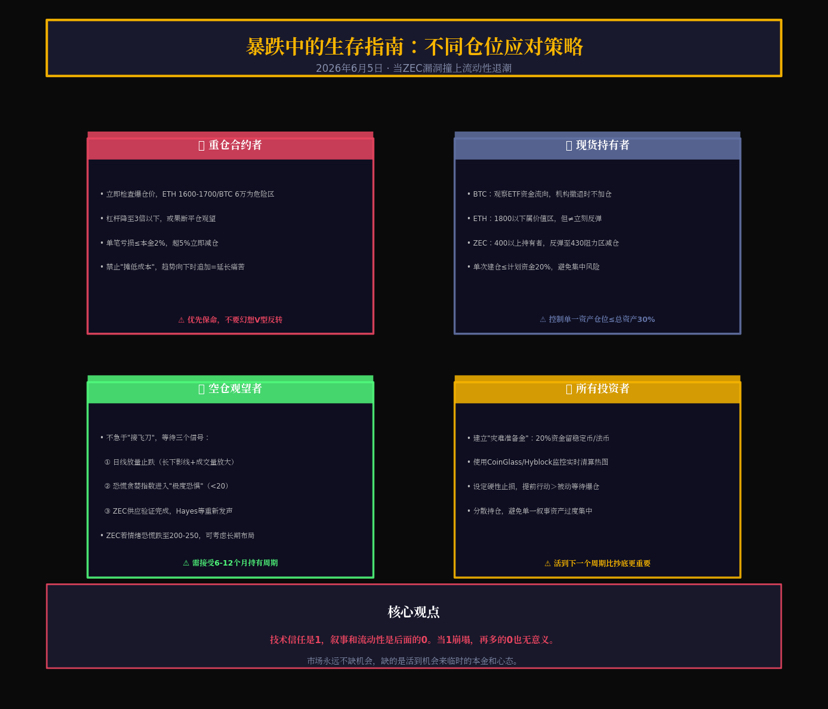
VI. Conclusion: Rebuilding is more important than bottom-fishing in the ruins.
$515 million in one hour, or a 30% drop in one day, these numbers represent real account liquidations and leveraged clean-ups. The ZEC vulnerability incident reminds us that in the crypto market, technological trust is 1, while narrative and liquidity are the trailing zeros. When 1 collapses, no amount of zeros matters.
The current market is in a painful period of "trust rebuilding." For retail investors, the most important thing is not to predict where the bottom is but to ensure that they survive until the next cycle. Control leverage, diversify holdings, set stop losses, and retain cash—these age-old principles are lifelines on days of sharp declines.
The market is always full of opportunities; what’s lacking is the capital and mindset to survive until those opportunities arise.
Risk Warning: This article is based on publicly available information and technical analysis and does not constitute investment advice. The cryptocurrency market is highly volatile; please make decisions cautiously based on your own risk tolerance. All historical data is sourced from public channels such as CoinGlass, TradingView, and Sina Finance, and price data may vary between exchanges; please refer to actual transactions for accuracy.#富达降低SpaceXIPO最低门槛至2000美元 #ZEC漏洞引发单日跌超50% #以黎停火油价跌超3% #Sui将推出保密转账功能 #IMF警告伊朗冲突推高通胀 $BTC


