
Web3 Matrix 媒体矩阵
WEB3媒体矩阵 飞机w3matrix
543 Following
726 Followers
7.2K+ Liked
290 Shared
Posts
All
Live
🎙️ $ETH 2026年 NVF喵喵币涨100万倍😼😼以太链上Meme之王#NVF喵喵币

End
02 h 17 m 35 s
1.2k
1
$ETH
By the end of 2025, the MiaoMiaoCoin project team came to us,
and conducted an airdrop on our Web3 media matrix platform.
At that time, nobody paid attention to this project,
only 9 users participated,
and 0 grabbed the airdrop.
After the launch on January 1, 2026, the price surged 300 times.
Although we managed to get on board with 0.1 eth, which has now become 1.x eth.
We've already broken our legs from slapping the大腿, wow!!
By the end of 2025, the MiaoMiaoCoin project team came to us,
and conducted an airdrop on our Web3 media matrix platform.
At that time, nobody paid attention to this project,
only 9 users participated,
and 0 grabbed the airdrop.
After the launch on January 1, 2026, the price surged 300 times.
Although we managed to get on board with 0.1 eth, which has now become 1.x eth.
We've already broken our legs from slapping the大腿, wow!!
$ETH
Bought 0.1 eth, now it's 1 eth
Will eth this year produce a big dog like pepe and shib?
Bought 0.1 eth, now it's 1 eth
Will eth this year produce a big dog like pepe and shib?
$ETH
ETH
The first major fortune of the year🐱
Set sail for a hundred million times
ETH
The first major fortune of the year🐱
Set sail for a hundred million times
Once the economy declines, all the shiny façades will fall away,
those who can truly survive are never the "elites,"
but the beggars.
Because beggars never rely on illusions to survive,
they only depend on resilience, execution, and a keen sense for opportunities.
While others are still holding onto their pride, we have already begun to take action;
while others disdain small tasks, we have already rolled up our capital;
while others wait for the right moment, we are already grabbing resources in the wind.
The worse the economy, the clearer it becomes who the true strong ones are.
The rules have changed, the environment has changed, but the one thing that remains unchanged is: beggars will always survive.
When all industries start laying off workers, shrinking, and cutting costs,
beggars will instead become the new "mainstream" of this era.
Not because we are strong,
but because we are daring, competitive, and willing to take risks.
Economic downturn?
Good.
Beggars are about to become the largest gang.
those who can truly survive are never the "elites,"
but the beggars.
Because beggars never rely on illusions to survive,
they only depend on resilience, execution, and a keen sense for opportunities.
While others are still holding onto their pride, we have already begun to take action;
while others disdain small tasks, we have already rolled up our capital;
while others wait for the right moment, we are already grabbing resources in the wind.
The worse the economy, the clearer it becomes who the true strong ones are.
The rules have changed, the environment has changed, but the one thing that remains unchanged is: beggars will always survive.
When all industries start laying off workers, shrinking, and cutting costs,
beggars will instead become the new "mainstream" of this era.
Not because we are strong,
but because we are daring, competitive, and willing to take risks.
Economic downturn?
Good.
Beggars are about to become the largest gang.
New Species in the Web3 Task Platform: Web3 Media Matrix
In this industry, many task platforms operate on a lottery system—relying on luck and big accounts.
Ordinary users spend hours posting, only to end up with no rewards.
So we created something entirely different:
🚀 Web3 Media Matrix: Post and Get Rewarded—100% Guaranteed, No Luck Required
This is a truly fair platform designed for retail users.
✔ Earn points, tokens, or USDT just for posting
No lotteries, no probabilities, no "Thank you for participating."
✔ All users are from the Binance ecosystem
Link your Binance ID to ensure real users, not bots.
✔ Eliminate bots and spam
Same link cannot be submitted repeatedly forever. IP and user-level rate limiting, multiple anti-cheating measures.
✔ Multi-platform support
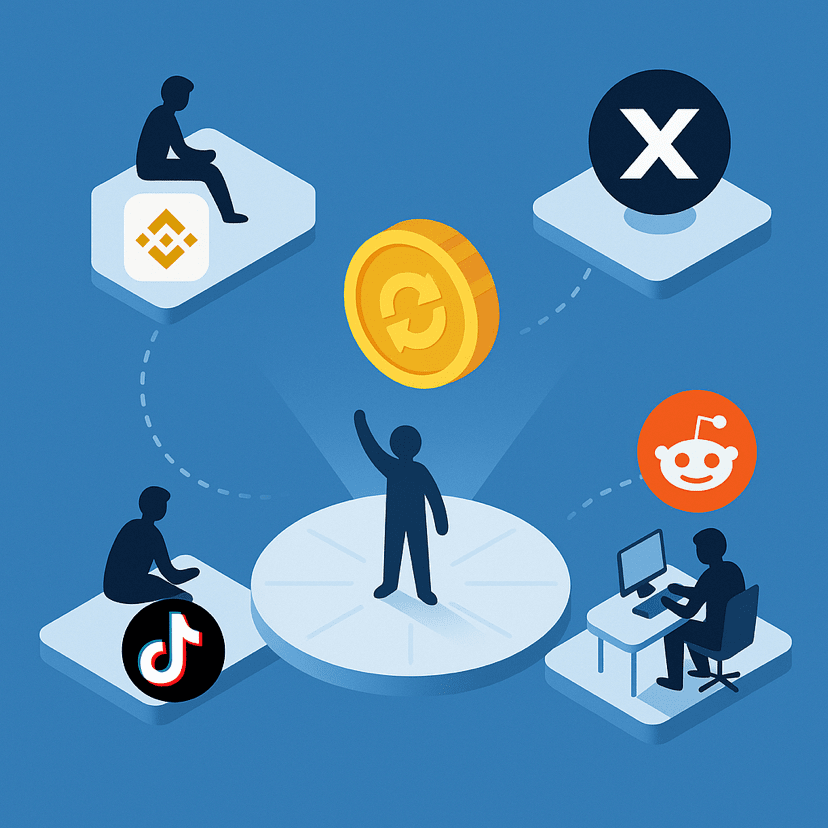
Binance Square / X (Twitter) / Reddit / Xiaohongshu / TikTok
Post anywhere—your efforts count.
✔ Retail-friendly, everyone can be a pioneer
Every ordinary user can participate and earn rewards—no monopolization by big accounts.
💡 Why are we doing this?
Because in Web3, everyone is part of the community, a token holder, and a KOL.
The voice of retail users deserves to be amplified.
We aim to build a task platform where every ordinary user truly matters.
🎁 Join Now
👉 Entry: web3matrix.xyz
👉 Community: ✈ w3matrix
👉 Complete tasks to earn points and the rewards specified for each task.
👉 Points will be used in the future for incentives, governance, exclusive benefits, and more ecosystem privileges
True Web3 isn't about stories—it's about enabling everyone to participate, earn money, and contribute.
Welcome to join Web3 Media Matrix and become part of the Web3 retail force. #web3matrix
In this industry, many task platforms operate on a lottery system—relying on luck and big accounts.
Ordinary users spend hours posting, only to end up with no rewards.
So we created something entirely different:
🚀 Web3 Media Matrix: Post and Get Rewarded—100% Guaranteed, No Luck Required
This is a truly fair platform designed for retail users.
✔ Earn points, tokens, or USDT just for posting
No lotteries, no probabilities, no "Thank you for participating."
✔ All users are from the Binance ecosystem
Link your Binance ID to ensure real users, not bots.
✔ Eliminate bots and spam
Same link cannot be submitted repeatedly forever. IP and user-level rate limiting, multiple anti-cheating measures.
✔ Multi-platform support
Binance Square / X (Twitter) / Reddit / Xiaohongshu / TikTok
Post anywhere—your efforts count.
✔ Retail-friendly, everyone can be a pioneer
Every ordinary user can participate and earn rewards—no monopolization by big accounts.
💡 Why are we doing this?
Because in Web3, everyone is part of the community, a token holder, and a KOL.
The voice of retail users deserves to be amplified.
We aim to build a task platform where every ordinary user truly matters.
🎁 Join Now
👉 Entry: web3matrix.xyz
👉 Community: ✈ w3matrix
👉 Complete tasks to earn points and the rewards specified for each task.
👉 Points will be used in the future for incentives, governance, exclusive benefits, and more ecosystem privileges
True Web3 isn't about stories—it's about enabling everyone to participate, earn money, and contribute.
Welcome to join Web3 Media Matrix and become part of the Web3 retail force. #web3matrix
SolVM's Core Advantages Compared to EVM
The Solana Virtual Machine (SolVM) has a significant advantage over the Ethereum Virtual Machine (EVM) in terms of modern architecture and high-performance execution capabilities. The EVM is a serial global state machine, where each transaction is executed sequentially, resulting in limited throughput; in contrast, SolVM employs a Parallel Execution model, where each transaction declares the accounts it will access before execution, and the system automatically detects conflicts to achieve multi-threaded concurrent processing, greatly enhancing efficiency.
At the consensus layer, Solana combines Proof of History (PoH) with Tower BFT, achieving block times of approximately 400–500 milliseconds and final confirmations in 1–2 seconds, which is significantly faster than Ethereum's 12 seconds block time and 1-minute confirmation delay. This near real-time confirmation speed makes SolVM more suitable for performance-sensitive scenarios such as DeFi, high-frequency trading, and gaming.
The account model design of SolVM is also more efficient. Each account is an independent state object, and contracts can only access explicitly declared accounts, avoiding the performance bottlenecks caused by EVM's global locking, while also enhancing security and auditability. Additionally, SolVM compiles Rust/C/C++ to BPF bytecode, achieving near-native performance, far exceeding the performance of Solidity bytecode, which is based on interpreted execution.
Furthermore, the SPL Token standard of SolVM is implemented at the system level, eliminating the need to deploy separate ERC-20 contracts for each token like in EVM, simplifying token operations and reducing security risks. Coupled with the precise resource measurement of the Compute Units (CU) model, Solana can support high-concurrency transactions while maintaining low fees.
Overall, SolVM leads EVM in performance, scalability, and security through parallel execution, an efficient account model, low-latency consensus, and native performance language, representing a new generation of high-performance blockchain virtual machines.
$SOL
The Solana Virtual Machine (SolVM) has a significant advantage over the Ethereum Virtual Machine (EVM) in terms of modern architecture and high-performance execution capabilities. The EVM is a serial global state machine, where each transaction is executed sequentially, resulting in limited throughput; in contrast, SolVM employs a Parallel Execution model, where each transaction declares the accounts it will access before execution, and the system automatically detects conflicts to achieve multi-threaded concurrent processing, greatly enhancing efficiency.
At the consensus layer, Solana combines Proof of History (PoH) with Tower BFT, achieving block times of approximately 400–500 milliseconds and final confirmations in 1–2 seconds, which is significantly faster than Ethereum's 12 seconds block time and 1-minute confirmation delay. This near real-time confirmation speed makes SolVM more suitable for performance-sensitive scenarios such as DeFi, high-frequency trading, and gaming.
The account model design of SolVM is also more efficient. Each account is an independent state object, and contracts can only access explicitly declared accounts, avoiding the performance bottlenecks caused by EVM's global locking, while also enhancing security and auditability. Additionally, SolVM compiles Rust/C/C++ to BPF bytecode, achieving near-native performance, far exceeding the performance of Solidity bytecode, which is based on interpreted execution.
Furthermore, the SPL Token standard of SolVM is implemented at the system level, eliminating the need to deploy separate ERC-20 contracts for each token like in EVM, simplifying token operations and reducing security risks. Coupled with the precise resource measurement of the Compute Units (CU) model, Solana can support high-concurrency transactions while maintaining low fees.
Overall, SolVM leads EVM in performance, scalability, and security through parallel execution, an efficient account model, low-latency consensus, and native performance language, representing a new generation of high-performance blockchain virtual machines.
$SOL
2025: Altcoins Struggling
As we enter 2025, the focus of the crypto market is shifting back towards "Bitcoin legitimization" and "real-world assets (RWA)", while altcoins find themselves in unprecedented difficulties. In the last bull market, projects that quickly rose to prominence based on concepts, airdrops, and community enthusiasm are now struggling amidst tightening regulations, shrinking liquidity, and capital withdrawal waves.
Firstly, the narrative dividends have been exhausted. Former hotspots like DeFi, GameFi, AI, and SocialFi have proven to largely lack sustained user demand and business models. A large number of projects have seen their token prices plummet by more than 90% after losing speculative interest, development has stalled, and communities have disbanded. New narratives cannot replace old illusions, and the market has entered a "fatigue cycle".
Secondly, the trend of liquidity centralization is obvious. Major funds are flowing back into Bitcoin and Ethereum, with institutions favoring stable returns and compliant assets. Altcoins have not only lost retail traffic but also the support of DeFi liquidity market-making. Higher listing thresholds on exchanges and exhausted liquidity have sharply increased the "exit difficulty" for small and medium-sized projects.
Thirdly, regulation and compliance have become a matter of life and death. The United States, European Union, Hong Kong, and other regions have successively strengthened regulation of token issuance and trading, requiring projects to disclose actual controllers and the flow of funds. Those altcoin projects that rely on anonymity, cross-chain features, and gambling as selling points have basically lost their space for compliance and can only retreat to the dark web or niche chains.
Finally, the maturation of user mentality is also key. After several rounds of bubbles, investors are becoming increasingly clear: the vast majority of altcoin projects are not innovations but rather "shell financing". When the market returns to rationality, speculation is hard to sustain, and the bubble naturally dissipates.
The altcoin market in 2025 is no longer a playground of a hundred flowers blooming, but rather a purgatory of survival and elimination. Only projects that truly solve real problems and can be embedded in the real economy or on-chain infrastructure may be reborn in the next cycle.
This is a brutal but necessary cleansing—when speculation recedes, value has the opportunity to emerge.
As we enter 2025, the focus of the crypto market is shifting back towards "Bitcoin legitimization" and "real-world assets (RWA)", while altcoins find themselves in unprecedented difficulties. In the last bull market, projects that quickly rose to prominence based on concepts, airdrops, and community enthusiasm are now struggling amidst tightening regulations, shrinking liquidity, and capital withdrawal waves.
Firstly, the narrative dividends have been exhausted. Former hotspots like DeFi, GameFi, AI, and SocialFi have proven to largely lack sustained user demand and business models. A large number of projects have seen their token prices plummet by more than 90% after losing speculative interest, development has stalled, and communities have disbanded. New narratives cannot replace old illusions, and the market has entered a "fatigue cycle".
Secondly, the trend of liquidity centralization is obvious. Major funds are flowing back into Bitcoin and Ethereum, with institutions favoring stable returns and compliant assets. Altcoins have not only lost retail traffic but also the support of DeFi liquidity market-making. Higher listing thresholds on exchanges and exhausted liquidity have sharply increased the "exit difficulty" for small and medium-sized projects.
Thirdly, regulation and compliance have become a matter of life and death. The United States, European Union, Hong Kong, and other regions have successively strengthened regulation of token issuance and trading, requiring projects to disclose actual controllers and the flow of funds. Those altcoin projects that rely on anonymity, cross-chain features, and gambling as selling points have basically lost their space for compliance and can only retreat to the dark web or niche chains.
Finally, the maturation of user mentality is also key. After several rounds of bubbles, investors are becoming increasingly clear: the vast majority of altcoin projects are not innovations but rather "shell financing". When the market returns to rationality, speculation is hard to sustain, and the bubble naturally dissipates.
The altcoin market in 2025 is no longer a playground of a hundred flowers blooming, but rather a purgatory of survival and elimination. Only projects that truly solve real problems and can be embedded in the real economy or on-chain infrastructure may be reborn in the next cycle.
This is a brutal but necessary cleansing—when speculation recedes, value has the opportunity to emerge.
Why has Bitcoin Layer 2 all but fizzled out?
Over the past year, Bitcoin Layer 2 has been viewed as the new narrative focal point in the crypto world, from the frenzy of Ordinals and BRC-20 to the successive appearances of projects like Stacks, Rootstock, and the Lightning Network, seemingly heralding the "awakening of the Bitcoin ecosystem." However, just a few months later, the enthusiasm for Layer 2 has plummeted, with trading volumes, developer activity, and capital inflows cooling almost simultaneously. Why has Bitcoin Layer 2 "fizzled out"?
First, the technical foundation is weak. The Bitcoin main chain was never designed for complex smart contracts or scaling solutions, resulting in most Layer 2 protocols having to rely on the main chain's "minimum trust" consensus, lacking truly efficient interaction. Unlike Ethereum, Bitcoin does not have a unified virtual machine standard or a rich ecosystem of development tools, making each Layer 2 almost an island.
Second, there is insufficient economic incentive. The profit-seeking nature of developers and capital dictates that funds will flow to ecosystems with higher returns. Bitcoin Layer 2 lacks native tokens (or the token economy cannot be linked to the main chain), leading to unsustainable liquidity and incentives. In contrast, Ethereum's Layer 2 solutions like Solana, Base, and Blast have airdrops, yields, and users, while Bitcoin Layer 2 can only rely on narrative support.
Third, poor user experience and narrative fatigue. BRC-20 and Ordinals initially brought a frenzy with the "inscription economy," but their high transaction costs, slow confirmations, and poor practicality were quickly abandoned by speculative funds. The Lightning Network, despite its mature technology, has never achieved large-scale adoption—problems with deposits, routing failures, and a user experience inferior to centralized wallets.
Finally, the conservativeness of the Bitcoin community limits the space for innovation. Bitcoin main chain development is extremely cautious, lacking the experimental culture seen in Ethereum; ecosystem participants are more "coin holders" than "builders."
In summary, the collective fizzling out of Bitcoin Layer 2 is not accidental but rather a structural result of technology, economics, and culture. Without new consensus models, incentive mechanisms, and an open spirit, relying solely on the "Layer 2 narrative" cannot ignite a true ecological revival.
$BTC #BTC #Layer2
Over the past year, Bitcoin Layer 2 has been viewed as the new narrative focal point in the crypto world, from the frenzy of Ordinals and BRC-20 to the successive appearances of projects like Stacks, Rootstock, and the Lightning Network, seemingly heralding the "awakening of the Bitcoin ecosystem." However, just a few months later, the enthusiasm for Layer 2 has plummeted, with trading volumes, developer activity, and capital inflows cooling almost simultaneously. Why has Bitcoin Layer 2 "fizzled out"?
First, the technical foundation is weak. The Bitcoin main chain was never designed for complex smart contracts or scaling solutions, resulting in most Layer 2 protocols having to rely on the main chain's "minimum trust" consensus, lacking truly efficient interaction. Unlike Ethereum, Bitcoin does not have a unified virtual machine standard or a rich ecosystem of development tools, making each Layer 2 almost an island.
Second, there is insufficient economic incentive. The profit-seeking nature of developers and capital dictates that funds will flow to ecosystems with higher returns. Bitcoin Layer 2 lacks native tokens (or the token economy cannot be linked to the main chain), leading to unsustainable liquidity and incentives. In contrast, Ethereum's Layer 2 solutions like Solana, Base, and Blast have airdrops, yields, and users, while Bitcoin Layer 2 can only rely on narrative support.
Third, poor user experience and narrative fatigue. BRC-20 and Ordinals initially brought a frenzy with the "inscription economy," but their high transaction costs, slow confirmations, and poor practicality were quickly abandoned by speculative funds. The Lightning Network, despite its mature technology, has never achieved large-scale adoption—problems with deposits, routing failures, and a user experience inferior to centralized wallets.
Finally, the conservativeness of the Bitcoin community limits the space for innovation. Bitcoin main chain development is extremely cautious, lacking the experimental culture seen in Ethereum; ecosystem participants are more "coin holders" than "builders."
In summary, the collective fizzling out of Bitcoin Layer 2 is not accidental but rather a structural result of technology, economics, and culture. Without new consensus models, incentive mechanisms, and an open spirit, relying solely on the "Layer 2 narrative" cannot ignite a true ecological revival.
$BTC #BTC #Layer2
Alpha Ban on Cryptocurrency Studios
Recently, the Alpha platform has implemented a comprehensive ban on certain cryptocurrency "studios", a move that has garnered high praise from a large number of users. For a long time, these so-called "cryptocurrency studios" have been masquerading as "research institutions", "project incubation", and "community operation", while actually profiting through false advertising, manipulating public opinion, and pumping and dumping, severely disrupting the normal ecology of the crypto market. Alpha's decisiveness is undoubtedly a timely intervention, setting a benchmark for the purification of the entire industry.
In recent years, the cryptocurrency space has shifted from frenzy to agitation, with information noise far exceeding genuine insights. Countless investors have been misled by beautifully packaged "research reports" and "insider information", falling into a cycle of FOMO and panic. Studios rely on social media and KOL resources to create emotional fluctuations, and the illusion of becoming rich overnight has made rational analysis lose its market. Alpha's ban is a resolute rebuttal to this "false prosperity". It indicates that true financial innovation should not be built on lies and manipulation, but should return to value, technology, and trust.
It is commendable that Alpha did not adopt a one-size-fits-all approach, but instead accurately identified violating accounts through data analysis and public opinion models. This combination of technology and regulation demonstrates the maturity and professionalism of platform governance. More importantly, it conveys a message—that content platforms should not just be traffic machines, but should also take on industry responsibility, guiding a healthy and rational discussion atmosphere.
This ban has deprived speculator teams that profit from exploiting others of their stage, and has allowed creators who genuinely study blockchain technology and long-term value to regain their voice. Alpha has proven through action that maintaining authenticity and rewarding excellence while punishing the inferior is the fundamental path to promoting the healthy development of the crypto industry.
It can be said that Alpha's ban is not repression, but a just clean-up; it is not the suppression of speech, but the protection of truth. It has restored people's belief that technology platforms can still be guardians of fairness and integrity.
#ALPHA $BTC $BNB
Recently, the Alpha platform has implemented a comprehensive ban on certain cryptocurrency "studios", a move that has garnered high praise from a large number of users. For a long time, these so-called "cryptocurrency studios" have been masquerading as "research institutions", "project incubation", and "community operation", while actually profiting through false advertising, manipulating public opinion, and pumping and dumping, severely disrupting the normal ecology of the crypto market. Alpha's decisiveness is undoubtedly a timely intervention, setting a benchmark for the purification of the entire industry.
In recent years, the cryptocurrency space has shifted from frenzy to agitation, with information noise far exceeding genuine insights. Countless investors have been misled by beautifully packaged "research reports" and "insider information", falling into a cycle of FOMO and panic. Studios rely on social media and KOL resources to create emotional fluctuations, and the illusion of becoming rich overnight has made rational analysis lose its market. Alpha's ban is a resolute rebuttal to this "false prosperity". It indicates that true financial innovation should not be built on lies and manipulation, but should return to value, technology, and trust.
It is commendable that Alpha did not adopt a one-size-fits-all approach, but instead accurately identified violating accounts through data analysis and public opinion models. This combination of technology and regulation demonstrates the maturity and professionalism of platform governance. More importantly, it conveys a message—that content platforms should not just be traffic machines, but should also take on industry responsibility, guiding a healthy and rational discussion atmosphere.
This ban has deprived speculator teams that profit from exploiting others of their stage, and has allowed creators who genuinely study blockchain technology and long-term value to regain their voice. Alpha has proven through action that maintaining authenticity and rewarding excellence while punishing the inferior is the fundamental path to promoting the healthy development of the crypto industry.
It can be said that Alpha's ban is not repression, but a just clean-up; it is not the suppression of speech, but the protection of truth. It has restored people's belief that technology platforms can still be guardians of fairness and integrity.
#ALPHA $BTC $BNB
Tron wants to protect the dominant position of USDT and must break free from the EVM architecture at the technical level, completely separating itself from ETH.
The reason Tron (TRON) has stood out in the stablecoin arena is due to its fast transaction speed and extremely low gas fees, especially in terms of USDT usage, where it once held a dominant position. However, the problem is that Tron has adopted an EVM-compatible architecture since its inception, which was a reasonable choice at the time to quickly attract Ethereum developers. However, today it has become a potential risk.
The essence of the EVM gas mechanism is 'the more users, the higher the fees,' which has been verified countless times on Ethereum. Even if Tron optimizes the underlying layer, as long as it continues to use the EVM model, when the number of on-chain users and applications increases, transaction fees will inevitably rise, and problems such as network congestion and resource competition will gradually emerge. This contradicts Tron's initial strategic positioning of 'building an efficient payment public chain.'
In contrast, emerging high-performance chains like TON and Solana have bypassed the limitations of the EVM and pursued native solutions for parallel processing, low latency, and high throughput from the underlying architecture. They have already posed a substantial threat to Tron in the payment and application domains. Moreover, since USDT has already achieved multi-chain distribution, Tether may completely allocate traffic to networks with better performance in the future. Once Tron loses its core advantage of 'the lowest transaction fees,' the dominant position of USDT will also be shaken.
If Tron continues to rely on EVM compatibility to attract developers, it will sacrifice long-term stability and performance advantages. The real moat is a self-developed high-performance VM, a customized execution environment for stablecoins, rather than replicating Ethereum's outdated architecture.
Now is a critical moment for Tron to make a strategic transformation. Only by breaking free from the shackles of EVM and embracing a natively optimized high-performance architecture can it solidify USDT's dominant position in the Web3 payment arena.
The reason Tron (TRON) has stood out in the stablecoin arena is due to its fast transaction speed and extremely low gas fees, especially in terms of USDT usage, where it once held a dominant position. However, the problem is that Tron has adopted an EVM-compatible architecture since its inception, which was a reasonable choice at the time to quickly attract Ethereum developers. However, today it has become a potential risk.
The essence of the EVM gas mechanism is 'the more users, the higher the fees,' which has been verified countless times on Ethereum. Even if Tron optimizes the underlying layer, as long as it continues to use the EVM model, when the number of on-chain users and applications increases, transaction fees will inevitably rise, and problems such as network congestion and resource competition will gradually emerge. This contradicts Tron's initial strategic positioning of 'building an efficient payment public chain.'
In contrast, emerging high-performance chains like TON and Solana have bypassed the limitations of the EVM and pursued native solutions for parallel processing, low latency, and high throughput from the underlying architecture. They have already posed a substantial threat to Tron in the payment and application domains. Moreover, since USDT has already achieved multi-chain distribution, Tether may completely allocate traffic to networks with better performance in the future. Once Tron loses its core advantage of 'the lowest transaction fees,' the dominant position of USDT will also be shaken.
If Tron continues to rely on EVM compatibility to attract developers, it will sacrifice long-term stability and performance advantages. The real moat is a self-developed high-performance VM, a customized execution environment for stablecoins, rather than replicating Ethereum's outdated architecture.
Now is a critical moment for Tron to make a strategic transformation. Only by breaking free from the shackles of EVM and embracing a natively optimized high-performance architecture can it solidify USDT's dominant position in the Web3 payment arena.
Why is Bitcoin resilient while other coins plummet?
At times of extreme volatility in the cryptocurrency market, Bitcoin (BTC) often demonstrates remarkable stability, whereas other altcoins fall like a row of dominoes. This phenomenon is not coincidental but is the result of multiple factors working together.
First, Bitcoin has the strongest consensus foundation. It is the pioneer of the crypto world, regarded as 'digital gold', and possesses safe-haven attributes. When market confidence wavers and risk assets significantly decline, substantial funds flow from high-risk altcoins into Bitcoin, thus supporting its price floor. This 'Bitcoin inflow' mechanism makes it a true anchor in the crypto space.
Second, Bitcoin's deflationary model and immutability make it more like a store of value rather than a speculative asset. In contrast, many altcoins have unlimited issuance and arbitrary changes in mechanism, lacking scarcity and credibility. Once the market turns bearish, these coins lose their support points, and a crash becomes inevitable.
Third, institutional preference and regulatory recognition provide a moat for Bitcoin. Whether it is MicroStrategy's continued accumulation or traditional financial giants like BlackRock and Fidelity launching Bitcoin ETFs, they are building a legitimate financial ecosystem dominated by Bitcoin. Other coins, on the other hand, are often viewed as securities or illegal tokens within regulatory frameworks, facing suppression and delisting risks.
Finally, Bitcoin has a higher degree of decentralization. It has no foundation, no founder controlling it, and cannot be easily manipulated, which is particularly important in the increasingly important 'anti-censorship' crypto world. Many altcoins are behind the scenes with project teams, VCs, and market makers colluding to exploit investors; once the market becomes aware, they naturally flee.
In summary, Bitcoin's resilience stems from the fact that it has long transcended being just a 'coin' and has become a symbol, a safe haven. Other coins, for the most part, are still stories, speculation, and bubbles; once the wind stops, they will inevitably collapse.
At times of extreme volatility in the cryptocurrency market, Bitcoin (BTC) often demonstrates remarkable stability, whereas other altcoins fall like a row of dominoes. This phenomenon is not coincidental but is the result of multiple factors working together.
First, Bitcoin has the strongest consensus foundation. It is the pioneer of the crypto world, regarded as 'digital gold', and possesses safe-haven attributes. When market confidence wavers and risk assets significantly decline, substantial funds flow from high-risk altcoins into Bitcoin, thus supporting its price floor. This 'Bitcoin inflow' mechanism makes it a true anchor in the crypto space.
Second, Bitcoin's deflationary model and immutability make it more like a store of value rather than a speculative asset. In contrast, many altcoins have unlimited issuance and arbitrary changes in mechanism, lacking scarcity and credibility. Once the market turns bearish, these coins lose their support points, and a crash becomes inevitable.
Third, institutional preference and regulatory recognition provide a moat for Bitcoin. Whether it is MicroStrategy's continued accumulation or traditional financial giants like BlackRock and Fidelity launching Bitcoin ETFs, they are building a legitimate financial ecosystem dominated by Bitcoin. Other coins, on the other hand, are often viewed as securities or illegal tokens within regulatory frameworks, facing suppression and delisting risks.
Finally, Bitcoin has a higher degree of decentralization. It has no foundation, no founder controlling it, and cannot be easily manipulated, which is particularly important in the increasingly important 'anti-censorship' crypto world. Many altcoins are behind the scenes with project teams, VCs, and market makers colluding to exploit investors; once the market becomes aware, they naturally flee.
In summary, Bitcoin's resilience stems from the fact that it has long transcended being just a 'coin' and has become a symbol, a safe haven. Other coins, for the most part, are still stories, speculation, and bubbles; once the wind stops, they will inevitably collapse.
ETH has stepped down from the altar of smart contracts and DAPPs with EVM
Once upon a time, Ethereum (ETH) represented the entire future of smart contracts, and EVM was seen as the key to opening a new era of decentralized applications. However, a decade has passed, and ETH has not continued to lead; instead, it has gradually dragged the entire industry into a 'compatibility quagmire,' ultimately falling from its pedestal.
The era of explosive smart contracts was indeed led by ETH, but starting in 2021, this track has gradually been hijacked by 'hype, copy-paste' and 'technological stagnation.' EVM has been touted as the 'industry standard,' yet has not truly evolved. Developer tools are outdated, gas fees remain high, L2 is slow and cumbersome, cross-chain experiences are poor... this is far from an altar; it is clearly shackles that lock down innovation.
The most ironic thing is that while EVM-compatible chains are rampant, chains with real technological breakthroughs (such as Aptos with Move VM, Solana with parallel computing, and Cosmos with modularity) are dismissed by the ETH community as 'heretics,' with the reasoning that they are 'not EVM compatible.' One must ask, whose burden is EVM? Today's ETH is not leading technology but is instead conservative and outdated—dragging the Web3 world into a stalemate of a 'lowest common development platform.'
ETH should have been synonymous with innovation, yet has become the spokesperson for 'backward compatibility.' Technology should favor the fittest, and the world of smart contracts should be updated and renewed, rather than forever trapped in the dull old frameworks of Solidity and MetaMask.
It is time to acknowledge: ETH has stepped down from the altar of smart contracts and DAPPs with EVM. The new wave of technology will be led by platforms that truly embrace performance, user experience, and developer friendliness. Saying goodbye to myths and welcoming reality is the true awakening of Web3.
Once upon a time, Ethereum (ETH) represented the entire future of smart contracts, and EVM was seen as the key to opening a new era of decentralized applications. However, a decade has passed, and ETH has not continued to lead; instead, it has gradually dragged the entire industry into a 'compatibility quagmire,' ultimately falling from its pedestal.
The era of explosive smart contracts was indeed led by ETH, but starting in 2021, this track has gradually been hijacked by 'hype, copy-paste' and 'technological stagnation.' EVM has been touted as the 'industry standard,' yet has not truly evolved. Developer tools are outdated, gas fees remain high, L2 is slow and cumbersome, cross-chain experiences are poor... this is far from an altar; it is clearly shackles that lock down innovation.
The most ironic thing is that while EVM-compatible chains are rampant, chains with real technological breakthroughs (such as Aptos with Move VM, Solana with parallel computing, and Cosmos with modularity) are dismissed by the ETH community as 'heretics,' with the reasoning that they are 'not EVM compatible.' One must ask, whose burden is EVM? Today's ETH is not leading technology but is instead conservative and outdated—dragging the Web3 world into a stalemate of a 'lowest common development platform.'
ETH should have been synonymous with innovation, yet has become the spokesperson for 'backward compatibility.' Technology should favor the fittest, and the world of smart contracts should be updated and renewed, rather than forever trapped in the dull old frameworks of Solidity and MetaMask.
It is time to acknowledge: ETH has stepped down from the altar of smart contracts and DAPPs with EVM. The new wave of technology will be led by platforms that truly embrace performance, user experience, and developer friendliness. Saying goodbye to myths and welcoming reality is the true awakening of Web3.
Bitcoin has risen from over 10,000 US dollars to 110,000 US dollars
Those still saying it's the early stage of a bull market are truly the fighter jets among idiots
$BTC
Those still saying it's the early stage of a bull market are truly the fighter jets among idiots
$BTC
The reason why TP Wallet (TokenPocket) is hailed as the primary traffic gateway of Web3 lies in its ecological advantages of 'multi-chain support + high-frequency usage + community radiation' as a trinity.
Firstly, TP Wallet fully supports mainstream public chains such as Ethereum, BSC, Solana, TRON, and EOS, while also being compatible with the EVM ecosystem, truly enabling multi-chain interoperability in the Web3 world. This capability of 'one wallet to access all chains' makes it the first choice for users to manage assets and interact with DApps, naturally gathering the most Web3 users.
Secondly, TP Wallet not only serves as a wallet but also acts as a high-frequency traffic integration platform for Web3 applications. From DApp browsers, NFT marketplaces, DeFi entrances, to on-chain message notifications and Web3 identity binding, TP almost covers all behavioral paths of Web3 users, truly realizing a one-stop closed loop from asset management to scenario participation. With millions of daily open frequencies and activity levels, it forms a high traffic stickiness.
Finally, TP Wallet has long been deeply rooted in the East Asian and Southeast Asian user markets, possessing a large community base and KOL matrix, and exhibiting a strong role as a 'Web3 traffic amplifier.' As long as project parties launch on the TP DApp square, it equates to seizing the core exposure position of Web3.
In summary, TP Wallet is not only a wallet but also a super gateway, traffic engine, and ecological core of the Web3 world.
Thus, TPT deserves attention.
Firstly, TP Wallet fully supports mainstream public chains such as Ethereum, BSC, Solana, TRON, and EOS, while also being compatible with the EVM ecosystem, truly enabling multi-chain interoperability in the Web3 world. This capability of 'one wallet to access all chains' makes it the first choice for users to manage assets and interact with DApps, naturally gathering the most Web3 users.
Secondly, TP Wallet not only serves as a wallet but also acts as a high-frequency traffic integration platform for Web3 applications. From DApp browsers, NFT marketplaces, DeFi entrances, to on-chain message notifications and Web3 identity binding, TP almost covers all behavioral paths of Web3 users, truly realizing a one-stop closed loop from asset management to scenario participation. With millions of daily open frequencies and activity levels, it forms a high traffic stickiness.
Finally, TP Wallet has long been deeply rooted in the East Asian and Southeast Asian user markets, possessing a large community base and KOL matrix, and exhibiting a strong role as a 'Web3 traffic amplifier.' As long as project parties launch on the TP DApp square, it equates to seizing the core exposure position of Web3.
In summary, TP Wallet is not only a wallet but also a super gateway, traffic engine, and ecological core of the Web3 world.
Thus, TPT deserves attention.
How does Solana attempt to solve the 'downtime' problem?
Solana (Sol) is one of the few public chain projects that has experienced 'mainnet downtime' multiple times.
How to solve the downtime problem
Direction 1: Improve node stability
QUIC network replaces UDP: Enhances the reliability of communication between nodes, preventing node disconnection due to network packet loss.
Stricter leader node selection mechanism: Introduces leader failover mechanism; if the current leader cannot produce blocks, quickly switch to the next one.
Direction 2: Optimize parallel execution mechanism
Solana proposed parallel transaction execution (Sealevel). Although this architecture already exists, further optimization of the scheduling algorithm is needed to reduce resource conflicts.
Perform account conflict detection in advance (pre-execution phase), grouping transactions that may conflict to avoid deadlocks or blocking during execution.
Direction 3: Introduce partial modularity and independent design
For example, in Firedancer, a 'module separation' approach is proposed:
Decoupling the consensus layer and execution layer to prevent contract execution failures from impacting consensus.
Rewrite the node client to avoid historical bugs and performance bottlenecks in the original Rust client.
Technical Update 1: Firedancer Client
Developed by Jump Crypto, the Solana client is rewritten in C language.
Advantages:
Higher performance, lower latency.
Fewer memory leaks and stability issues.
After Firedancer goes live, it will provide a fault-tolerant backup client, allowing the network to switch to another implementation if the original client encounters issues.
Technical Update 2: Retry Mechanism and Transaction Review Optimization
In the new version of the client, an automatic transaction retry mechanism is added.
A malicious spam transaction detection and defense module is added, for example, a large number of invalid transaction attacks will be rate-limited.
Solana is currently still in the parallel phase of 'extreme performance' and 'stability refinement', but with the official launch of Firedancer and the strengthening of the leader replacement mechanism, the frequency of large-scale downtime events has significantly decreased.
Solana (Sol) is one of the few public chain projects that has experienced 'mainnet downtime' multiple times.
How to solve the downtime problem
Direction 1: Improve node stability
QUIC network replaces UDP: Enhances the reliability of communication between nodes, preventing node disconnection due to network packet loss.
Stricter leader node selection mechanism: Introduces leader failover mechanism; if the current leader cannot produce blocks, quickly switch to the next one.
Direction 2: Optimize parallel execution mechanism
Solana proposed parallel transaction execution (Sealevel). Although this architecture already exists, further optimization of the scheduling algorithm is needed to reduce resource conflicts.
Perform account conflict detection in advance (pre-execution phase), grouping transactions that may conflict to avoid deadlocks or blocking during execution.
Direction 3: Introduce partial modularity and independent design
For example, in Firedancer, a 'module separation' approach is proposed:
Decoupling the consensus layer and execution layer to prevent contract execution failures from impacting consensus.
Rewrite the node client to avoid historical bugs and performance bottlenecks in the original Rust client.
Technical Update 1: Firedancer Client
Developed by Jump Crypto, the Solana client is rewritten in C language.
Advantages:
Higher performance, lower latency.
Fewer memory leaks and stability issues.
After Firedancer goes live, it will provide a fault-tolerant backup client, allowing the network to switch to another implementation if the original client encounters issues.
Technical Update 2: Retry Mechanism and Transaction Review Optimization
In the new version of the client, an automatic transaction retry mechanism is added.
A malicious spam transaction detection and defense module is added, for example, a large number of invalid transaction attacks will be rate-limited.
Solana is currently still in the parallel phase of 'extreme performance' and 'stability refinement', but with the official launch of Firedancer and the strengthening of the leader replacement mechanism, the frequency of large-scale downtime events has significantly decreased.
Latest Innovative Direction in the Crypto Space: AIFi
In the world of decentralized finance (DeFi), existing financial models are primarily driven by fixed algorithms and automated trading strategies realized through smart contracts. Although these solutions have made significant progress in improving accessibility, autonomy, and transparency, they also come with some serious flaws. These flaws are not only technical limitations but also structural issues that threaten the decentralized essence of DeFi.
One of the most apparent problems is the dominance of bots' arbitrage strategies, where these algorithmic traders can exploit inefficiencies in the market. Bots can execute hundreds of trades in seconds, profiting from small price differences between different platforms. While this may seem to enhance efficiency, it undermines market fairness. Ordinary users lack similar technology or infrastructure to participate, placing them at a disadvantage in the DeFi market, making DeFi less inclusive and potentially steering the market in favor of high-frequency traders.
One of the most apparent problems is the dominance of bots' arbitrage strategies, where these algorithmic traders can exploit inefficiencies in the market. Bots can execute hundreds of trades in seconds, profiting from small price differences between different platforms. While this may seem to enhance efficiency, it undermines market fairness. Ordinary users lack similar technology or infrastructure to participate, placing them at a disadvantage in the DeFi market, making DeFi less inclusive and potentially steering the market in favor of high-frequency traders.
Why the Long-term Bearish View on Ethereum
1. Ethereum's Scalability Bottleneck
Although the Ethereum 2.0 PoS (Proof of Stake) upgrade has been completed, its scalability remains limited, especially in terms of throughput when handling a large number of transactions. Existing Layer 2 solutions have seen improvements but have not yet reached the level needed for large-scale applications.
Ethereum's transactions per second (TPS) is still relatively low compared to other blockchains like Solana or Avalanche, making Ethereum prone to congestion when handling high transaction volumes, resulting in high transaction fees.
2. Decreased Decentralization of ETH
Although the Ethereum 2.0 PoS (Proof of Stake) upgrade has been completed, its scalability remains limited, especially in terms of throughput when handling a large number of transactions. Existing Layer 2 solutions have seen improvements but have not yet reached the level needed for large-scale applications.
Ethereum's transactions per second (TPS) is still relatively low compared to other blockchains like Solana or Avalanche, making Ethereum prone to congestion when handling high transaction volumes, resulting in high transaction fees.
2. Decreased Decentralization of ETH
#特朗普马斯克分歧
After Musk acquired X (formerly Twitter), he transformed one of the world's most influential public platforms into a 'private asset,' manipulating recommendation algorithms, filtering mechanisms, and political topics in the name of freedom. Trump, on the other hand, is the spokesperson for the deep integration of populism and capital: he utilizes the attention mechanisms of media and social platforms to construct an 'emotional and shortsighted' political kingdom.
These two individuals represent two dangerous realities:
Politics has devolved into a game of traffic, institutions have failed.
The super-rich possess greater influence and execution power than the government.
In this system, democracy has been alienated into a formality; what truly determines the direction of society is no longer public opinion or law, but rather the logic of recommendations, manipulation of public opinion, and capital games.
After Musk acquired X (formerly Twitter), he transformed one of the world's most influential public platforms into a 'private asset,' manipulating recommendation algorithms, filtering mechanisms, and political topics in the name of freedom. Trump, on the other hand, is the spokesperson for the deep integration of populism and capital: he utilizes the attention mechanisms of media and social platforms to construct an 'emotional and shortsighted' political kingdom.
These two individuals represent two dangerous realities:
Politics has devolved into a game of traffic, institutions have failed.
The super-rich possess greater influence and execution power than the government.
In this system, democracy has been alienated into a formality; what truly determines the direction of society is no longer public opinion or law, but rather the logic of recommendations, manipulation of public opinion, and capital games.
Insufficient Innovation Has Become a Major Problem in the Crypto Sphere
In the past few rounds of bull and bear markets, the blockchain industry has always touted concepts like 'disruption', 'revolution', and 'the next generation of the internet'. However, by 2024-2025, more and more practitioners and investors are forced to face a harsh reality: the crypto sphere has fallen into a vicious cycle of innovation exhaustion.
The most obvious manifestation is the severe product homogeneity. DeFi projects are merely skin-deep reboots, NFT platforms are repetitively rehashing old ideas, and even the new generation of 'meme coins' are just replicating the successful formula from Solana, with the addition of task systems and bots. The underlying logic hasn’t changed, the game mechanics remain the same, and the only innovation is changing token distribution to 'task completion for airdrops'.
More seriously, there is stagnation in the technical field. EVM still dominates most new chains, no new virtual machines have emerged, and smart contracts still use Solidity from a decade ago. The so-called 'L2 flourishing' is actually cost optimization rather than a paradigm breakthrough. Fewer people are willing to tackle difficult, slow-yielding foundational protocol research, and the narrative around public chains has almost fallen silent.
This 'low-level repetitive construction' has drained users’ enthusiasm, capital’s patience, and developers’ confidence. Many funds are starting to shift towards speculation, memes, and short-term arbitrage, forming a vicious cycle of 'no innovation—no expectations—speculation'.
The root cause lies in the fact that the crypto sphere relies too heavily on 'story-driven market cap expansion' rather than 'technology-driven practical implementation'. Project teams are accustomed to launching quickly and creating buzz, rather than delving deep into core technologies or exploring real application scenarios. Although the regulatory gray area offers opportunities, it has fostered an industry culture that neglects long-termism.
If this trend is not broken, the crypto world will lose its original momentum—the reconfiguration of order brought by decentralized technology. What is needed is a true 'innovation renaissance' to rewrite this narrative: not just a new concept, but entirely new chain designs, new programming paradigms, and even breakthroughs that integrate with AI and social collaboration mechanisms.
Otherwise, the crypto sphere will ultimately degenerate into a speculative playground that constantly rehashes old memes.
In the past few rounds of bull and bear markets, the blockchain industry has always touted concepts like 'disruption', 'revolution', and 'the next generation of the internet'. However, by 2024-2025, more and more practitioners and investors are forced to face a harsh reality: the crypto sphere has fallen into a vicious cycle of innovation exhaustion.
The most obvious manifestation is the severe product homogeneity. DeFi projects are merely skin-deep reboots, NFT platforms are repetitively rehashing old ideas, and even the new generation of 'meme coins' are just replicating the successful formula from Solana, with the addition of task systems and bots. The underlying logic hasn’t changed, the game mechanics remain the same, and the only innovation is changing token distribution to 'task completion for airdrops'.
More seriously, there is stagnation in the technical field. EVM still dominates most new chains, no new virtual machines have emerged, and smart contracts still use Solidity from a decade ago. The so-called 'L2 flourishing' is actually cost optimization rather than a paradigm breakthrough. Fewer people are willing to tackle difficult, slow-yielding foundational protocol research, and the narrative around public chains has almost fallen silent.
This 'low-level repetitive construction' has drained users’ enthusiasm, capital’s patience, and developers’ confidence. Many funds are starting to shift towards speculation, memes, and short-term arbitrage, forming a vicious cycle of 'no innovation—no expectations—speculation'.
The root cause lies in the fact that the crypto sphere relies too heavily on 'story-driven market cap expansion' rather than 'technology-driven practical implementation'. Project teams are accustomed to launching quickly and creating buzz, rather than delving deep into core technologies or exploring real application scenarios. Although the regulatory gray area offers opportunities, it has fostered an industry culture that neglects long-termism.
If this trend is not broken, the crypto world will lose its original momentum—the reconfiguration of order brought by decentralized technology. What is needed is a true 'innovation renaissance' to rewrite this narrative: not just a new concept, but entirely new chain designs, new programming paradigms, and even breakthroughs that integrate with AI and social collaboration mechanisms.
Otherwise, the crypto sphere will ultimately degenerate into a speculative playground that constantly rehashes old memes.
Login to explore more contents