
WHAT IS BLOCKCHAIN? — W3W EXPLAINED SIMPLE (2025 EDITION)
“Words that decode the future of blockchain.”
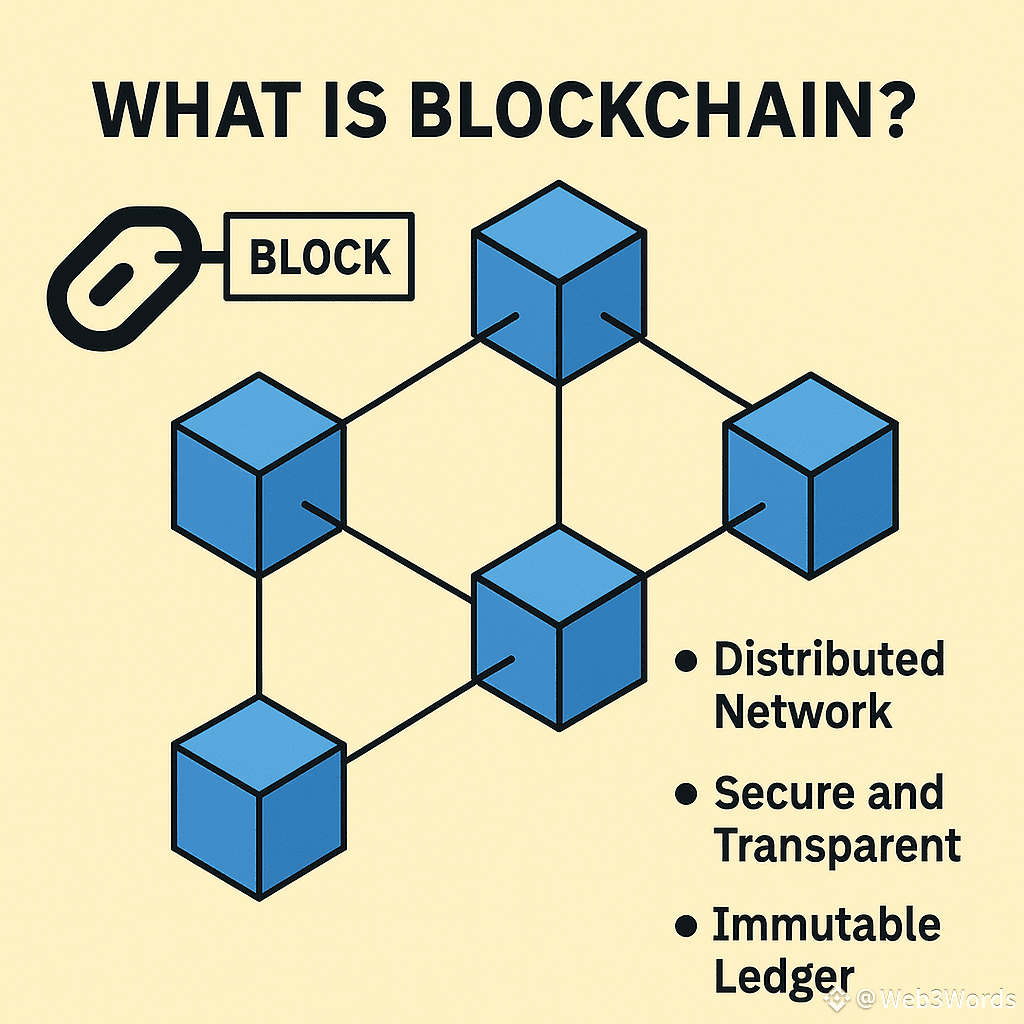
🧩 Introduction: Blockchain Isn’t Complicated
If you can use the internet, you can understand blockchain.
Think of blockchain as a digital notebook where every entry:
Is visible to everyone
Exists in copies across the entire network
Cannot be changed once recorded
That’s why blockchain is often called trustless technology — trust is built into the system itself.
🔷 What Is Blockchain? (Simple Definition)
Blockchain is a distributed digital ledger where information is stored inside “blocks.”
These blocks are linked together in a chain — which creates the term Block + Chain = Blockchain.
Each block contains:
Transaction data
A reference (hash) to the previous block
A timestamp
Because of this structure, blockchain becomes secure, transparent, and tamper-proof.
🔗 Why Is Blockchain Special? 3 Big Reasons
1️⃣ Distributed Network
There is no central server.
Data is stored across thousands of computers (nodes).
Even if one computer fails, the network continues to operate.
2️⃣ Secure and Transparent
All transactions are publicly visible.
This transparency makes cheating or fraud nearly impossible.
3️⃣ Immutable Ledger
Once data is added to a block,
it’s almost impossible to alter or delete.
This is one of the main reasons digital money like Bitcoin remains secure.
🧱 How Blockchain Works (Step-by-Step)
Let’s break it down with a simple example:
Step 1: You initiate a transaction
You send 0.01 $BTC to someone.
Step 2: The transaction is broadcast
Your transaction is shared with all nodes in the network.
Step 3: Miners / Validators verify it
The network checks:
Do you have enough balance?
Is the transaction valid?
Is there any sign of fraud?
Step 4: The transaction is added to a block
Valid transactions are grouped into a new block.
Step 5: The block is added to the chain permanently
The data becomes permanently stored and secure.
🔥 Types of Blockchains
1. Public Blockchains
Examples:
$BTC Bitcoin,

$ETH Ethereum

Open to everyone, fully transparent.
2. Private Blockchains
Used by companies (Hyperledger, Corda)
3. Consortium Blockchains
Controlled by multiple organizations.
4. Layer-2 Blockchains
Built to scale networks: Polygon, Arbitrum, Optimism
💡 Why Blockchain Matters (Future Impact)
🔹 Finance Transformation
Decentralized Finance (DeFi) is replacing traditional systems.
🔹 Supply Chain Transparency
Every product’s full history can be tracked.
🔹 Digital Identity
You control your identity — not corporations.
🔹 AI + Blockchain
AI agents will operate on blockchain networks (2025–2030).
🔹 The Future Internet: Web3
Users will own their own data.
🌍 Real-World Use Cases
Blockchain is already being used in:
Payments (Bitcoin Lightning)
Smart Contracts (Ethereum)
Healthcare records
Cross-border transactions
Voting systems
NFTs (digital ownership)
🧠 W3W Insight: Blockchain = Trust, Not Technology
Most people think blockchain = crypto coins.
But the truth is:
Blockchain is a philosophy — it replaces trust with technology.
In the future, it will power banking, identity, governance, AI systems, and more.
🏁 Conclusion
Blockchain is not just about digital currency.
It is becoming a global infrastructure —
one of the most important inventions after the internet.
If you understand it today, the entire Web3 future opens up for you.
#BTCVSGOLD #BinanceBlockchainWeek #ETHInstitutionalFlows #TrumpTariffs
