
There’s a strange kind of silence in crypto, a silence dazai notices every time Injective makes another breakthrough, and yet the world keeps staring at Ethereum as if nothing else exists. Ethereum deserves its crown, sure, but there’s one advantage Injective carries that almost feels unfair: the chain wasn’t built to compete with Ethereum… it was built to fix everything Ethereum struggles with. And somehow no one talks about this enough. Maybe that’s why dazai is writing this now, because the moment you see what’s happening under the hood, you stop comparing Injective to anything else entirely.
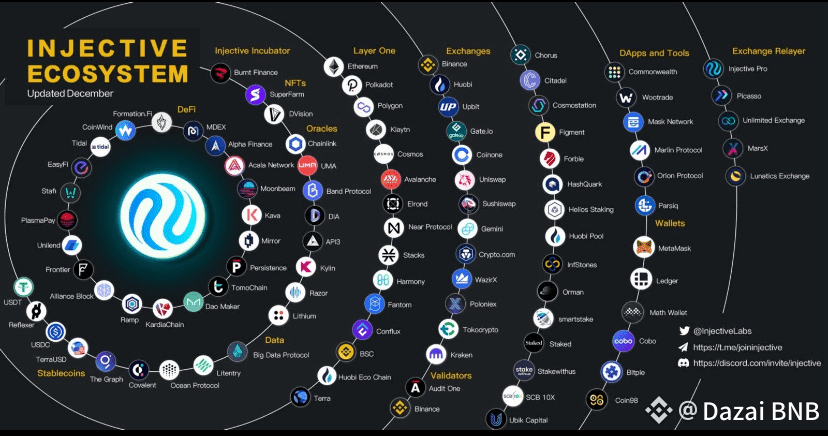
Injective’s biggest advantage isn’t just speed or cost—people already shout that from rooftops. The real secret is that Injective behaves like a financial engine rather than a generic blockchain. Ethereum is a global computer; Injective is a global exchange layer. That difference changes everything, especially now as the Injective ecosystem explodes with new modules, sub-accounts, order book upgrades, and the kind of on-chain finance tooling developers always wished Ethereum had. Dazai has watched countless liquid staking protocols, prediction markets, RWAs, and perps platforms quietly migrate toward Injective because they finally found a chain designed for them, not against them.
As 2025 continues, Injective’s newsflow has felt like a nonstop storm. The chain launched its EVM release, unlocking a new era where Ethereum developers can deploy instantly—not by rewriting their entire codebase, but by simply plugging into Injective’s financial primitives. Multichain liquidity routing, MEV resistance, on-chain order books, the new INJ burn mechanisms—dazai keeps thinking this is what Ethereum would look like if someone rebuilt it from scratch using the 2025 playbook instead of being stuck in 2015 limitations.
The thing dazai loves most is that Injective doesn’t pretend everything should run as an AMM. Ethereum pushed AMMs to become normal, but deep down everyone knows the truth: real finance still depends on order books, precision, stability, and execution. Injective brought that back, and suddenly the entire idea of on-chain trading changed. You don’t “swap” on Injective; you actually trade—with millisecond finality and no gas fees on every order. And that one difference has quietly attracted the biggest builders in decentralized finance, even if they don’t scream it loudly.
What no one talks about is how Injective’s architecture eliminates the typical friction points that Ethereum users accept as fate. Congestion? Not here. Sky-high fees? Gone. MEV bots front-running your trades? Not on Injective’s watch. The consensus, the order execution environment, the cross-chain compilers—all of it works like a single tuned engine rather than a messy toolkit. The more dazai digs into it, the more it feels like Injective is the chain people will migrate to once they get tired of fighting Ethereum’s limitations.
And then there’s the token itself—INJ. Dazai remembers when INJ’s burn auctions were a small detail; now they’ve become one of the strongest deflationary mechanisms in any major blockchain. With every new dApp, every new trading pair, every new module, the burn rate grows, strengthening the ecosystem without forcing artificial hype cycles. Combine that with new staking utilities, cross-chain governance expansion, and the ecosystem fund supporting builders entering Injective’s EVM era, and suddenly INJ isn’t just another layer-1 token. It’s fuel, governance, and ecosystem equity wrapped together.
Dazai watched Injective enter 2025 with partnerships that felt like puzzle pieces snapping into place—collaborations with Binance ecosystem projects, liquidity partners joining the new Injective hubs, multiple gaming and RWA platforms deploying on Injective’s EVM, and even broker-style applications using Injective as their settlement layer. These aren’t small moves. They’re indicators that projects are choosing Injective not because it’s trendy, but because it’s the most practical foundation for financial apps that need to survive long-term.
Ethereum taught the world how to build. Injective is teaching the world how to execute. And in a market where users are tired of failed transactions, slow block times, fake liquidity, and unstable protocols, execution becomes the currency that matters. Dazai believes this is why Injective feels so different—its core advantage isn’t a feature; it’s a philosophy. A belief that blockchains should feel invisible, smooth, almost effortless.
Maybe that’s why Injective keeps outperforming expectations. Maybe that’s why devs silently deploy there first. Maybe that’s why INJ keeps showing resilience during every cycle while other L1s fade into noise. Because Injective didn’t try to replace Ethereum—it tried to fix the parts of Ethereum everyone complained about but accepted. And now the silence around Injective’s greatest advantage won’t last much longer.
Dazai can already imagine the headlines when the world finally catches up: The Finance Chain Becomes the Main Chain. And when that happens, people will say Injective’s rise was sudden. But it wasn’t sudden. It was simply inevitable.

