
The conversation around layer one chains has shifted in the last eighteen months. While many projects still chase headlines with raw throughput statistics or celebrity endorsements, a different kind of recognition has started to appear inside the teams that actually build sophisticated trading venues, perpetuals platforms, prediction markets, and on chain order book derivatives. When those teams decide where to deploy capital and engineering time for the long term, Injective keeps coming out on top, and the reasons have little to do with the usual marketing points.
Injective was designed from the ground up with the specific constraints of financial applications in mind. Most general purpose chains treat exchange functionality as an afterthought layered on top of a virtual machine that was never meant to handle tight spreads, sub second finality, and massive order cancellation rates. Injective flipped that model. The chain itself is an application specific blockchain whose entire consensus and execution environment was built around the needs of order book based trading. That single decision has cascading effects that become obvious once you move beyond simple token transfers and start running basic automated market makers.
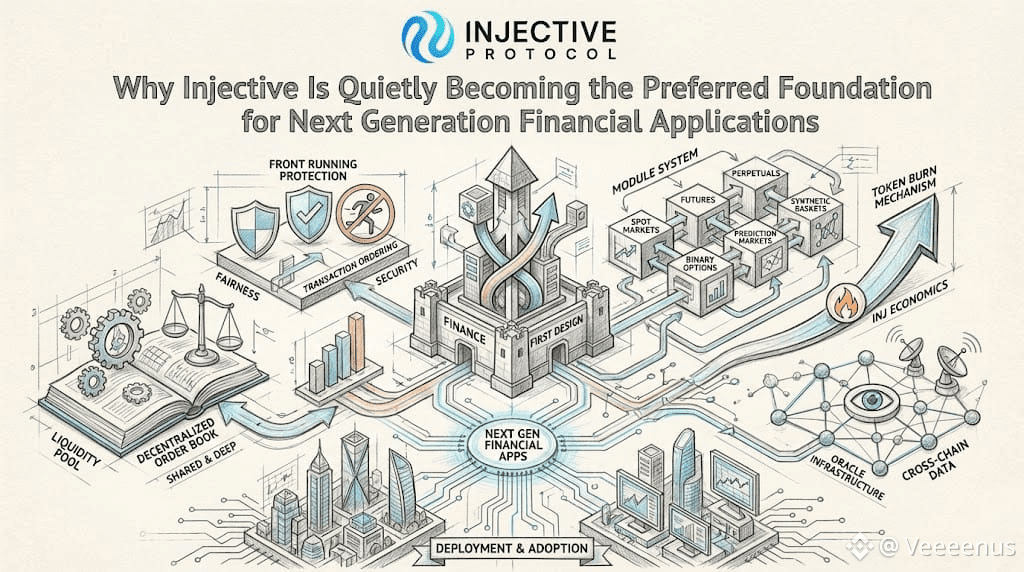
The most under discussed advantage is the way Injective handles order matching directly at the protocol level. Instead of forcing every trading venue to implement and maintain its own matching engine as a set of smart contracts, Injective provides a fully decentralized, high performance, limit order book that lives natively on chain. Any application can plug into this shared order book without giving up custody or routing orders through a centralized relay. The result is that multiple front ends, multiple strategies, and multiple asset classes can all share the same deep pool of liquidity while still maintaining completely separate user interfaces and fee structures. This shared order book model is the closest thing the crypto industry has seen to the way traditional electronic communication networks operate, and it solves the fragmentation problem that has plagued decentralized perpetuals and spot markets for years.
Another consequence of the finance first design is the way Injective treats transaction ordering and front running protection. The chain uses frequency scaling and batch auctions for certain markets, combined with encrypted mempools in others, creating an environment where high frequency strategies can exist without automatically devolving into miner extracted value wars. Teams building advanced execution algorithms repeatedly choose Injective because they can implement strategies that simply would not be profitable on chains where block builders can see and reorder transactions at will.
The module system also deserves more attention than it usually receives. Injective allows developers to deploy entirely new financial primitives as first class modules that become part of the core protocol after governance approval. We have already seen this with the binary options module, the insurance fund module, and the recently added basket derivatives module. Each of these started life as an independent application but graduated to protocol level status because multiple teams wanted the same functionality. This path from application to protocol primitive is almost unique to Injective and creates a flywheel where the most successful financial products automatically strengthen the base layer for everyone else.
The on chain derivative capabilities extend far beyond simple perpetual contracts. Injective supports spot markets, perpetuals, futures with physical delivery, prediction markets, binary options, and now synthetic stock baskets all using the same underlying infrastructure. A single application can offer exposure to traditional equities, commodities, forex pairs, and crypto assets while operating entirely on chain with transparent settlement. This unification under one chain dramatically reduces the operational complexity for teams that want to offer broad market access without running multiple bridges or relying on centralized oracles for pricing.
The way Injective approaches oracle infrastructure also reflects its financial focus. Rather than relying on a single price feed or even a medianized set of feeds, Injective maintains separate oracle modules for different asset classes, with some markets using committed price feeds from market makers and others using on chain order book depth directly as the settlement source. This hybrid approach means that highly liquid crypto pairs can settle against actual on chain trades while less liquid traditional assets use carefully vetted price feeds, creating the best possible combination of decentralization and accuracy.
Looking at actual deployment patterns tells the story better than any marketing material. Several of the largest decentralized perpetuals platforms by open interest now run primarily on Injective, alongside specialized prediction markets that handle millions during major events and on chain sports betting applications that require instant settlement. The common thread is that all these applications need the specific properties: deep order book liquidity, protection against certain kinds of extraction, and the ability to compose complex financial products without starting from scratch. Injective provides exactly that combination at the protocol level rather than hoping it emerges organically from general purpose smart contracts.
The token itself plays a surprisingly elegant role in this architecture. INJ is used for gas performs standard functions, but its more interesting uses come from staking to secure the shared order book validators and from the buy back and burn mechanism tied to protocol fees. Every trade across every market on Injective contributes to token burn, creating a direct link between financial activity and token economics that becomes more powerful as more sophisticated applications choose the chain. Unlike many projects where token utility feels bolted on, here the tokenomics were clearly designed alongside the financial infrastructure rather than after the fact.
What we are witnessing is the quiet emergence of a specialized financial settlement layer that prioritizes the needs of actual trading Apps over general purpose computation. While other chains continue trying to be everything to everyone, Injective doubled down on doing one thing exceptionally well: providing the infrastructure that serious financial applications actually require. The result is a base layer that increasingly looks like the natural home for the next generation of on chain trading venues, derivative markets, and structured products. The teams building these applications understand the difference between a chain that can support finance and a chain that was built for it, and their deployment decisions are making that distinction clearer with each passing month.
